Amir Gutfreund - Our Holocaust
Здесь есть возможность читать онлайн «Amir Gutfreund - Our Holocaust» весь текст электронной книги совершенно бесплатно (целиком полную версию без сокращений). В некоторых случаях можно слушать аудио, скачать через торрент в формате fb2 и присутствует краткое содержание. Год выпуска: 2006, Издательство: Toby Press Ltd, Жанр: Современная проза, Прочая документальная литература, на английском языке. Описание произведения, (предисловие) а так же отзывы посетителей доступны на портале библиотеки ЛибКат.
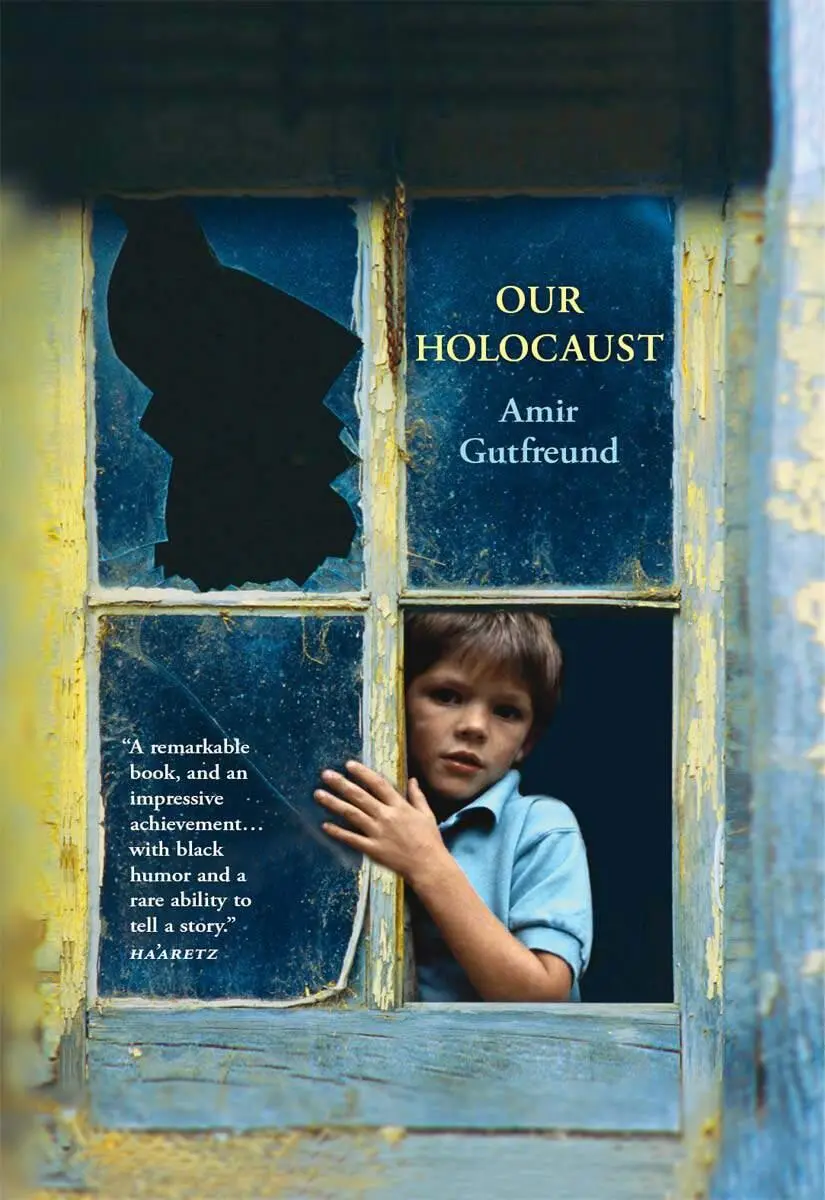
- Название:Our Holocaust
- Автор:
- Издательство:Toby Press Ltd
- Жанр:
- Год:2006
- ISBN:нет данных
- Рейтинг книги:4 / 5. Голосов: 1
-
Избранное:Добавить в избранное
- Отзывы:
-
Ваша оценка:
Our Holocaust: краткое содержание, описание и аннотация
Предлагаем к чтению аннотацию, описание, краткое содержание или предисловие (зависит от того, что написал сам автор книги «Our Holocaust»). Если вы не нашли необходимую информацию о книге — напишите в комментариях, мы постараемся отыскать её.
Our Holocaust — читать онлайн бесплатно полную книгу (весь текст) целиком
Ниже представлен текст книги, разбитый по страницам. Система сохранения места последней прочитанной страницы, позволяет с удобством читать онлайн бесплатно книгу «Our Holocaust», без необходимости каждый раз заново искать на чём Вы остановились. Поставьте закладку, и сможете в любой момент перейти на страницу, на которой закончили чтение.
Интервал:
Закладка:
“About a week after the end of the Sperre , Yom Kippur came, on September twenty-first. The ghetto was preoccupied with work, food and sickness. I walked far, as far as my legs could carry me, as if that were my way to somehow mark the torments of the holy day. And behold, from one of the houses emerged a distinguished Jew. He looked at me with penetrating eyes and asked, ‘Would you like to pray on this holiest of days?’ And wonder of wonders, he took me into an alcove in the house, where a secret prayer group was squeezed into the cellar. Jews wrapped in prayer shawls looked up at me and nodded their welcomes. I was handed my own tallis . A moment later, I, Yosef Ingberg of Bochnia, was praying in a minyan . Guess who this miraculous man was, who dared to come out to me, to look into my eyes, to see that I was merely a Jew seeking prayers, not an agent or a chief agent?”
Grandpa Yosef wants me to guess. I give up. “Well, who was it?”
“It was Mr. Hirsch. Yes, Mr. Hirsch, the man who sometimes wanders through the neighborhood.” He looks at me, detecting trains of amazement running over my face.
“Hirsch?”
“Yes, Mr. Hirsch. Now you have to make an effort and replace the person you know with his image from the ghetto days, when he was still an honorable rabbi, one of the senior beadles of the Admor of Tipow. Soon after I arrived in the ghetto I had noticed him on the streets; he stood out because of his great height, which did not result from the length of his body but from his gait — upright, arrogant even. He walked proudly through the ghetto, fraternizing only with similarly Orthodox men. They lived as a collective, a cohesive group from Tipow, obeying the rulership of their rabbi, the Admor, daring even to defy Rumkowski and his gang. In every matter they held Rumkowski accountable. They negotiated with him fearlessly over food rations and work quotas and housing. Everything. The Admor of Tipow gave the word, and his disciples went to battle.
“After the prayers, where I had been the tenth man to complete their minyan , Hirsch did not dismiss me. For some reason he attached me — not to his group, God forbid, but to himself, solely to himself. I found myself strolling the streets with him, just the two of us. We spoke a little, but mostly we were silent. Most of the words were spoken by Hirsch. He thought out loud, gave me his homiletics, and the things I heard from him I never imagined I would hear. Until the war I had been a man of Torah, I had studied diligently, but what I had learned was unlike anything I heard from Hirsch. He spoke pearls of wisdom and his persona was lofty and exalted, splendor in his appearance and splendor in his heart. To him, only to him, I poured out the entire truth, that I was not an agent nor anything of the kind. Only with him was I bold enough to let down my guard. I also gave him Ahasuerus’s money. I told him to take it and give it to charity. But Hirsch only shook his head and laughed bitterly. ‘Why would we want your money?’ he asked mockingly, as if I had offered something forbidden.
“Sometimes he would erupt in fits of anger, accusing the whole world, accusing assimilated Jews, modernism, even myself. Sometimes there were long silences and I walked beside him quietly, waiting for his foul mood to pass. But usually he was in good spirits, and his Torah was as sweet as honey. During the hours I spent with him, life seemed to grow larger. It was so easy to believe that there was a world beyond the ghetto walls, and it was as if my soul had already been set free, comforted. I felt myself a man of freedom, walking wherever I pleased.
“We met almost every day. Each morning I hurried from my home on Dolna Street to meet him, and if he did not arrive, the whole day went badly. But when he did, we soon began to walk around the ghetto in conversation. He gradually began to unfetter his tongue. He asked me, ‘Wherefore the destruction?’ Standing at a crossroads, he grasped my shoulders and repeated the question: ‘Wherefore the destruction?’ It was a custom of his, to ask questions, when he was the one who had the answers. He came up with a question and repeated it over and over again, but it was not from me that he sought an answer — rather, from himself. Again and again, ‘Wherefore the destruction?’ And his reply: ‘Due to the diminution of life.’ What did this mean?
“Rabbi Hirsch explained. ‘Even before the war, long before we could have imagined this state of affairs, I used to look around at life in our rabbi’s court. Everything was so simple, the usual worries. In the cheders the little boys studied, and in the yeshivas the young men, and rabbis expounded upon the Torah, and Admors guided the simple people, and our minds did not engage in the greater questions of life. These wise men wished to delve deeper into rabbinic writings, to amend and revalue the laws, to interpret the sages’ opinions. And the questions grew smaller and smaller, down to the scale of a feather, a bone, an egg. Oh, how small the questions grew. I gave notes to the rabbi on trivial matters — an onion fallen on an impure stovetop, or a crumb hidden among the straw. Tiny questions — shadows of questions. Where was the richness of life, the mystery?!
“‘And when the questions grow small, so too does the soul and the faith. Our eyes suffice with small sins, and our hearts follow our eyes. Exploitation does not gnaw at one’s conscience, lies do not sour one’s breath. And life is pleasant, and worshipping Hashem is done off hand. Jews needed their lives to grow large again, after having diminished so. This is why everything now descends upon us. Because we stopped asking questions. Effortless existence weakened our questions. And here, now, everyone is asking questions…’
“Rabbi Hirsch’s look turned cruel for a moment, vengeful. I had yet to learn of his tragedy, the tears he wept inside while he spoke so finely. Nothing I had learned had prepared me for such opinions. It was a desecration that was, somehow, not desecrating. As I lay in bed at night, I turned his words over and over in my mind. Life that had diminished…and what had befallen us because of it. I revisited scenes from the Sperre , the children, Rabbi Halberstam from Bochnia on the street, just like that, lying on the street, and for a moment I thought of Feiga, the comfort in her arms, and back came pictures from the Sperre , and up floated Hirsch’s words.
“The diminution of life.
“In the morning my feet were drawn to Hirsch, and I spent entire days with him, with his relentless, unforgiving theories, and his words, which were unbefitting, and the likes of which I had never before heard. They were so sharp, and they compelled my heart to listen, to examine, to self-examine — was my own life so small? Were my questions small?
“I noticed that as the days passed, the fire of hatred grew stronger in him. His claims were harsh, bitter. ‘How can we remonstrate?’ he asked. ‘After all, we ourselves are commanded in the holy Bible to destroy a people, Amalek. What is the difference between a command from our Lord, Ribono shel olam , and a command from their mustached god? What is the difference between annihilating Amalek and annihilating the Jews? We are commanded in the holy Torah, Thou shalt blot out the remembrance of Amalek from under heaven; thou shalt not forget. Why, therefore, should we complain that the goyim too have been given their own Torah, in which they are commanded to kill us?’
“‘And the children?’ I asked. The children. Scenes of the Sperre flickered through my mind, and scenes of Bochnia, and beautiful Irenka, but Hirsch stood and faced me and his voice thundered, ‘It is said in our Torah, Now go and smite Amalek and spare them not…but slay both man and woman, infant and suckling… do you understand, sir? Infant and suckling !!’
Читать дальшеИнтервал:
Закладка:
Похожие книги на «Our Holocaust»
Представляем Вашему вниманию похожие книги на «Our Holocaust» списком для выбора. Мы отобрали схожую по названию и смыслу литературу в надежде предоставить читателям больше вариантов отыскать новые, интересные, ещё непрочитанные произведения.






Обсуждение, отзывы о книге «Our Holocaust» и просто собственные мнения читателей. Оставьте ваши комментарии, напишите, что Вы думаете о произведении, его смысле или главных героях. Укажите что конкретно понравилось, а что нет, и почему Вы так считаете.