Amir Gutfreund - Our Holocaust
Здесь есть возможность читать онлайн «Amir Gutfreund - Our Holocaust» весь текст электронной книги совершенно бесплатно (целиком полную версию без сокращений). В некоторых случаях можно слушать аудио, скачать через торрент в формате fb2 и присутствует краткое содержание. Год выпуска: 2006, Издательство: Toby Press Ltd, Жанр: Современная проза, Прочая документальная литература, на английском языке. Описание произведения, (предисловие) а так же отзывы посетителей доступны на портале библиотеки ЛибКат.
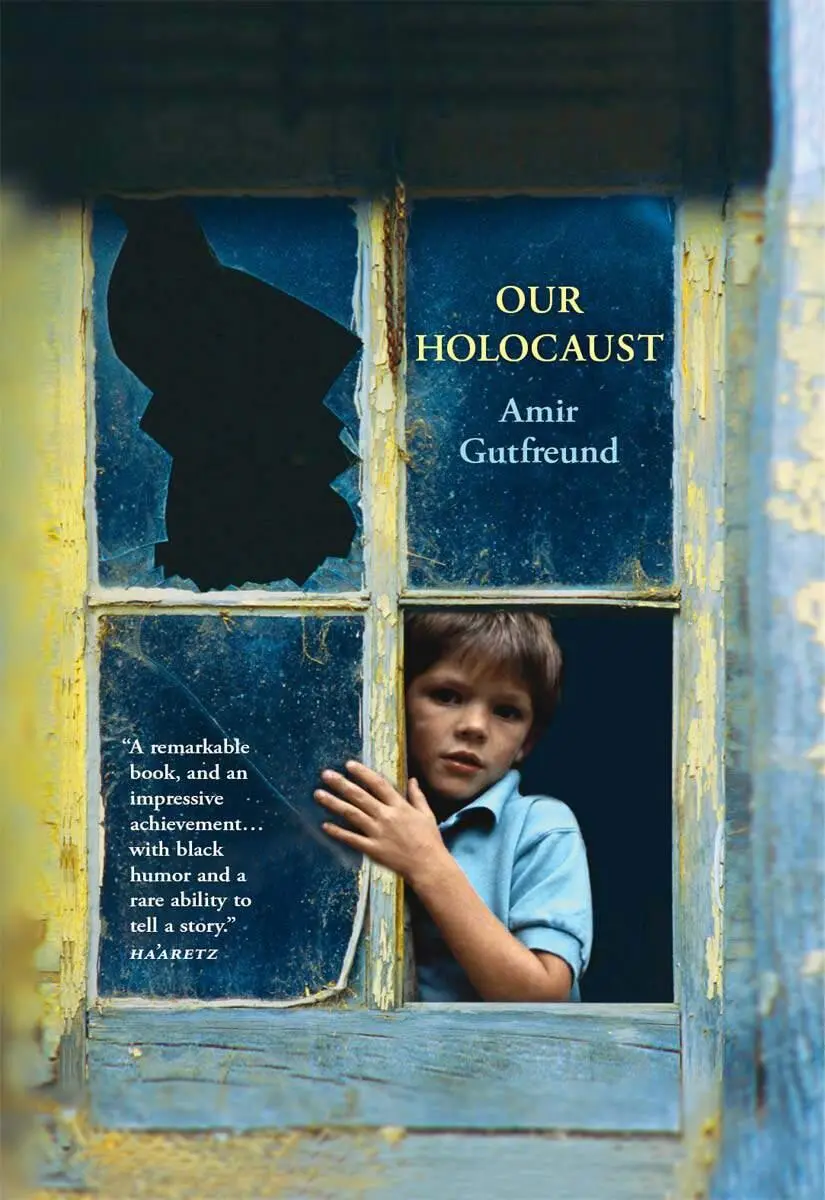
- Название:Our Holocaust
- Автор:
- Издательство:Toby Press Ltd
- Жанр:
- Год:2006
- ISBN:нет данных
- Рейтинг книги:4 / 5. Голосов: 1
-
Избранное:Добавить в избранное
- Отзывы:
-
Ваша оценка:
Our Holocaust: краткое содержание, описание и аннотация
Предлагаем к чтению аннотацию, описание, краткое содержание или предисловие (зависит от того, что написал сам автор книги «Our Holocaust»). Если вы не нашли необходимую информацию о книге — напишите в комментариях, мы постараемся отыскать её.
Our Holocaust — читать онлайн бесплатно полную книгу (весь текст) целиком
Ниже представлен текст книги, разбитый по страницам. Система сохранения места последней прочитанной страницы, позволяет с удобством читать онлайн бесплатно книгу «Our Holocaust», без необходимости каждый раз заново искать на чём Вы остановились. Поставьте закладку, и сможете в любой момент перейти на страницу, на которой закончили чтение.
Интервал:
Закладка:
Grandpa Yosef looks serious. “I was beginning to believe that his ‘humpf’ was the magic whisper, but it turned out not to be. And the whole story turned out to be a long introduction to one more secret.
“Yanek Leib purses his lips and his eyes sparkle. ‘Here in Lodz,’ he says, ‘I discovered that the lion whisper also works against the Nazis, damn them! Yes, humpf, it calms them like little lambs, it calms them. Indeed, only yesterday one such man stood opposite me and I faced him coolly. I began to whisper the magic words and looked deep into his eyes, damn him. He opened his eyes wide — how dare this Jew stand right across from him? Humpf. He was already thinking of his whip, perhaps his pistol. But after a moment his heart became as tender as a lamb. An innocent kid stood before me with no thoughts in his head. Had I wished to, I could have taken his handkerchief from his pocket, blown my nose and put it back. But no! The authorities must not be provoked. You should not be too smart for your own good. A lion is a lion, and a Nazi is a Nazi, damn them, humpf. So I simply walked away and left him to his perplexity. In a moment or two he would awake and have no idea where he was, what he had done, or indeed the name of the cursed mother who had borne him. Humpf!’
“Yanek’s face was flushed and excited, he was agitated. His ‘humpfs’ became more frequent, sticking in his throat.
“‘I have already offered myself to the underground. I could play my trick on the authorities, transfer information. Humpf. But they are disbelieving, humpf, they almost threw me out. Humpf, they demand a demonstration, humpf. They’ll get one, humpf, tomorrow. In front of the congregation’s eyes, I, Yanek Leib, will subdue a goy , humpf.’
“He subsided for a moment. His breath grew quiet. But suddenly his face filled with fear. ‘I will not reveal the words, I will not!’ he screamed, and started digging through his coat pockets, and bleating and mumbling.
“It had never occurred to me to steal his whisper — this whisper was his only asset, worth a multitude of food stamps and more. And in any case it was the underground I was thinking of. Was he connected to the underground? Perhaps he could help me with my affair. There was a sword hanging over my neck, after all. I laid out my plea before him. Yanek Leib arched his eyebrows and gravely considered the request. He could not promise anything. But I was already excited and I urged him, ‘Please, for me.’ Yanek Leib stood up as if in a hurry again. I chased after him, one block, two, urging him, my heart pounding, ‘The underground, the underground, please help.’
“Finally he consented. He knotted his eyebrows together, sighed, and agreed to present my case before the underground the next day. But from that day onwards, until the end of time, I never saw Yanek again. What happened to him, I do not know. I wanted to ask, but people kept their distance. As far as they were concerned, the chief agent had conversed with a man, and the next day the man was gone. And a few days later came the Sperre .
“Have you heard the word? Sperre ? That was what they called the Lodz ghetto Aktion . What can I say about the Aktion ? Every horror you can imagine occurred. A baby taken from its mother’s arms, speared on the gun’s bayonet, and put back in her arms with wild laughter — she wanted her baby back, didn’t she? People were thrown out of windows…children too. Lying broken-boned on the sidewalks, no one coming to their aid. Your heart could not contain all that the Nazis inflicted, in the streets, in houses, lines of people going to Chelmno, the death camp. To this day, sometimes, still, my eyelids close in the middle of the day, my head droops, and from that cursed place those scenes pour forth in front of my eyes.
“First the announcement went through the ghetto: the Gestapo authorities had given an order to evacuate some of the residents. ‘Evacuate’ was the term they used. At first it was the sick and the weary, then the elderly. Then — the children. The ghetto community leaders had to hand over a list of twenty-thousand people. And to where would they be evacuated? God help them, now we know it was to Chelmno. Back then? We knew and we did not know; we understood and we did not understand. And what can I say…the entire ghetto was panic-stricken, and an uprising was organized. In our hearts we knew where the evacuees would be taken, and it shook people up. The demand passed by word of mouth: Do not give anyone up. Let the goyim come and take them themselves. Even the Rambam decreed it is forbidden to give a person up for death, even if it is to the advantage of the entire congregation. Forbidden.
“President Rumkowski gave a speech. He entreated us to hand the people over, otherwise it would get worse. Committees began to meet and divide people up. There were lists. People looked out for their loved ones, pushed people off the lists, wrote others in. Anyone with power, anyone capable of accessing the lists. And there was wailing all the time. I myself was not on the lists of those going to death. No one dared write down the name of the chief agent, for fear their own name might replace it at the last minute, reversing their fortunes.
“On September fifth a curfew was declared. The Aktion had begun. Eight days and eight nights of terror. I have said already that in our hearts we knew where they were going. And testimonies had crept into the ghetto. The Rabbi of Grabow sent a letter, a voice of truth to his brethren in the ghetto. True, there were also denials, letters signed by people in the deportations, even rabbis, asking how we were and reporting how fortunate they had been. A moment or two before the gas chambers they were forced to write comforting letters, planting doubt against the cautioning testimonies. But in our hearts we knew the truth. We believed there was annihilation. Everyone thought about their relatives and stopped imagining their lives in the East, trying instead to come to terms with their deaths. I too, from the little window in the room I called home, peeked out at the goings-on in the streets and my memory called up the Aktion in Bochnia, the military courtyard, Mother, Father, my sister, my brother. I thought about the large group from which I had been removed to be sent to Rakowice. In the streets below mothers begged, children were dragged kicking into carts, and I recalled four-year-old Irenka standing next to me in line, waiting quietly. A little angel with golden hair. I remembered how she used to sing for us in the ghetto when they organized concerts. Her mother, Bronia, who was a musician at the Krakow Conservatory, would write songs, and Irenka would stand with a violin, playing and singing.”
Grandpa Yosef begins to sing a Polish song:
Bo ja jadę dzisiaj do Palestyny
Po radośniejszego życia los
Tam przy cichem gaju pomarańczowym
Będę snuć życia radosnego nić
Grandpa Lolek’s eyelid flutters a little. How far are the Polish words reaching?
I ask for a translation.
Grandpa Yosef thinks for a while. It will be hard in Hebrew, he thinks; the words embrace one another less. His lips test the words, gain confidence. Then he hums Irenka’s song in Hebrew:
Today I travel to Palestine
To the fate of a more joyful life
There in a tranquil orange grove
I will spin the thread of life’s joy
“It sounds better in Polish,” Grandpa Yosef emphasizes. “And the song was so beautiful when Irenka sang it. She sang many songs, but unfortunately only this one remains in my memory. They took Irenka, with Bronia, and with her father Leon, to Belzec. Nu , four years old, with such angel eyes and golden hair. Nu , that was how Irenka went. For many years Leon waited to be blessed with that daughter. In the First World War he fought in the Austrian army. He was taken hostage and held for a long time. When he came home he worked with his father as a barber, he had to make a living, but he never gave up his dream of studying music, and every spare moment he played his violin in the barbershop. ‘Chasing away the customers,’ his father used to grumble. That was your father’s grandfather, Sigmund Shlomo. At a late age, Leon was able to see his dream come true, and at the Conservatory he met the woman of his dreams, Bronia, whom everyone called Ronia. They fell in love and got married. How beautiful the world seemed when Irenka was born, such an angel. All their dreams were coming true, and then Belzec. But our Irenka was just one little angel, and there in the Sperre , through my window, we saw dozens of angels crowded onto a wagon and taken away. People followed the wagon, screaming. Shots were fired. People lay in their coats on the street, blood spurting, as the wagon went off into the distance. Screaming, wailing.
Читать дальшеИнтервал:
Закладка:
Похожие книги на «Our Holocaust»
Представляем Вашему вниманию похожие книги на «Our Holocaust» списком для выбора. Мы отобрали схожую по названию и смыслу литературу в надежде предоставить читателям больше вариантов отыскать новые, интересные, ещё непрочитанные произведения.




Обсуждение, отзывы о книге «Our Holocaust» и просто собственные мнения читателей. Оставьте ваши комментарии, напишите, что Вы думаете о произведении, его смысле или главных героях. Укажите что конкретно понравилось, а что нет, и почему Вы так считаете.