Amir Gutfreund - Our Holocaust
Здесь есть возможность читать онлайн «Amir Gutfreund - Our Holocaust» весь текст электронной книги совершенно бесплатно (целиком полную версию без сокращений). В некоторых случаях можно слушать аудио, скачать через торрент в формате fb2 и присутствует краткое содержание. Год выпуска: 2006, Издательство: Toby Press Ltd, Жанр: Современная проза, Прочая документальная литература, на английском языке. Описание произведения, (предисловие) а так же отзывы посетителей доступны на портале библиотеки ЛибКат.
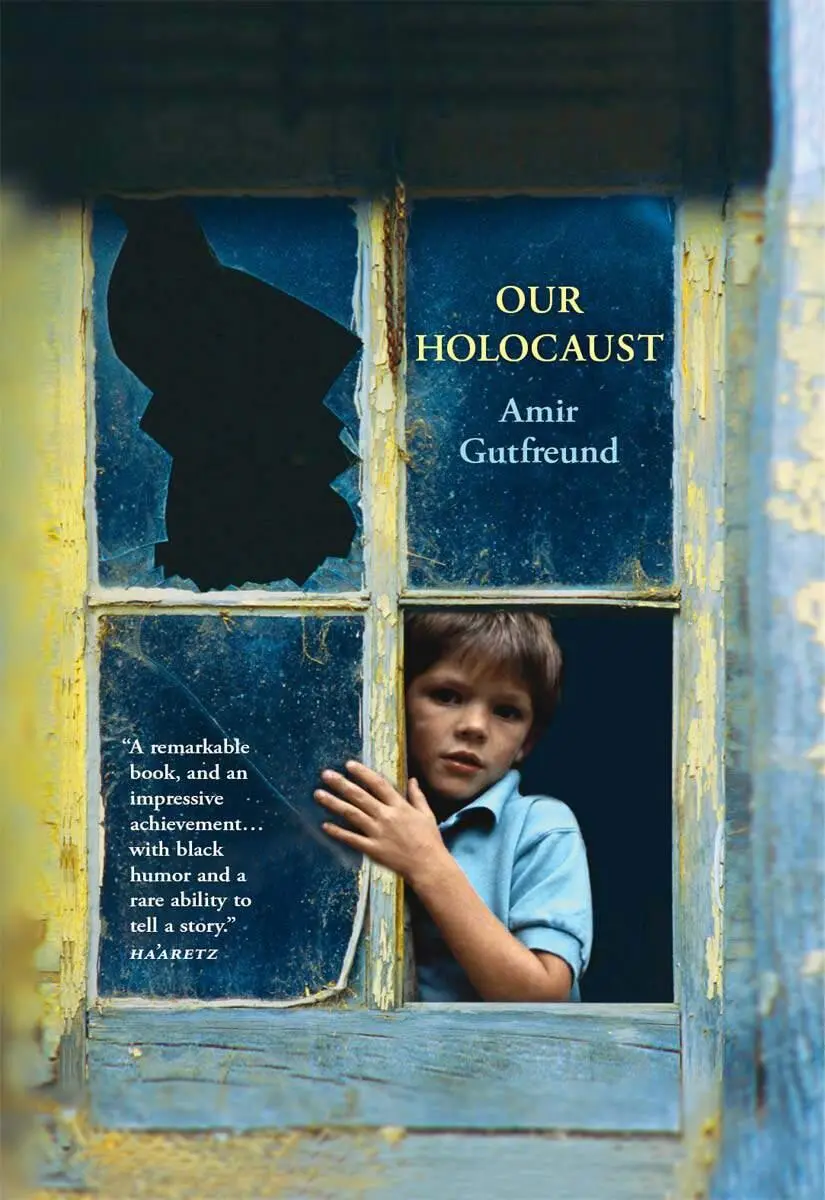
- Название:Our Holocaust
- Автор:
- Издательство:Toby Press Ltd
- Жанр:
- Год:2006
- ISBN:нет данных
- Рейтинг книги:4 / 5. Голосов: 1
-
Избранное:Добавить в избранное
- Отзывы:
-
Ваша оценка:
Our Holocaust: краткое содержание, описание и аннотация
Предлагаем к чтению аннотацию, описание, краткое содержание или предисловие (зависит от того, что написал сам автор книги «Our Holocaust»). Если вы не нашли необходимую информацию о книге — напишите в комментариях, мы постараемся отыскать её.
Our Holocaust — читать онлайн бесплатно полную книгу (весь текст) целиком
Ниже представлен текст книги, разбитый по страницам. Система сохранения места последней прочитанной страницы, позволяет с удобством читать онлайн бесплатно книгу «Our Holocaust», без необходимости каждый раз заново искать на чём Вы остановились. Поставьте закладку, и сможете в любой момент перейти на страницу, на которой закончили чтение.
Интервал:
Закладка:
“At midday we visited a camp. Again I sat imprisoned in the car while Ahasuerus met with the camp personnel. This time I saw women. Female prisoners and policewomen. Was the journey to Feiga over? Suddenly there was a knock on the window. A prisoner, an actual prisoner, was knocking urgently. His face looked like the skeleton I had seen the day before. That one had just stood and looked at me, a nameless figure with crazed eyes, but this one was more daring. I opened the window a crack and asked hurriedly, ‘Feiga, née Blau, is she here?’
“‘Bread?’ the prisoner asked. ‘Anything?’
“His skeletal face was crazed with fear. My reaction was too slow for him and he skipped away and disappeared among the huts without waiting for my answer. A moment later two SS men passed by and stared lengthily at the car. In my heart I knew that Feiga was not there. When I reached her camp I would know, I would not need conversations.
“I waited for Ahasuerus and did not trouble my mind with thoughts of the prisoner, that skeletal face of his, the likes of which I had never seen in the ghetto. I did not bother with thoughts of the type of life that engenders such terror. My heart was directed elsewhere, to an uncomfortable flutter, a dense sort of desperation. As if my heart was a true prophet, when Ahasuerus came out his steps seemed weak, his expression strange. I looked at him and suddenly all was clear: the voyage was over, no more. Ahasuerus had given up on his journey. Why the confidence? Why the certainty? It was his face. I could tell without a doubt that he was no longer determined, that he had lost his purpose. He got into the car without even glancing at me, and started to drive. The previous night had broken something in him, something greater than mere time lost. I could see this with certainty. Though in fact he appeared more at ease, as if something in him had found calmness, or had been lost, disappeared. But my heart was not available to study the inner workings of a Nazi general. It was Feiga that I was thinking of. Was my voyage still going ahead as planned? Ahasuerus, after all, knew nothing of the journey’s purpose. Only the Little Lover was in his head, and now, no Little Lover, and no more need for the ‘short Jew’ he had wanted to bring her as a gift. What would he do with me?
“The roadsides began to be dotted with villages. The villages grew denser and denser. We were driving through the outskirts of a town. German army guard posts, roadblocks, inspections, examinations. Everyone let Ahasuerus go on his way, retreating with a salute. We sailed deeper in. I slowly began to read names on the road-signs, and realized we had reached the city of Lodz. Why Lodz, I did not know. Had Feiga been taken there? Why was Ahasuerus bringing me to Lodz? What was he scheming? Was he planning to get rid of me now that I was unnecessary? And why not simply put a bullet through my head right there?
“From the fear, not only my heart shrunk. Begging your pardon, my bladder did too. To this day I remember the endless, painful pressure. My life was on the line, but it was my bladder that preoccupied me. If only Ahasuerus would stop for a moment, I could jump out and urinate. He might think I was escaping. He might shoot me. But my thoughts could not tolerate the caution that might delay urination. Still suffering, my bladder so full that it was almost erupting, we reached the gates of a low wall, and beyond it, I knew immediately, was a ghetto. Far larger than the Bochnia ghetto, unfamiliar and crowded, but there was no mistaking it. A ghetto is immediately recognizable. An entire town of hungry, ill Jews. The Lodz ghetto.
“To this day I wonder why Ahasuerus brought me to the Lodz ghetto. Was it so I would be killed in the Aktion that was planned for the next few days? He must have known about it (perhaps even ordered it). Or maybe it was just the opposite — it was life that he ordered for me. He knew what everyone knows today, that after the next Aktion this ghetto would be allowed to survive, the last of the ghettos. So his was an act of grace. Or maybe it was neither. Here was simply a place where he could leave me among the hundreds of thousands of people crowded into the ghetto, who walked its streets daily, characters coming and going with the wind. Here no questions would be asked. But why would a Gestapo general need to be so cautious? In the Bochnia ghetto they shot hundreds like me, lined up against the walls, so why would a general inconvenience himself for one miserable Jew? He could have shot me, no questions asked, on the side of the road.
“Back then, much like today, I was full of questions. But Ahasuerus was indifferent. We were destined to meet again several days later, and as I have said, Ahasuerus would address me one more time. But on that day he left me by the entrance to a building. He gave me some sort of Certifikat and a little bag which contained, I discovered, Polish and German currency. Dispensing with niceties, he left me and disappeared. As if the neglected regions of the world had never been traversed together by these two: a Nazi general and a short Jew. At that moment I still did not know how much future we were yet to have together.
“I soon realized that I had been left outside the German police headquarters. I was promptly led to the office of the Jewish police by two German officers who treated me with inexplicable respect. The Jewish clerks I was delivered to also treated me with caution, even deference. They interviewed me, asked questions. They explained to me about the difficulties, the rationing. They promised to help with housing, although the situation was practically hopeless, and in any case it was warm on these summer nights and the street was a good option for now. Better the street than the houses, where typhus and boils were raging. The streets were cleaner. They dared to ask, in hushed voices, if I had any particular desires, if I required assistance in my mission, any requests?
“No, they said, they hadn’t heard of Feiga, née Blau, but they would find out. Two-hundred thousand Jews in the ghetto, but not to worry, everything was in the records. Order, there was. Law, there was. The clerks would do their jobs and Feiga would be located. Did I wish to make any further inquiries of another kind? Any orders, for example?
“I was naïve. I did not realise that to them, a man dropped off in the middle of the Lodz ghetto in the black car of a Gestapo general, dressed in fine clothes and a pink shirt, had to be an agent. They were in awe of my unabashed scheming; I had not slipped into the ghetto dressed in plain clothes, but had arrived demonstratively in a black car that had stopped right outside the police headquarters. And they must have pondered the pink shirt. What kind of an agent dressed like that? In my innocence, I did not divine the thoughts surrounding me. I did not yet conceive of the size of the Lodz ghetto, the two hundred thousand Jews crowded into it, the hundred Jews who died there routinely every day, in hunger and in sickness, in suicide and over-crowdedness. I did not imagine the thieves, the agents, the informers, the policemen, the underground activists, a great tapestry of people in conflict with one another, fighting over a hunk of bread, over a sliver of authority. An entire city full of passions and torments. In this city there were people who jumped out of windows, and there were those who were selflessly charitable. There was a woman in this city, a simple daughter of Israel, who was accused of having eaten from the flesh of her own son’s body. And there were martyrs who died for kiddush hashem . A city that even had strikes and labor riots, instructions from foremen, and weddings and prayers and distinguished gentlemen. And into this cauldron, the vast Lodz ghetto, tenfold larger than our ghetto in Bochnia, I descended in a pink shirt.
Читать дальшеИнтервал:
Закладка:
Похожие книги на «Our Holocaust»
Представляем Вашему вниманию похожие книги на «Our Holocaust» списком для выбора. Мы отобрали схожую по названию и смыслу литературу в надежде предоставить читателям больше вариантов отыскать новые, интересные, ещё непрочитанные произведения.











Обсуждение, отзывы о книге «Our Holocaust» и просто собственные мнения читателей. Оставьте ваши комментарии, напишите, что Вы думаете о произведении, его смысле или главных героях. Укажите что конкретно понравилось, а что нет, и почему Вы так считаете.