Amir Gutfreund - Our Holocaust
Здесь есть возможность читать онлайн «Amir Gutfreund - Our Holocaust» весь текст электронной книги совершенно бесплатно (целиком полную версию без сокращений). В некоторых случаях можно слушать аудио, скачать через торрент в формате fb2 и присутствует краткое содержание. Год выпуска: 2006, Издательство: Toby Press Ltd, Жанр: Современная проза, Прочая документальная литература, на английском языке. Описание произведения, (предисловие) а так же отзывы посетителей доступны на портале библиотеки ЛибКат.
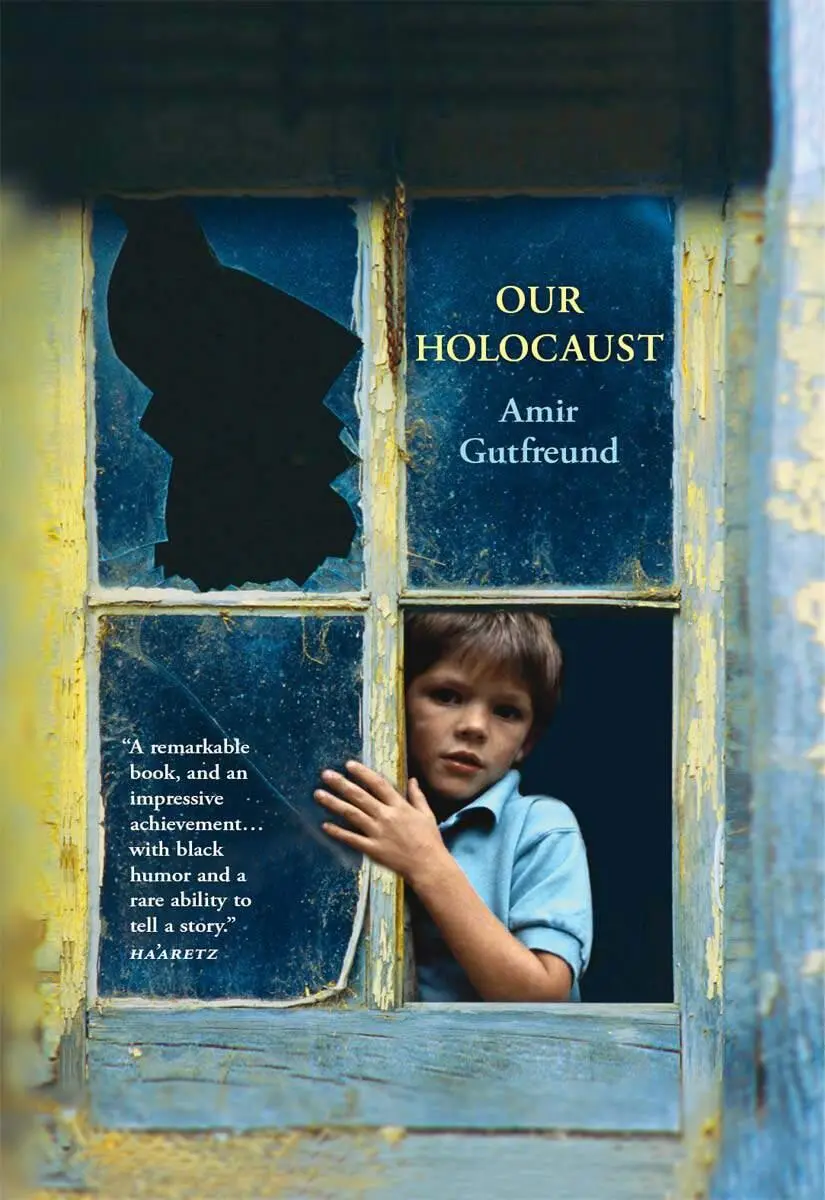
- Название:Our Holocaust
- Автор:
- Издательство:Toby Press Ltd
- Жанр:
- Год:2006
- ISBN:нет данных
- Рейтинг книги:4 / 5. Голосов: 1
-
Избранное:Добавить в избранное
- Отзывы:
-
Ваша оценка:
Our Holocaust: краткое содержание, описание и аннотация
Предлагаем к чтению аннотацию, описание, краткое содержание или предисловие (зависит от того, что написал сам автор книги «Our Holocaust»). Если вы не нашли необходимую информацию о книге — напишите в комментариях, мы постараемся отыскать её.
Our Holocaust — читать онлайн бесплатно полную книгу (весь текст) целиком
Ниже представлен текст книги, разбитый по страницам. Система сохранения места последней прочитанной страницы, позволяет с удобством читать онлайн бесплатно книгу «Our Holocaust», без необходимости каждый раз заново искать на чём Вы остановились. Поставьте закладку, и сможете в любой момент перейти на страницу, на которой закончили чтение.
Интервал:
Закладка:
Grandpa Yosef comes to a stop with screeching brakes. “Do you know what Feiga means? Feigaleh ? It’s a bird. A female bird. A little female bird.”
He continues his story.
“This Amalek did not let go of the wheel until the roads led to another camp. I felt them immediately; the fences, the huts, the terror. My general was tensely welcomed by an SS man, the camp commandant, who gave him their heil salute. It seemed my general had taken him by surprise. They both disappeared into a building, where they sat down to eat and talk. They spent six hours there while I was trapped in the car, watching the camp routine through the windows. The daylight was dark through the heavy glass and the scenes were dim. No sounds penetrated the car. Beyond the fences were inmates, exhausted and skeletal. No one came close. They did not dare. I sat watching, not knowing at all that I was in the height of the days that would come to be called the Shoah, believing that my suffering was due to loneliness, with Feiga somewhere out there, unrevealed. I believed my family was in the East, perhaps in the Ukraine, working hard, if they had not met with some disaster on their difficult journey. I myself was at the mercy of a Nazi general and I did not know what would be done with me. There was terror in my heart but there was a certain sweetness too — I was going to Feiga, I was destined for a great adventure. A black car was driving me through places I had only dreamed of as a boy, when I used to sit at the edge of Bochnia looking at the faraway landscape, my heart hollow with vague longings, weeping with love — Feiga, Feiga.
“A faint smell wafted into the car. My senses immediately conjured up a thought — potatoes! But that smell belied something else, and to the left of the car I could see a billow of smoke. A hut obscured my view of the source of the smoke. I stretched my neck out, my body leaning as far sideways as possible, but I could not see around the hut. The smoke billowed upwards from the earth as if someone were stoking that fire well, and the smell became more and more pronounced as the smoke thickened. For a moment I contemplated moving to the general’s seat, where I would be able to see, but the mere thought was enough to cover my heart with ice. I must not! I remained in my seat, turned away from the billow of smoke, and a moment later I thanked my lucky stars because the general came out, surrounded by officers. They looked excited, as if they had been vigorously commended, their fear of criticism gone. They saluted him and walked him to our car with ingratiating looks. They did not move from the road until the car drove through the gates.
“We drove north. All the car’s movements, the official stops at SS camps, all were directed northward. An iron plan was in his heart, to reach his escaped lover, and he did not sleep, and did not cease, and only for the sake of good order, damn them, did he visit his officers on the way.
“By that time I had already found a name for him, for the Nazi general. From the first I felt the need to give him a name. A nickname. If I were to die at his hands, he might as well have a name. I had already named the woman he was traveling to, Little Lover. And him, I had already silently called him Amalek, murderer, cruel soldier, Pharaoh, Haman, murderer. And possibly because of Haman, I suddenly determined to name him after Ahasuerus, the King of Persia who was incited by Haman to kill all the Jews. Perhaps this was not emblematic of his character, not an appropriate name for such an evil man, but it was what my heart decided.
“Evening came. We visited our fourth camp in a single day. My heart was dimly terrified, sensing we were getting closer to the end of our voyage. Ahasuerus would deliver me to the Little Lover. Sacrifice me on her altar. May God have mercy. But when we left the camp gates, Ahasuerus’s face had changed. I dared not look at him directly, knowing it was better not to, but out of the corner of my eye I could see a glimpse of his face. It was gray and drawn and deadened. As if he had learned of a great disaster that had befallen his family. His hands, seemingly uninformed of the bad news, grasped the wheel strongly as they drove the car. These people seemed to have no connection between their hearts and their hands. But then finally the broken heart reached the hands, and Ahasuerus slowed down and drove his car onto the shoulder of the road, where he stopped beside a small puddle of mud. He did not explain the stop to me, as if I were nothing to him. He sat clutching the wheel, his back straight. He sat that way for a long time. Ahasuerus was silenced. The whole world was still. Ahasuerus’s breath counted time — the seconds, the minutes. In and out it went, heavy and slow. Ahasuerus was tormented.
“I stared straight ahead, careful not to look at him, God forbid. Suddenly, there was a sound. The door opened and Ahasuerus got out. He walked alongside the car. He dug into the hollows of his eyes with his thumb and finger to rub the tiredness and trouble away from them, as I used to do when I was studying. Then he put his hand over his eyes as if he were crying. Suddenly he moved his hand to reveal his eyes and there was nothing to separate him from me. He looked at me, the Angel of Death.
“Ahasuerus got back into the car. The end is near, I thought, and suddenly it seemed that a bundle of pictures I had stored away in my memory was erupting. The Nazis shoot Metzger the baker in the hiding place he made for himself behind the oven, and while being led to Rakowice, I pass his body, bullet-ridden and white as ice. The body of young Yehezkel, my classmate, on his back, his eyes facing me. Mrs. Otkova yelling, running through the courtyard, no one knows what she wants. And Rabbi Halberstam, what of Rabbi Halberstam? With his wife, both shot against the wall.
“Nothing in my heart was apparent to Ahasuerus. He wanted to get back on the road, to keep going north. But the car would not cooperate. He could not start it. He got out, checked the engine, got back in. In and out again, he hurried around, regal and slow, but his concern was apparent. Around us night was falling, the woods, wild beasts. Nu , may God protect. For some reason, I was confident that he would manage. In my mind I could not envision a Nazi general failing, damn them. We believed in them so, those sons of death. But the car did not fear him. It remained silent and still, as if this marble angel was insulted at having been made to stop on a muddy road.
“Ahasuerus got back into the car. Silence prevailed. The cold began to seep in. Night was falling. Not a soul was on the road. Forests on both sides. Trees. A few birds fluttered through the treetops, screeching, groaning, demanding to know why the Creator had brought them to this remote land. And suddenly I sensed sleep fossilizing on the general’s face. But then something moved in the stoniness of his strong chin and he left me in the car again, going out to explore the wilderness. His boots creaked in the freezing cold. Birds screeched and an echo passed from one end of the world to the other. We were alone. Around us an endless forest. No salvation.
“I looked through the window of the car. Ahasuerus’s fingers rested on his eyes. His figure was hunched over for a moment. Tired and irritated and helpless. Lightening struck in my heart: He will kill me here with his gun. I tried to diminish my presence, shrinking into my pink shirt like a miserable reptile — perhaps he would take pity. Indeed. An evil Gestapo man, a general, and from him I expected mercy. Still fresh in my mind were pictures of shattered babies, Rabbi Halberstam shot with his wife. And there I was, expecting compassion. Still, my body was taut, hoping for mercy, mercy.
“Ahasuerus returned and sat down beside me in his place. I dared to steal a quick look. His face was still hard and his sorrow evident. What was going on in his soul? Had he heard bad news of his escaped lover? Had he seen her? Was she not impressed by his efforts, had she simply told him that everything they had told each other previously was revoked?
Читать дальшеИнтервал:
Закладка:
Похожие книги на «Our Holocaust»
Представляем Вашему вниманию похожие книги на «Our Holocaust» списком для выбора. Мы отобрали схожую по названию и смыслу литературу в надежде предоставить читателям больше вариантов отыскать новые, интересные, ещё непрочитанные произведения.










Обсуждение, отзывы о книге «Our Holocaust» и просто собственные мнения читателей. Оставьте ваши комментарии, напишите, что Вы думаете о произведении, его смысле или главных героях. Укажите что конкретно понравилось, а что нет, и почему Вы так считаете.