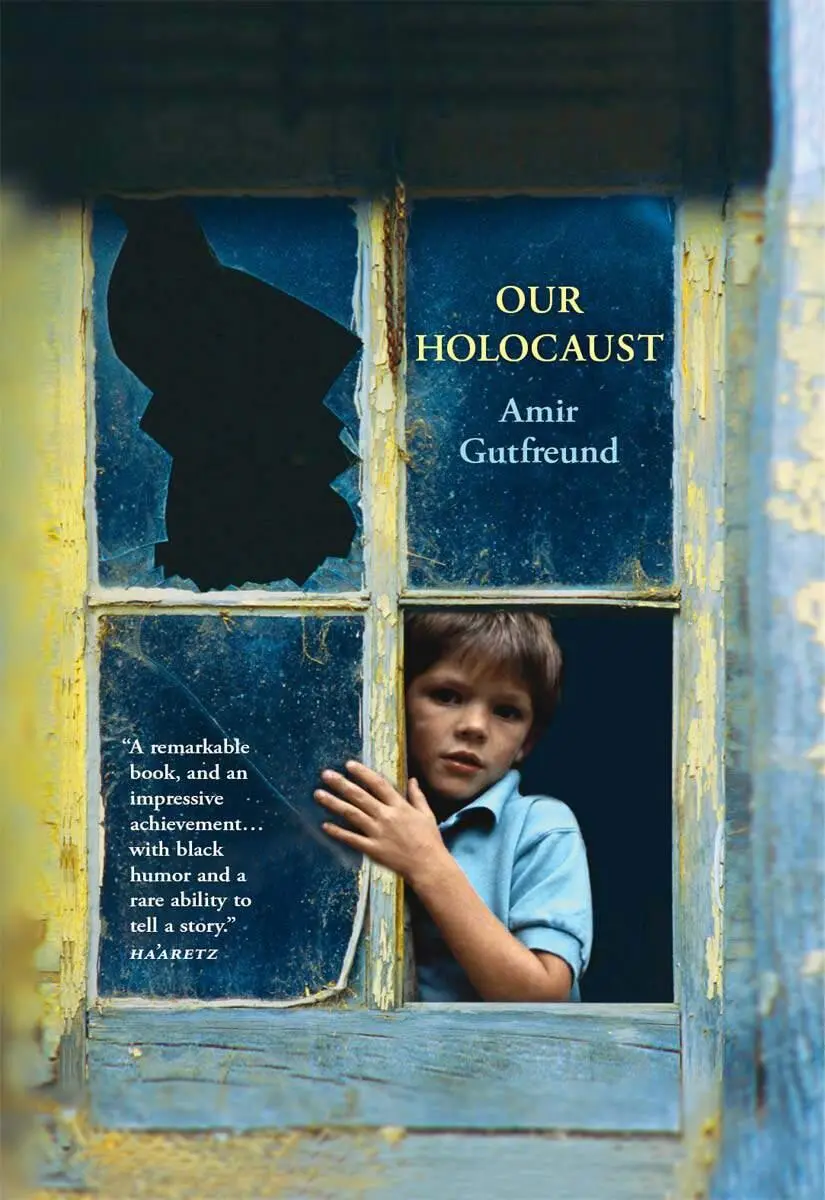
Amir Gutfreund - Our Holocaust
Здесь есть возможность читать онлайн «Amir Gutfreund - Our Holocaust» весь текст электронной книги совершенно бесплатно (целиком полную версию без сокращений). В некоторых случаях можно слушать аудио, скачать через торрент в формате fb2 и присутствует краткое содержание. Год выпуска: 2006, Издательство: Toby Press Ltd, Жанр: Современная проза, Прочая документальная литература, на английском языке. Описание произведения, (предисловие) а так же отзывы посетителей доступны на портале библиотеки ЛибКат.
- Название:Our Holocaust
- Автор:
- Издательство:Toby Press Ltd
- Жанр:
- Год:2006
- ISBN:нет данных
- Рейтинг книги:4 / 5. Голосов: 1
-
Избранное:Добавить в избранное
- Отзывы:
-
Ваша оценка:
Our Holocaust: краткое содержание, описание и аннотация
Предлагаем к чтению аннотацию, описание, краткое содержание или предисловие (зависит от того, что написал сам автор книги «Our Holocaust»). Если вы не нашли необходимую информацию о книге — напишите в комментариях, мы постараемся отыскать её.
Our Holocaust — читать онлайн бесплатно полную книгу (весь текст) целиком
Ниже представлен текст книги, разбитый по страницам. Система сохранения места последней прочитанной страницы, позволяет с удобством читать онлайн бесплатно книгу «Our Holocaust», без необходимости каждый раз заново искать на чём Вы остановились. Поставьте закладку, и сможете в любой момент перейти на страницу, на которой закончили чтение.
Интервал:
Закладка:
Dad read the list and filled up with new memories. The Marsend family. Father, mother, little Etinka.
Who was little Etinka? Why didn’t you ever tell us about her? Where is Attorney Perl on the list? Didn’t he live with you at 7 Leonarda?
Dad struggled to explain, to bring order. The Perls were taken in the first Aktion . This was a list from the time between the first and second Aktionen . The Marsends came after the first Aktion . They were taken in the third Aktion .
And who is little Etinka?
Before I can finish the thought, Grandpa Yosef comes back carrying two cups of “Swiss coffee.” One for me. Didn’t I ask for one? He thought I did. Really? Won’t I drink it? It’s a pity to waste it.
Grandpa Lolek’s eye gives its quick wink. The scent of wasted money disturbs his rest.
I take the coffee and sip unwillingly. It has no sugar — a double punishment.
Grandpa Yosef makes himself comfortable, surrendering to the flavor of the coffee. He looks up at me and says, “When it comes down to it, the ghetto was not completely bad.” As if finishing up a story, or starting one, or interfering in Dad’s. Unclear.
He sips from his cup. One hand rests on the edge of Grandpa Lolek’s bed.
“Up until they closed us off in the ghetto, the lives of Jewish people were not too bad. Everyone suffered, goyim and Jews. The beginnings of the ghetto did not foreshadow what was about to happen to the Jewry of Bochnia, to all Jewry. The ghetto commandant, Müller, was not an evil villain. Perhaps if he had been as abusive as some other SS officers, we might have been more on our guard, might have dared to find any way possible to escape. Even the Gestapo chief, an older German by the name of Schomburg, did not help us divine the true circumstances faced by Bochnia Jewry. He did not treat us harshly, and in return for bribes he was willing to issue authorizations, certificates, whatever was needed. We were closed off in the ghetto, waiting for the gloom to lift, not imagining what lay ahead. It was crowded, there was little food, there were worries. But Bochnia was known throughout the region as a good place to live. Jews flocked there to become a part of the imprisoned community. The Germans did not stop them. They sat in their offices and rubbed their hands together gleefully. This was their plan, after all. First, to gather the Jews from the small villages and farms into the towns. Then, to concentrate the town Jews in the district centers, and finally, to lead them all into the large cities. A diligent and thorough cleansing plan. They implemented it with force, with decrees, with train cars. And at the same time, Jews flowed in of their own free will. Bochnia was filled with them. And what can I say? Until the first Aktion , life was bustling. Within the crowdedness and the density, people grew closer — some through love, some through strife, some through communal study, some through screaming to high heavens. It was hard, but life burst through. There was a little field on the outskirts of the ghetto in a deforested piece of land, where I would meet Feiga every day. We would sit and talk of important matters like spring, the prophets, silly Marushka. But the ghetto children also liked the field, those rascals, your father too, and when we wanted to be alone we had to go up to an isolated wooden hut on a hilltop on Leonarda Street. In the middle of the little ghetto was this magnificent hilltop. Around it were crowded houses and noisy masses, but on the hilltop — not a thing. Our own Noah’s Ark. You could sense the gathering, more and more Jews streaming into the ghetto from the villages of the Bochnia district. Tiny ghettos were shut down and their Jews were sent to us. Slowly and diligently the Germans labored to convene all the rural Jews in our ghetto. The crowdedness became worse and worse, you wouldn’t believe how the skirmishes and the screaming outweighed the love and friendship. How people became less happy with the imposed communality, and the Jewish heart with its righteousness and patience could no longer suffice. Something had to break — even Noah’s Ark had room only for couples.
“But I had Feiga, and what else did I need in the world?
“One day, all of a sudden, no Feiga. Thunder on a bright day. Her family disappeared, and the rumor was that they had secretly escaped. They were heading to Hungary, which was often the destination at that time for those who had the means or the connections.”
“Your rabbi did that too, the Admor of Belz,” I charge. “But his disciples stayed behind for the Aktionen .”
“ Nu, nu ,” Grandpa Yosef protests.
Grandpa Lolek’s winking eye stirs a little; it seems his opinion of the religious in general has been voiced.
“What will be the end of this?” Grandpa Yosef sighs, straightening the blanket on Grandpa Lolek, short, elderly fingers expertly tucking the blanket beneath his body.
I begin to be frightened that he might stop talking. I suddenly realize that Grandpa Yosef is sitting here about to tell me his story. The entire story. Childhood bustles within me excitedly, gratefully. I must not disturb him, he must not stop talking. Grandpa Yosef comes through.
“I could not understand how Feiga had left without saying a word,” he says, returning to the point at which he left off. And he quickly rejects my unvoiced question. “No, I was not hurt. At first perhaps, there was a grain of anger, but even before the grain sprouted, my heart was flooded with joy: my love was in a safe place, a great worry had been lifted.
“But after a few days the rumors began. They said her family had been betrayed by its guides, they had been captured. They said some were dead, some taken away. Feiga had been taken north, for some reason. The Germans were lacking a beautiful Jewish woman in northern Poland, so instead of killing Feiga they fished her out of the south and handed her over to the north, to balance out their world. Nu .”
“How did the rumors start?”
“They just did. In the ghetto, rumors had the healthiest of legs. All day long they hurried around from here to there, never tiring. They ran around and built up strength, not like us humans. Nu . And there were people who still traveled around in all sorts of ways among the ghettoes, bearing news and rumors. They knew what was going on. Everyone knew. The only thing they didn’t know was that only thirty days away, death was waiting for us all. Feiga disappeared in July, and in August they suddenly declared a roll-call. They ordered us to line up in the military camp courtyard adjacent to the ghetto.
“It was the Aktion , which meant a transport of Jews to the death camps. We knew nothing of the liquidation. We were told of a campaign for resettlement in the East, where they would turn Jewish people into productive citizens. We were even ordered to pack bags for the journey. The deceit worked beautifully. We gathered obediently in the empty camp, where they would separate people intended for the transport from those permitted to stay. Anyone who had a permit to stay in the ghetto felt safe, and the others, without knowing a thing, sensed death. People hid out, dug themselves into attics, hollows, anywhere they could. The Germans went from door to door, aided by Polish policemen and local assistants. Whoever was caught was shot on the spot. Women, elderly people, children. The whole ghetto filled with the sounds of screaming and shooting. Bodies rolled down the streets. The Aktion continued for three days. To the credit of this Aktion one could say that it was easy compared to the two Aktionen that would come later in ghetto Bochnia, until the liquidation. I myself saw no more than the first Aktion . I was destined for a transport.
Читать дальшеИнтервал:
Закладка:
Похожие книги на «Our Holocaust»
Представляем Вашему вниманию похожие книги на «Our Holocaust» списком для выбора. Мы отобрали схожую по названию и смыслу литературу в надежде предоставить читателям больше вариантов отыскать новые, интересные, ещё непрочитанные произведения.






Обсуждение, отзывы о книге «Our Holocaust» и просто собственные мнения читателей. Оставьте ваши комментарии, напишите, что Вы думаете о произведении, его смысле или главных героях. Укажите что конкретно понравилось, а что нет, и почему Вы так считаете.