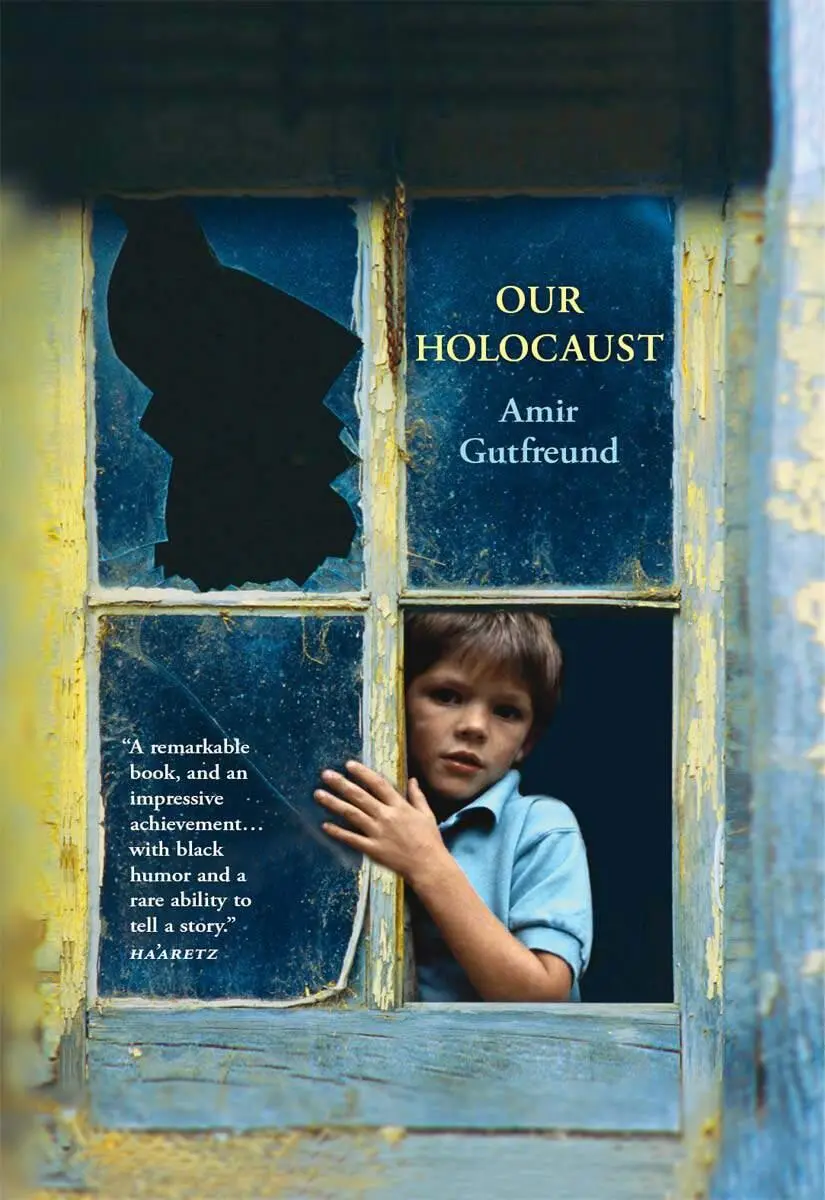
Amir Gutfreund - Our Holocaust
Здесь есть возможность читать онлайн «Amir Gutfreund - Our Holocaust» весь текст электронной книги совершенно бесплатно (целиком полную версию без сокращений). В некоторых случаях можно слушать аудио, скачать через торрент в формате fb2 и присутствует краткое содержание. Год выпуска: 2006, Издательство: Toby Press Ltd, Жанр: Современная проза, Прочая документальная литература, на английском языке. Описание произведения, (предисловие) а так же отзывы посетителей доступны на портале библиотеки ЛибКат.
- Название:Our Holocaust
- Автор:
- Издательство:Toby Press Ltd
- Жанр:
- Год:2006
- ISBN:нет данных
- Рейтинг книги:4 / 5. Голосов: 1
-
Избранное:Добавить в избранное
- Отзывы:
-
Ваша оценка:
Our Holocaust: краткое содержание, описание и аннотация
Предлагаем к чтению аннотацию, описание, краткое содержание или предисловие (зависит от того, что написал сам автор книги «Our Holocaust»). Если вы не нашли необходимую информацию о книге — напишите в комментариях, мы постараемся отыскать её.
Our Holocaust — читать онлайн бесплатно полную книгу (весь текст) целиком
Ниже представлен текст книги, разбитый по страницам. Система сохранения места последней прочитанной страницы, позволяет с удобством читать онлайн бесплатно книгу «Our Holocaust», без необходимости каждый раз заново искать на чём Вы остановились. Поставьте закладку, и сможете в любой момент перейти на страницу, на которой закончили чтение.
Интервал:
Закладка:
His eyes were closed, but his right one was open a slit, just to make sure the world remembered that he always said, “People have to die of something.” He would not close his eyes until the world admitted that he did, indeed, say that. He had lived with that one opinion and would die with it. In fact, we should bury him with that victorious belief, like a Pharaoh entombed with his jewels so they can serve him on his eternal journey. We could leave his suits outside the grave, as well as his decorations, his certificates, the promissory notes and the papers for the land near Gedera — a good piece of land, one day its value will increase — but his opinions would be placed beside his body.
Grandpa Yosef broke down first and acknowledged Grandpa Lolek’s presence. He pointed to the silent man and tried to rationalize him. “ Nu , after all, one cannot forget. Jews in the war went like lambs to the slaughter, exterminated in the gas chambers, and this man here fought heroically. I heard stories about him from people who were there. A true lionheart. And me, with all my wanderings, all the pain and suffering, perhaps it would have been better if I had been like him.”
Fresh envy in Grandpa Yosef’s eyes. His look roamed worriedly over the still body, which somehow did not appear helpless. Grandpa Lolek was silent on his bed, stiff and still, like a Viking set adrift by his friends for one last voyage. The glory still enveloped him. It was hard to pity a body so taut — it seemed at any moment this Viking might sit up and smoke a cigarette. But for now he was afloat on the current, summing up his life with satisfaction, eyes shut. If not for the tiny slit in his right eye, which turned to a tremor like a wink, his image would have been perfect. The slight wink tarnished the glory. Grandpa Lolek was alive and planned to return.
Grandpa Yosef prepared for his defense. “Believe me, in the camps and the ghettos I also saw heroism.” His voice strengthened. “Individuals sacrificed themselves. Lone soldiers, without uniforms or orders. At the moment of truth they flung themselves into death. And who will tell their stories?”
His question lingers in the air.
Who will tell their stories?
Grandpa Yosef stands up. He thinks he saw some “Swiss coffee” in the vending machine at the end of the hallway. That was what the label said. He has no idea what it means. Would I like a cup too?
No.
Grandpa Yosef goes off to examine the mystery of the vending machine label. By my side Grandpa Lolek lies tall and still, ready for inspection.
Who will tell their stories?
Grandpa Yosef managed to traverse our entire childhood without giving away too much. His attempts at concealment were successful. On the train, on the trips to Tel Aviv, the spring poured forth once a year. No more. Strategically, Grandpa Yosef had won. And now he cautions — who will tell their stories? As if now of all times, from within his victory, he is considering the possibility of taking a loss. Perhaps he wishes to offer himself up: He will tell, I will listen. We will sit on either side of Grandpa Lolek and whatever manages to cross over his bed will be mine. But I have my own reservations. It has been fifty years. Whatever has been told, has been told. I once pursued these stories. I poisoned Feiga with fake pills for them, and knelt before any old man willing to talk. Now we have grown up. We are the second-and-a-half generation to the Shoah, living our lives, and we have no need to adhere to the past anymore. Life flows vigorously enough. I still visit Attorney Perl and talk with him. With him the Shoah lives on, a climbing plant that never ceases to sprout new branches. But the conversations with him are the malkosh —the last rain of the season. The final rains of a great winter that has come and gone.
When we went to Poland with Dad to see his stories made real (the imaginary pictures solidified, we could even take photographs), we discovered that we did not need the Holocaust stories as much as we wanted the stories of his childhood — the happy one, the forgotten one, in Bochnia before the war. Dad showed us places, houses, abandoned gaps of time. He gestured with his hands — this happened here, that happened there.
The house he was born in.
The soccer field across the street.
The rooftop where he chased pigeons and almost fell off.
The chestnut trees whose fruit he used to gather with his friend Penek Lamensdorf (1930–1942), intending — based on a personal scientific hypothesis — to manufacture sophisticated glue.
There was a certain discord between our childhood stories and the reality we found. Things turned out to be the opposite of what they had seemed. Our memories stood gravely in attendance, prepared to defend the childhood stories in this complicated suit — after all, this conspiratorial reality was scandalous. But as we walked behind Dad through the ghetto, reality went through the stories with a fine-tooth comb, dismantling everything. Dad left nothing whole.
“Here, look,” he pointed to a little path between pretty houses, trees and greenery. There, in front of our eyes, was the-lane-Dad-zigzagged-through.
Since we were little kids, every year, Dad had told us about the day he and a friend had tried to hide their stamp collection. The Germans called out to them to stop. They ran away down the alley. Dad’s father had instructed him to always run in zigzags when shots were being fired. (I think of Yariv. What will I teach him?) His friend ran in a straight line and was killed. It was a simple story for Dad. We became Old Enough for this story fairly early. Perhaps from his point of view it was a trivial tale — only one child was killed. But it was imprinted in our memories, and its visual traits gave us many versions of Dad running, dodging the bullets, the zigzag overcoming everything. We did not hesitate to dramatize the different versions in dusty lanes on dry, colorless, pitiful gravel. When we were older we learned to add shades of color we came to know in the alleys of Gaza, in Khan-Younis.
We gazed in wonder. Here, in front of us, was the zigzag lane. It was raining, everything was glimmering, giving off a fresh smell. And the ghetto. The ghetto where people had to line up on the sidewalks to die. A violent and pale ghetto, surrounded by walls, crowded, morbid. But we walked down narrow streets and stood in front of the house at 7 Leonarda Street, the mythological house from the stories. We looked at a little yard where a swing hung from a tree, and there were bushes, and flowers. At this moment it became clear that of everything in this journey to Poland, we would remain with only one accurate link between the childhood stories and the Polish reality: The famous window from which a cat willingly leapt sixty years ago after Dad gave it a bottle of ammonia to sniff. A thousand forms of this window had been imagined since Dad told the story, a thousand cats leaping, a thousand versions of its hesitant return home a few days later.
Dad pointed to the window. The thousand windows of our imagination murmured satisfactorily, pleased with the father who begat them.
In the meantime a small door had opened at 7 Leonarda. Mr. Petrovich, the resident, came out to see us. He was the son of the man who had owned the house at the time when its owners were thrown out so that Jews could be housed in it. The father, an educated Polish Christian, was sent to Auschwitz, one of the first from Bochnia. The son was friendly. He recalled how his father used to send him to the confiscated house to see how it was getting along. He even found an old document listing the Jewish tenants during the ghetto period. Someone had written everything down in neat handwriting, every single detail, seemingly assigning the utmost importance to the lives of these people, most of whom would soon be murdered in the gas chambers at Belzec.
Читать дальшеИнтервал:
Закладка:
Похожие книги на «Our Holocaust»
Представляем Вашему вниманию похожие книги на «Our Holocaust» списком для выбора. Мы отобрали схожую по названию и смыслу литературу в надежде предоставить читателям больше вариантов отыскать новые, интересные, ещё непрочитанные произведения.





Обсуждение, отзывы о книге «Our Holocaust» и просто собственные мнения читателей. Оставьте ваши комментарии, напишите, что Вы думаете о произведении, его смысле или главных героях. Укажите что конкретно понравилось, а что нет, и почему Вы так считаете.