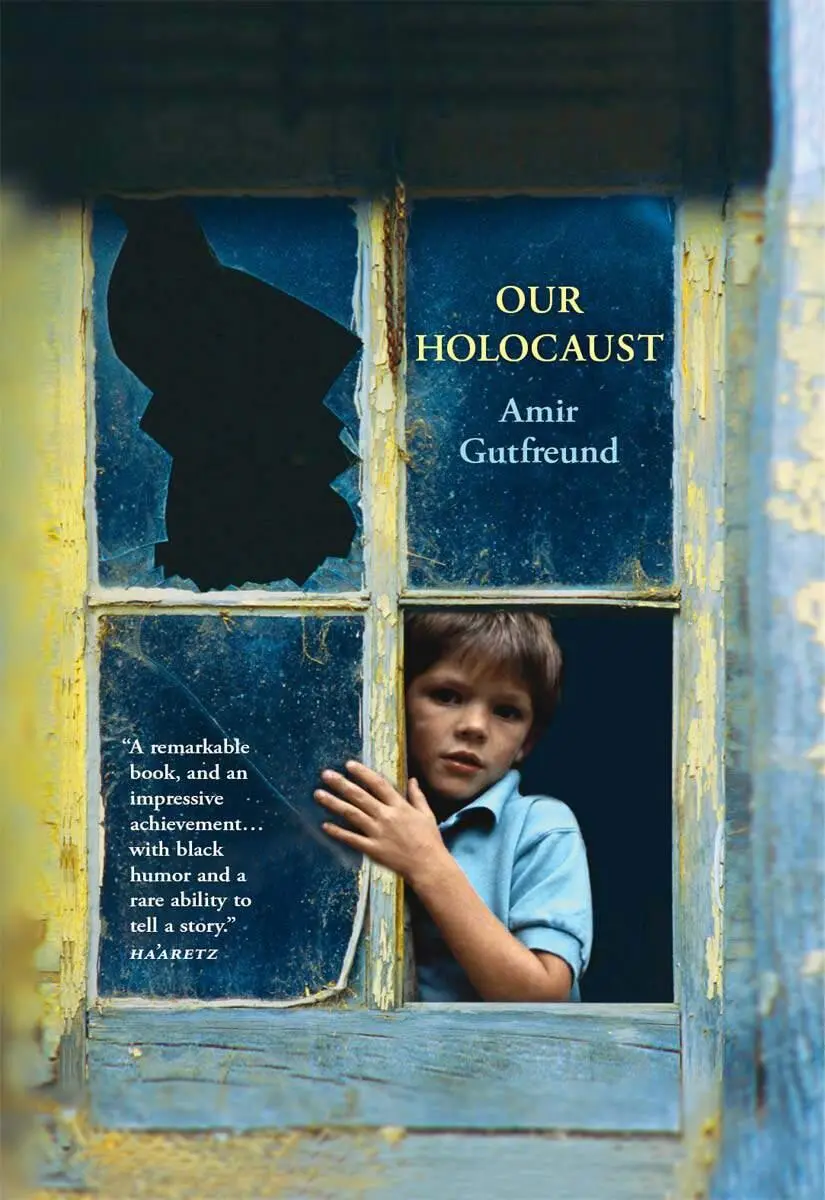
Amir Gutfreund - Our Holocaust
Здесь есть возможность читать онлайн «Amir Gutfreund - Our Holocaust» весь текст электронной книги совершенно бесплатно (целиком полную версию без сокращений). В некоторых случаях можно слушать аудио, скачать через торрент в формате fb2 и присутствует краткое содержание. Год выпуска: 2006, Издательство: Toby Press Ltd, Жанр: Современная проза, Прочая документальная литература, на английском языке. Описание произведения, (предисловие) а так же отзывы посетителей доступны на портале библиотеки ЛибКат.
- Название:Our Holocaust
- Автор:
- Издательство:Toby Press Ltd
- Жанр:
- Год:2006
- ISBN:нет данных
- Рейтинг книги:4 / 5. Голосов: 1
-
Избранное:Добавить в избранное
- Отзывы:
-
Ваша оценка:
Our Holocaust: краткое содержание, описание и аннотация
Предлагаем к чтению аннотацию, описание, краткое содержание или предисловие (зависит от того, что написал сам автор книги «Our Holocaust»). Если вы не нашли необходимую информацию о книге — напишите в комментариях, мы постараемся отыскать её.
Our Holocaust — читать онлайн бесплатно полную книгу (весь текст) целиком
Ниже представлен текст книги, разбитый по страницам. Система сохранения места последней прочитанной страницы, позволяет с удобством читать онлайн бесплатно книгу «Our Holocaust», без необходимости каждый раз заново искать на чём Вы остановились. Поставьте закладку, и сможете в любой момент перейти на страницу, на которой закончили чтение.
Интервал:
Закладка:
Effi’s liked to look me over and say, “You see, there are good Germans.”
I never said there weren’t. There were back then too. Dad told me about German soldiers who cried when they saw a pile of dead children in the Bochnia ghetto. Who said there weren’t any good Germans? But within the current admixture of euphemisms — New Germany, the New Germans, Democratic Germany — hides the thing that allowed the criminals to keep on living, the thing that granted sweeping clemencies, gave them back their status, let them raise sweet grandchildren — Hans and Peter and Jorgen, who sometimes came to plant trees here in the Land of Israel. I despise those unwilling to confess to their crimes, the banks that traded in gold teeth, the factories that killed prisoners through slave labor, anyone who allowed these institutions to continue being part of the nation, to function under the patronage of national denial. I despise the hands raised in the Bundestag on May 8 th1960—only fifteen years after the war had ended — and voted to allow the expiration of the statute of limitation for minor crimes such as manslaughter, wrongful injury resulting in death, and denial of freedom resulting in death. I despise those hands, a democratic majority. But who ever said there weren’t any good Germans?
We invited Hans over to our place on weekends. As we sat around waiting for air-raid sirens, we grew more friendly. We slowly roamed through different conversation topics. First, orphanhood. What exactly was he researching? Then, the war. Germany. The Holocaust.
Hans Oderman took part in the conversations reluctantly. His scripted role was that of the culprit, and he took it upon himself without protest. We set him free in the swampy reeds of our intentions, a jet-black wolf for us to target and hit. But Hans Oderman sat frozen like a frightened duck. His function was to stand before us, accused. But we could not draw the lines that would differentiate us from him.
“What did your father do during the war?”
“My father? He was only born during the war.”
“And his father?”
“He was a soldier, killed on the Russian front near Leningrad.”
“And your mother’s family?”
“They were soldiers. One was a pilot. And there were two dissidents, one was imprisoned in Dachau for five years.”
But there was an uncle who belonged to the SS, he remembered, sheathing himself with the blanket of culpability after all.
Even without words (after all, many of the worst Nazis found these sorts of biographical responses for themselves), there was in him a sort of innocence. Guilt did not stick to him. A hidden line of defense came together from his looks, his embarrassment, his explanations. He was exonerated by the words we sensed hiding within his thoughts. He did not say everything, and what he left out was not damning — on the contrary, it might even have connected us to him. A riddle.
We introduced Hans to the family so he could wriggle under the light of their looks for a while. If he survived that, we would know he was innocent.
The family was enchanted by Hans’s politeness. Grandpa Lolek interrogated him and observed, “I killed a lot like him.”
The days went by and the Gulf War began to die out. Everyone was used to Dr. Hans Oderman, no longer excited by the appearance of this man who seemed to have been drawn from a Nazi leader’s dream. And then suddenly, in the midst of the routine days, without warning, Grandpa Yosef was back. He had been struck by a mysterious virus, courtesy of the Caribbean humidity, which had graced his pale yellow cheeks with a healthy flush and quickened his breath. He returned with a newly ardent and life-loving temperament and seemed agitated by the slow pace of routine events. He did not object to Hans Oderman’s presence in the empty apartment, which was now full of dead people with whom Grandpa Yosef had a thing or two to sort out privately. He warmly hosted him in his home. In fact, he deepened the intensity of the German doctor’s residence, cooking him food and washing his clothes, willfully and affectionately melting away Hans Oderman’s intentions to move a little closer to campus — there wasn’t even a bus route in this sleepy neighborhood.
In a sort of destruction of the sanctity of grief, in this house without Feiga and without Moshe, Grandpa Yosef and Hans organized a cooperative life for themselves. They cooked, cleaned and studied. They seemed thankful for each other’s company. Grandpa Yosef enjoyed the refreshing proximity of scholarliness. After the heat of the Caribbean days, he happily breathed in the cool air of science. Hans was charmed by his host, easily won over by Grandpa Yosef’s personality. He was especially happy to speak fluent German in the Holy Land. And he made the mistake of asking where Grandpa Yosef had acquired such fine German.
“I was in your land,” Grandpa Yosef clarified. As if he had spent time in Germany to inspect some furniture.
They sat often at Grandpa Yosef’s wooden table, talking about the problem Hans was working on at the university. Grandpa Yosef understood little, and was sorry that no miracle occurred, such as a brilliant idea that would come to him in a flash after one hearing. The Caribbean force still pulsed in him, and slow business irritated him.
Every evening, Hans Oderman came home from his studies and Grandpa Yosef from his do-gooding. They unloaded their daily baggage, two hunters laying their loot on the table. They talked, debated, argued. Our visits were not rejected, but were received somewhat indifferently. As if for our sake Grandpa Yosef was keeping up a demeanor appropriate for a man in mourning. We would come and find them walking around Katznelson together, in the parks, even the woods. They talked. Like two intellectual giants projecting their charms upon each other. They would stop for a moment to exchange an opinion and glance at one another. Two magicians, mutually awed, but each suspicious of the other’s tricks, wondering what was the secret of the other’s magic.
When Hans Oderman went back to Germany, the vivid impression he had made continued to accompany us in conversations, in thoughts, in meetings, until it became doubtful whether his physical presence could have added anything more. We felt as if he were with us. Phone calls also fostered the relationship. After one such conversation, we thought he had said his research was not done and that he would have to come back soon. We nibbled out of the air a feeling that such a promise had been made, and we nurtured it. (Effi tried to tempt him: “Come, come back. We have lots of wars here. Every decade or so there’s a good orphan season.”) We perceived Hans Oderman’s appearance in our lives as having a greater function than what had been revealed thus far, and could not accept that his return to Germany had put an end to it all. With uncommon generosity, we agreed to wait for months, even years, until the true role of Hans Oderman would be revealed. Only Grandpa Yosef turned out to be a realist. He viewed the separation straightforwardly: Hans had left. But a sadness befell him. He cut down on his bike rides and even considered a moped or a car. With an increased sense of charity he fell on the patients he had neglected for weeks in favor of the Caribbean, and still we did not understand — what had he found in the islands?
But we did not ask. The Caribbean adventure was over. That was it, and it was best forgotten. Why would we go searching for something that would supposedly explain a connection between the mourning in Kiryat Haim and the coconut trees of Tobago? We offered him a trip to Jerusalem, he hadn’t been to the holy city for years. We even suggested, somewhat anxiously, the reckless city of Eilat. Maybe there, in the Caribbean sphere, he would shake off the burning in his blood. But Grandpa Yosef rejected our offers and quickly accustomed himself to a life with new troubles. There were many needy people and no time to rest. He forged relationships with elderly people outside the neighborhood, and reconnected with an old love, the community of Belz Chassidim, where he found some good to do. He volunteered in the northern neighborhoods, where new immigrants began to look forward to his frequent visits. He was quick to commit to any affair, rushing to lend a shoulder.
Читать дальшеИнтервал:
Закладка:
Похожие книги на «Our Holocaust»
Представляем Вашему вниманию похожие книги на «Our Holocaust» списком для выбора. Мы отобрали схожую по названию и смыслу литературу в надежде предоставить читателям больше вариантов отыскать новые, интересные, ещё непрочитанные произведения.







Обсуждение, отзывы о книге «Our Holocaust» и просто собственные мнения читателей. Оставьте ваши комментарии, напишите, что Вы думаете о произведении, его смысле или главных героях. Укажите что конкретно понравилось, а что нет, и почему Вы так считаете.