Amir Gutfreund - Our Holocaust
Здесь есть возможность читать онлайн «Amir Gutfreund - Our Holocaust» весь текст электронной книги совершенно бесплатно (целиком полную версию без сокращений). В некоторых случаях можно слушать аудио, скачать через торрент в формате fb2 и присутствует краткое содержание. Год выпуска: 2006, Издательство: Toby Press Ltd, Жанр: Современная проза, Прочая документальная литература, на английском языке. Описание произведения, (предисловие) а так же отзывы посетителей доступны на портале библиотеки ЛибКат.
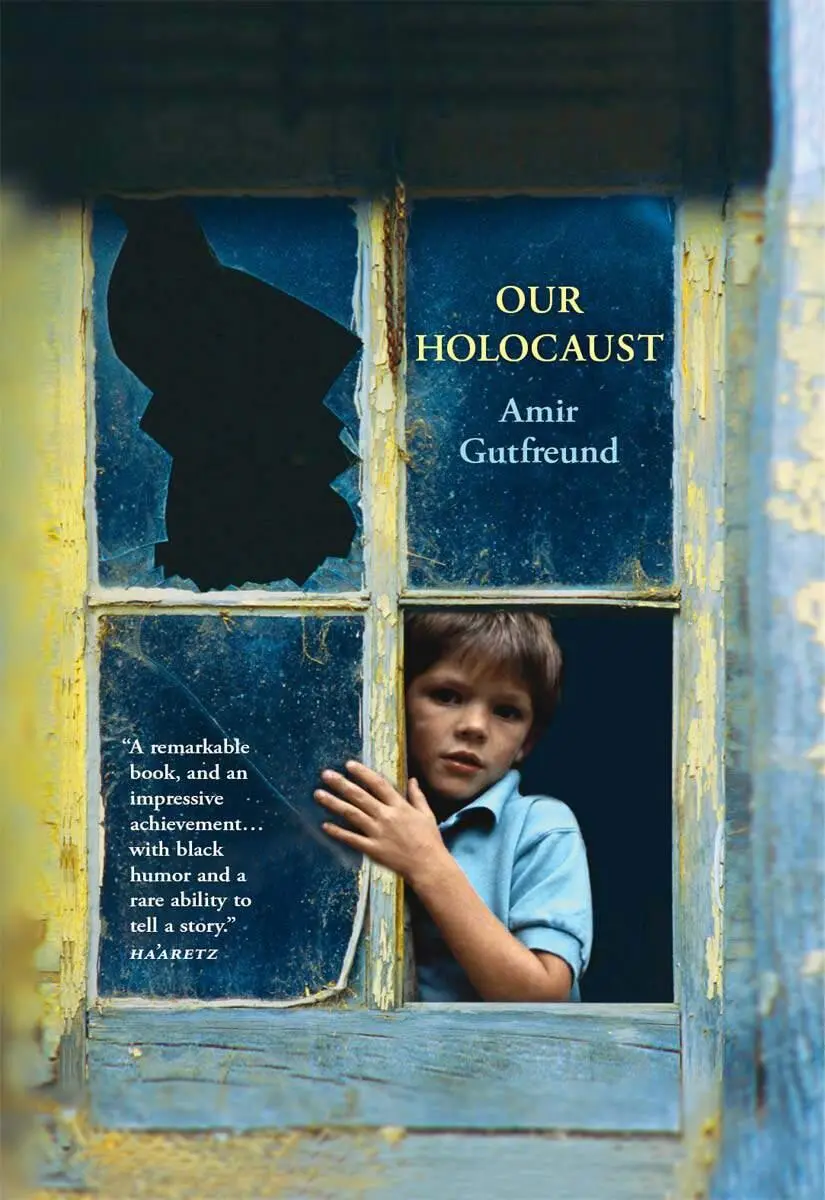
- Название:Our Holocaust
- Автор:
- Издательство:Toby Press Ltd
- Жанр:
- Год:2006
- ISBN:нет данных
- Рейтинг книги:4 / 5. Голосов: 1
-
Избранное:Добавить в избранное
- Отзывы:
-
Ваша оценка:
Our Holocaust: краткое содержание, описание и аннотация
Предлагаем к чтению аннотацию, описание, краткое содержание или предисловие (зависит от того, что написал сам автор книги «Our Holocaust»). Если вы не нашли необходимую информацию о книге — напишите в комментариях, мы постараемся отыскать её.
Our Holocaust — читать онлайн бесплатно полную книгу (весь текст) целиком
Ниже представлен текст книги, разбитый по страницам. Система сохранения места последней прочитанной страницы, позволяет с удобством читать онлайн бесплатно книгу «Our Holocaust», без необходимости каждый раз заново искать на чём Вы остановились. Поставьте закладку, и сможете в любой момент перейти на страницу, на которой закончили чтение.
Интервал:
Закладка:
They saw Gruppenführer Jürgen Stroop, liquidator of the Warsaw ghetto.
They saw Hauptsturmführer Fritz Suhren, commandant of Ravensbrück camp.
They saw Hauptsturmführer Josef Kramer, commandant of Bergen-Belsen camp.
They saw Obersturmbannführer Rudolf Höss, commandant of Auschwitz.
They saw Hauptsturmführer Hans Bothmann, commandant of the Chelmno death camp, liquidator of the Lodz ghetto.
Marching in front of me. Come to stay. Soon he would put his suitcases down in Grandpa Yosef’s home, place his ironed clothes on the shelves in the closet, hang his suits. Make himself a first cup of tea. Him. Here.
But when we reached Grandpa Yosef’s apartment we found Effi standing in the doorway, eating a carrot. It turned out she had been settled in at Grandpa Yosef’s for two days now, and was painting the apartment. She looked at Hans.
“Oy, the Nazi creature!” she said. She wore a long tank-top and nothing else.
“Effi, what are you doing here?”
“Look at you! You’ve really brought a Nazi,” she continued, examining Hans, offering him a carrot and pulling him into the apartment as if introductions had been made and all that was left was to divvy up Grandpa Yosef’s apartment.
“Effi, what are you doing here?” I chased after her, stepping over the plastic tarps she had spread throughout the apartment. “Effi, what are you doing here?”
She turned to me and promised, “Adolf and I will get along just fine.”
And that’s when I began to feel bad — he had suffered enough cruelty.
“His name is Hans,” I said to Effi, but you could tell he had picked up on the ‘Adolf.’ With one awkward wave of the hand he played out the entire requisite sequence — expressed shock, indicated that he understood the humor and knew that it was imposed by his persona, voiced his objection nonetheless, then downplayed it — he would give in if he had to.
“He can stay here,” Effi said generously, “we’ll be two doctors in one apartment.”
It seemed to me that she already had her eye on him. Him, Dr. Hans Oderman, six-foot-three-sapphire-blue-eyes-golden-locks. She led him to Feiga’s room and opened the windows to banish death, if there was any still remaining. She helped him lay his clothes out on the empty shelves (in the midst of the shiva Feiga’s clothes had been donated to an old age home; Grandpa Yosef’s charity campaigns never rested for a moment). As her hands took control of Hans’s property, with her face buried in the closet, she explained that her apartment lease was almost up, it was close to her work here, and the apartment needed to be fixed up a little before Grandpa Yosef got back.
A short while later we sat drinking tea at Grandpa Yosef’s wooden table. We talked. We asked Dr. Hans Oderman about his plans, his intentions, his family, the city of Frankfurt. We generously bypassed questions about things that should not be discussed, but tried to extract an admission of guilt — a happy childhood, grandmas and grandpas, the whole thing. Hans Oderman pleaded not guilty: he never knew his grandparents on either side. Things were not that easy for him either. His father had been orphaned as a child.
And what did he think about Israel?
We demanded love. Not just for us but for the elderly people who lived here, who would see him as he left the apartment every day, walked through the yard and down Katznelson. We could not imagine how easy it would be for Hans to integrate into the life of the neighborhood. Within a few days we would find that he had already been enlisted to perform the requisite tasks, helping the old people choose a room to seal off, measuring sheets of plastic as they buttressed themselves inside in preparation for another battle. (They grit their teeth, their elderly fingers caught up in masking tape, their faces wearing determined expressions — they would survive.)
During the first days of his stay we plodded around behind him responsibly, checking up — Effi in her capacity as roommate, and myself as liaison with Professor Shiloni. I felt obliged to report to him should anything occur, some fatal mistake or a case for the authorities to handle. We did not need to report his lingering visits at Sammy’s vegetable shop. Nor the cups of tea at Mrs. Rudin’s. We gradually eased up our supervision. We came to check up, to see how the neighborhood was getting along with Dr. Hans Oderman, and found him nicely assimilated. Sipping tea with Mrs. Rudin. Eating Mrs. Tsanz’s kugel . Chatting with Sammy about the crisis in German soccer, complaining about the price of tomatoes. He was doing well. He even had an encounter with Hirsch. Later, he asked for explanations. What was he yelling? Why did he yell? And finally we had an opportunity to explain this neighborhood, these people, the hidden significance of what occurred here.
We carefully monitored his opinions and actions. On his free days, we learned, he liked to go to Jerusalem, to Lake Kinneret, or to the Galilee. He also went to Masada, the Yad Vashem Holocaust museum, and the Ghetto Fighters’ Kibbutz. Our courteous offers were met with dismissal: Hans Oderman preferred to take the bus, so he could meet people. He came back from his travels full of impressions. He connected easily with people and learned to understand the different pieces of Israeli existence. He sat with us trying to fill in the gaps in his knowledge. Were Jews of Bulgarian origin considered Sephardic? What was the difference between a cooperative moshav and a regular moshav? Where exactly had the Cochin Jews come from?
He also found the beach, and he took slow walks there with his lustrous Atlas-like body, regally scanning the seashell-clutching women who stared at him and engaged him in conversation. He made no effort to avoid the streets of Haifa, especially the Carmel, amazed at the mottled mass of Eastern, Western, Southern and Northern notes. Women and young girls strolled up and down the streets of the Carmel — a miracle ignoring its own importance, coming and going from the houses, the stores, the cafés.
It sometimes seemed that an impenetrable contemplation flickered in his mind, something that might have taken on the shape of a thought — You mean these were the kinds of people they wanted to annihilate in the gas chambers? But the thought did not ripen. It remained in its crude form, hovering, bothering every other thought like a troublesome grain.
People asked us what he was doing at the university.
“Hans is completing a historical study on the subject of orphanhood,” I replied.
Meaning?
“Meaning, how they treated orphans in different cultures and through the prism of history.”
(“Very useful,” Effi pointed out.)
They wanted to know if he himself was an orphan.
I answered, “No.”
Anat said, “He looks a bit like an orphan.” (Finding even in Dr. Hans Oderman, six-foot-three-sapphire-blue-eyes-golden-locks, the orphan in need of help. Anat.)
We slowly came to understand his personality. Hans Oderman from Germany was an expert at awkwardness. Like a mouse trained to find cheese, praised every time he makes it through a maze, so was Hans, finding in every situation the way to be embarrassed, to hesitate, to grope his way out with cautious words. Six-foot-three-sapphire-blue-eyes-golden-locks was only a camouflage.
Towards the end of January the war came true. Missiles started falling. Worried, we scurried around on Hans’s behalf, trying to get him a gas mask. He didn’t want one. It wasn’t necessary, he believed. And in general, he had a tough time with masks and found it difficult to breathe with them because of respiratory problems. In between the air-raid sirens he cared for the sealed rooms, replacing plastic tarps and fixing strips of tape that had fallen away here and there.
Читать дальшеИнтервал:
Закладка:
Похожие книги на «Our Holocaust»
Представляем Вашему вниманию похожие книги на «Our Holocaust» списком для выбора. Мы отобрали схожую по названию и смыслу литературу в надежде предоставить читателям больше вариантов отыскать новые, интересные, ещё непрочитанные произведения.









Обсуждение, отзывы о книге «Our Holocaust» и просто собственные мнения читателей. Оставьте ваши комментарии, напишите, что Вы думаете о произведении, его смысле или главных героях. Укажите что конкретно понравилось, а что нет, и почему Вы так считаете.