Amir Gutfreund - Our Holocaust
Здесь есть возможность читать онлайн «Amir Gutfreund - Our Holocaust» весь текст электронной книги совершенно бесплатно (целиком полную версию без сокращений). В некоторых случаях можно слушать аудио, скачать через торрент в формате fb2 и присутствует краткое содержание. Год выпуска: 2006, Издательство: Toby Press Ltd, Жанр: Современная проза, Прочая документальная литература, на английском языке. Описание произведения, (предисловие) а так же отзывы посетителей доступны на портале библиотеки ЛибКат.
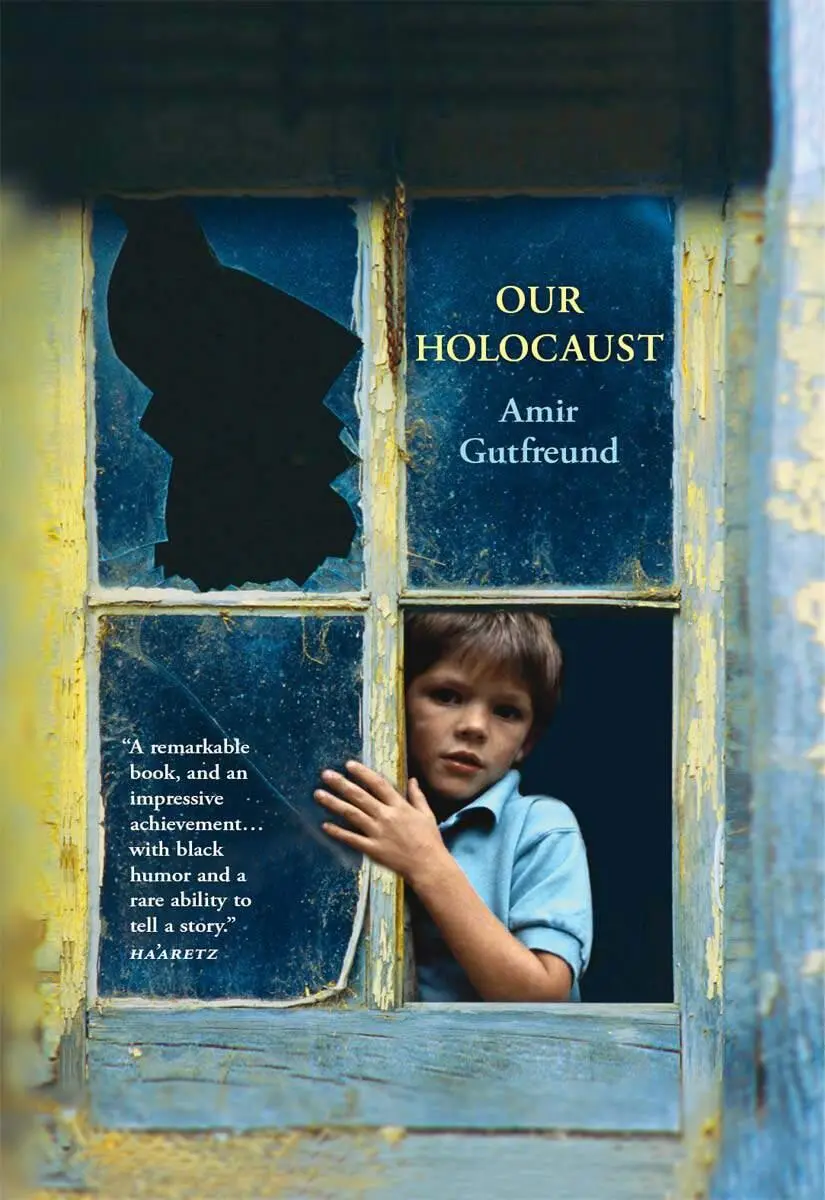
- Название:Our Holocaust
- Автор:
- Издательство:Toby Press Ltd
- Жанр:
- Год:2006
- ISBN:нет данных
- Рейтинг книги:4 / 5. Голосов: 1
-
Избранное:Добавить в избранное
- Отзывы:
-
Ваша оценка:
Our Holocaust: краткое содержание, описание и аннотация
Предлагаем к чтению аннотацию, описание, краткое содержание или предисловие (зависит от того, что написал сам автор книги «Our Holocaust»). Если вы не нашли необходимую информацию о книге — напишите в комментариях, мы постараемся отыскать её.
Our Holocaust — читать онлайн бесплатно полную книгу (весь текст) целиком
Ниже представлен текст книги, разбитый по страницам. Система сохранения места последней прочитанной страницы, позволяет с удобством читать онлайн бесплатно книгу «Our Holocaust», без необходимости каждый раз заново искать на чём Вы остановились. Поставьте закладку, и сможете в любой момент перейти на страницу, на которой закончили чтение.
Интервал:
Закладка:
After a few months the war itself broke out. Rockets fell. Perhaps Saddam Hussein was after more than annihilating the letter K. But even before the rockets, the main events had already occurred in the family. An era of traveling had begun. Effi decided to take advantage of a school vacation to go to Japan. In her room she piled up guidebooks, descriptions, recommendations. She was too lazy to read them, demanding instead that I give a brief, efficient summary — after all, I had read all the encyclopedias. I started my attempt, but after a moment she cut me off in astonishment. “Wait a minute, Japan is an island?” Fearful, perhaps she wouldn’t go after all. “An island? Tokyo is in the ocean?”
We took a trip with Dad to trace our roots in Poland, to see it all. Ronnie came back and then squeezed in a trip to the US. Effi finally set off for Japan. A frenetic pace took hold of the family. Something had decided to iron out the creases and reorganize things. We were all troubled. Business. Pleasure. Roots. Constant travel. Ostensibly independent trips — what did Japan have to do with Poland? But from above, something larger was waiting to rip out everything and dismantle it. Even the backdrops would be torn apart, destroyed (just in case we thought we might come back one day, everything was demolished).
First, Feiga died. Just like that. The impossible occurred without a second thought. One morning a trembling phone call came from Grandpa Yosef. Then a momentary dizziness. With him. At the graveside. With neighbors. At home at the shiva . We allowed him to mourn. Even Moshe improvised a quiet shiva . People went into Feiga’s room to believe. Her death, which had occurred opposite the surprised branches of the poinciana, was not yet apparent. The blankets did not look as if they had given up their place. There was still an odor of medication in the air. On the windowsill, the same delicately peeling old paint. The same thin branch staring inside. The impression of death was delayed.
Effi was in Japan. I had to locate her. She cried a lot. I had not realized how attached she was to Feiga. She was incomprehensible. She wanted to come home right away, but something went wrong, constraints beyond her control. When the shiva was over, I received postcards she had slipped one by one into a Japanese mailbox. She wrote how much she loved Grandpa Yosef, how everything was different now, how impossible it was. How could she have missed the funeral? I tried to locate her so I could cheer her up with the existence of Grandpa Yosef and replace him with Feiga, but in the meantime she had traveled home, just in time for Moshe’s death.
Moshe died.
It happened suddenly, not even as a result of one of his diseases. Heart failure. Another infliction he had been cursed with and which had hidden among his disasters, taking a backseat to the dramatic lead roles of retardation, brain damage, autism, adenopathy. A modest ghostly infliction, an unassuming stagehand to the great dramaturgy of Moshe’s life, turning up all at once to lower the curtain.
We could not ignore the proximity of the events. Moshe’s death followed Feiga’s as if a lifeline that had been obscured in the shadow of Grandpa Yosef’s grace had suddenly erupted, proving its vital existence only in its absence. Moshe had survived, ostensibly, with the support of Grandpa Lolek and Brandy and ourselves. But Feiga’s death had pierced the gentle artery of his will to live.
A slow, merciful wave enveloped the house. Mourners gathered from the edges of the neighborhood, from the city, taking routes usually traversed by Grandpa Yosef in the opposite direction. Even those who had not come to the house for Feiga’s death uprooted themselves and came this time. Adella Greuner, fragrant and despondent. Itcha Dinitz, unsure if it was the right thing to do. Mr. Bergman, restrained and heavy, sat and spoke in Polish about the sun rays.
We never noticed the disappearance of Brandy. On the day Moshe died she wailed like a wolf, and at some point during the shiva Grandpa Yosef asked if we had fed her.
Feiga was gone. Moshe was gone. Brandy was gone. The world does change .
During that shiva Grandpa Yosef conducted himself silently, with internal precision. He sat small and covered in his corner, addressing us only seldomly, to clarify confusing customs. “Now we need a minyan for the evening prayer.” “Tomorrow is Shabbat, no shiva tomorrow.” A lone sailor, leading himself on without us, we could not even pick up an oar to help him. At the end of the shiva he rose, his skin yellowing, his eyes bloodshot, and with a decisiveness that could have only emerged from focused contemplation, he announced that he intended to sail to the Caribbean islands.
The family was taken aback. The Caribbean? Haiti, Guadeloupe, Tobago, Martinique?
The Caribbean.
Why?
That question was not asked. And there was no answer.
We waited for the peculiar idea to pass, along with the sorrow and the layers of shock. This unwise plan would surely fade away as a mere fragment of thought that had offered him some consolation. It was an incomprehensible notion and would soon be gone. But the days went on and Grandpa Yosef went about his business, keeping secrets, making preparations.
The Caribbean?
Events proceeded at a surprising pace, and at the end of 1990 Grandpa Yosef took off in the estimated direction of Bermuda. He was a tourist with maps and a suitcase.
1991: Grandpa Yosef’s Travels
They eat lots of coconut and pork here,” his first postcard announced. He sounded disappointed, as if he had expected to find an observant congregation on the Caribbean islands. But his second postcard focused on the “amazing dark-skinned ladies,” whose supple gait made a great impression on the wise scholar. On the front of the postcard, to our regret, were only a modestly-topped palm tree and a stretch of blue ocean. A disgruntled Grandpa Lolek suggested sending a quick telegram demanding to see the glistening dark buttocks with our very own eyes. We ignored him and continued to peruse the postcard, on which Grandpa Yosef detailed his impressions of a cave he had toured and his pending voyage to an abandoned island (a pirate stronghold from the good old days), but Grandpa Lolek would not let go. Finally, he confessed: his dancer, Joyce, was black. We were amazed. We quickly had to repaint a reel of memories in Joyce’s new color and add the necessary features, somewhat awkwardly, to each imaginary scene. Even the color of the umbrellas with which she had danced for Grandpa Lolek on the rainy dock at Portsmouth had to be revised.
“Did you leave out any other details?” we asked firmly. We meant to straighten out the memories once and for all. These recollections were the fruit of so many stories, and suddenly, in the midst of a postcard from Grandpa Yosef — the first to lose his mind — now this grandpa was going mad too. We waited.
“She had a little yellow parasol. She carried it rain or shine.”
We were a little thrown off by the combination of rainy England and yellow parasols. How did the dance fit in? And what was the difference between an umbrella and a parasol? Like weary painters, we were forced to refinish our imaginations with the right colors. Joyce the dancer grew darker and more beautiful. The trivial objects that surrounded her also took on the appropriate characteristics (we threw in scarves, high-heels, purses). The exhausting engagement in color and details almost caused us to overlook the true hero of the evening, the supposedly unruly Grandpa Yosef. We still did not understand his fascination with the Caribbean, nor how these islands of palm trees had found themselves caught up in a life of prayer shawls, chopped liver and pickled herring with onion. At the edge of his postcard we identified a grease stain that demanded rigorous investigation. Was it possible that Grandpa Yosef was secretly committing transgressions over there? Ultimately, the source of the stain was officially determined to be okra, or possibly coconut. Case closed.
Читать дальшеИнтервал:
Закладка:
Похожие книги на «Our Holocaust»
Представляем Вашему вниманию похожие книги на «Our Holocaust» списком для выбора. Мы отобрали схожую по названию и смыслу литературу в надежде предоставить читателям больше вариантов отыскать новые, интересные, ещё непрочитанные произведения.







Обсуждение, отзывы о книге «Our Holocaust» и просто собственные мнения читателей. Оставьте ваши комментарии, напишите, что Вы думаете о произведении, его смысле или главных героях. Укажите что конкретно понравилось, а что нет, и почему Вы так считаете.