Amir Gutfreund - Our Holocaust
Здесь есть возможность читать онлайн «Amir Gutfreund - Our Holocaust» весь текст электронной книги совершенно бесплатно (целиком полную версию без сокращений). В некоторых случаях можно слушать аудио, скачать через торрент в формате fb2 и присутствует краткое содержание. Год выпуска: 2006, Издательство: Toby Press Ltd, Жанр: Современная проза, Прочая документальная литература, на английском языке. Описание произведения, (предисловие) а так же отзывы посетителей доступны на портале библиотеки ЛибКат.
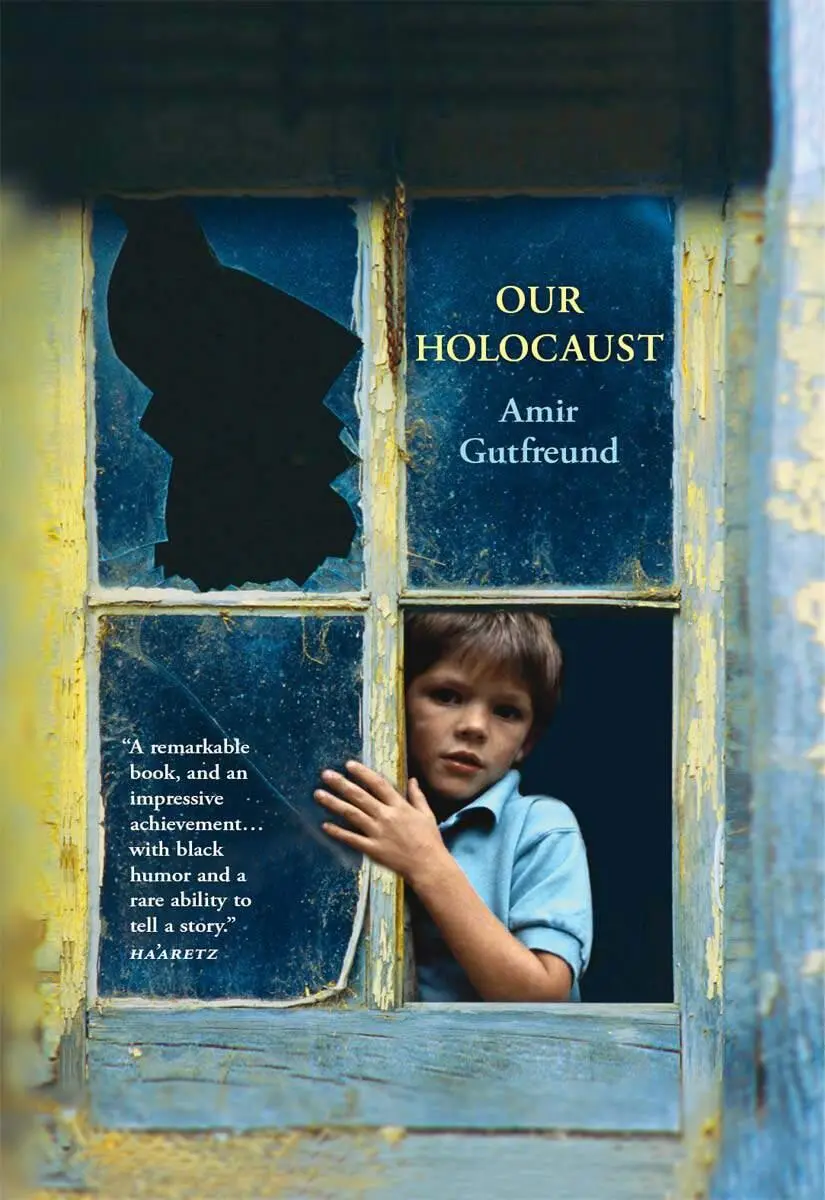
- Название:Our Holocaust
- Автор:
- Издательство:Toby Press Ltd
- Жанр:
- Год:2006
- ISBN:нет данных
- Рейтинг книги:4 / 5. Голосов: 1
-
Избранное:Добавить в избранное
- Отзывы:
-
Ваша оценка:
Our Holocaust: краткое содержание, описание и аннотация
Предлагаем к чтению аннотацию, описание, краткое содержание или предисловие (зависит от того, что написал сам автор книги «Our Holocaust»). Если вы не нашли необходимую информацию о книге — напишите в комментариях, мы постараемся отыскать её.
Our Holocaust — читать онлайн бесплатно полную книгу (весь текст) целиком
Ниже представлен текст книги, разбитый по страницам. Система сохранения места последней прочитанной страницы, позволяет с удобством читать онлайн бесплатно книгу «Our Holocaust», без необходимости каждый раз заново искать на чём Вы остановились. Поставьте закладку, и сможете в любой момент перейти на страницу, на которой закончили чтение.
Интервал:
Закладка:
Gershon-please-take-us-on-a-tour-of-the-sewer had been a failure, when childhood was said and done. During our games of Categories we began to comprehend Gershon Klima’s strategy of promises. He employed a miraculous mechanism of rejection, one thousand and one nights, and in each promise the next rejection was ingrained. We looked for guile in the eyes of our childhood friend, but all we found was a desire to keep himself a little piece of the world, one freedom, a place that could act as a sort of balance to the empty, unfurnished house that contained only a bed made of satin, silk, brocade and velvet. This was Gershon Klima: three generations of psychiatrists had certified him as insane, hospitalized him when he asked, diluted his gentle personality with pills and taken slight advantage of his strong hands to do a few repairs here and there on the hospital pipes. We sat across from him, grown up. ‘His own brother’ deciphered, cracked. We had imagined this deciphering for many long years of toffee candies, believing that the moment of discovery would shatter planets in our face, alloy saliva and breath in our throats. But no. Gershon Klima talked, we listened, and nothing. Was this the moment of maturation? Compassion exceeding curiosity? Even before the betrayal of Levertov, which had dispossessed us, banishing innocence into exile?
We kept growing up. We changed. Sent forth versions of ourselves to live, to try things outside. Every version that succeeded we wore as an overcoat, layer upon layer. But inside, a wholesome core still enquired once in a while:
Why don’t they spend time together?
Why is Mrs. Kopel infertile? (The long years sent forth the tail-end of an answer. Dr. Mengele.)
Why is Uncle Menashe from Netanya still a bachelor?
What about Mr. Bergman?
Versions of us asked questions. We did not abandon the Shoah but we bundled it up into one single day like everyone else did. Holocaust Remembrance Day. Like a pile of leaves neatly raked. We stood for the moments of silence. Watched the national ceremony. Communed. But daily life overcame us. The passing years. Only one connection remained to the lands of Shoah, one single flimsy ladder in the form of Attorney Perl. In his store there were debates over the culpability of the German nation, of the Nazis, of the SS. Everything I quickly convicted, Attorney Perl delayed, sentencing to caution and investigation. He walked his conclusions in a cold row of facts, enslaved by data and evidence.
“Every factor must be considered independently, and every pair of factors together, in terms of their influence on one another, and every group of factors, and so forth, in a neat order, with a settling of the conclusions at every stage, integrating them with what has already been concluded and what we aspire to.
“Let us read as testimony the words of Hans Karl Moeser, given during his trial in August in the year nineteen-hundred and forty-seven. Listen: ‘The same way, with the same pleasure as you shoot deer, I shoot a human being. When I came to the SS and had to shoot the first three people, my food didn’t taste good for three days, but today it is a pleasure. It is a joy for me.’”
Attorney Perl constructs ineradicable sentences within me. The bottom of my soul is paved with words. “With the same pleasure as you shoot deer, I shoot a human being.”
And always, always, it ended with the recitation of lists.
— Erich von dem Bach-Zelewski, Obergruppenführer. A general in the Einsatzgruppen. Sentenced to only ten years in prison, released after five years. In 1961 he was sentenced again to a period of four more years.
— Erich Fuchs. A mechanical expert who installed gas chambers in the Eastern death camps. Arrested only in 1963. Sentenced to four years in prison and revocation of citizenship.
— Dr. Karl Blaurock, chemist. An expert on asphyxiating gases, a consultant for the gas chamber program. Not found to this day.
— Hermann Michel. SS member, nicknamed “the Preacher of Sobibor.” Not found to this day.
— Adolf (Karl) Müller. One of the more brutal of the Sobibor staff members, whose name came up repeatedly in survivor testimonies. Not found to this day.
“What do you mean, ‘not found to this day’?” I asked. How do people disappear in such a precise nation? It was unacceptable. Unpaid sins. Names and more names. The list was merciless. Its length, its breadth. One after the other in an orderly march. The hatred was fanned. The helplessness. How could so many have got away? Who forgave them? Who let them live, and bear children?
The hours I spent with Attorney Perl passed through underground burrows. These were hours unaware of the questions that arose: Does the world change? Does it not change? Outside the store, in the silence that prevailed when my footsteps returned to the world, the underground hours reunited with real time. Maturation. Grown up life. Continuity. Within the store there was still the reign of logic and precision, the Holocaust up for study. Inside his little back room we spun a world and attempted to comprehend it. I suggested it might have been a different world back then, with different rules, incomprehensible to us.
Attorney Perl dismissed my claims. “People were as they are today. Everything worked according to the regular rules, it was not a different world. It was our world, familiar and examined. My Laura came to Belzec on a train whose travel time was precisely the distance of the route divided by its average speed of travel. The gas in the chambers behaved according to the laws of gas formulated by the chemist Avogadro. The engine output determined the speed at which the gas diff used through the given volume of the chambers. And from there, physiology. The duration of time until death was determined by certain parameters: the ratio of gas to air, lung supply, the rate of metabolism in the body. Even Laura’s final seconds, inside, can be described. Everything she went through during her final breaths. Doctors and experts have helped me to understand. And I talked with a survivor from the Sonderkommando who was somehow saved from death. His job was to clean the excrement and blood from the gas chambers. He described, at my request, everything he saw inside the chambers themselves. So you see, I know everything. I can go on with her until the last moment. And my Laura was so concerned with cleanliness and aesthetics. Even in the ghetto, despite the difficulties, she was so good about maintaining hygiene. Never let the crowdedness and the hunger sabotage her upbringing. And to die like that. Damn them…”
He breathed heavily.
“Damn them…”
A vein throbbed in his forehead.
“Damn them. Damn them.”
Outside his store, time passed by. The hours piled up, massed at the door like uncleared snow. When I went out the spell was lifted, the crawling time in Attorney Perl’s store disappeared in the flow of reality. A bus home. Falafel on HaChalutz Street. Car horns and stoplights. Only inside me the accumulating hours still lingered, constructing the only thing they were meant to construct: hatred for everything that went unpunished and still lives in our world, gazing fondly at its grandchildren. All the “not found to this day” who water their little suburban gardens, pay their taxes, wait for the weekend when their oldest son will come to visit with little Hans.
But the burrowing hours at Attorney Perl’s did not dam time completely. I met Anat in 1986. I got married in 1987. Alongside my life, Effi grew up. She had loves. She studied. In the army, they sent her to take photographs too. After the army she chose medical school, seemingly for all the right reasons: they told her it was hard to get in but then it was easy, you just needed a good memory. She wouldn’t have to stop taking photographs. But inside her, a hidden well of natural healing talent was crawling, waiting to spring. After seven years of school, she forgot about the camera.
Читать дальшеИнтервал:
Закладка:
Похожие книги на «Our Holocaust»
Представляем Вашему вниманию похожие книги на «Our Holocaust» списком для выбора. Мы отобрали схожую по названию и смыслу литературу в надежде предоставить читателям больше вариантов отыскать новые, интересные, ещё непрочитанные произведения.










Обсуждение, отзывы о книге «Our Holocaust» и просто собственные мнения читателей. Оставьте ваши комментарии, напишите, что Вы думаете о произведении, его смысле или главных героях. Укажите что конкретно понравилось, а что нет, и почему Вы так считаете.