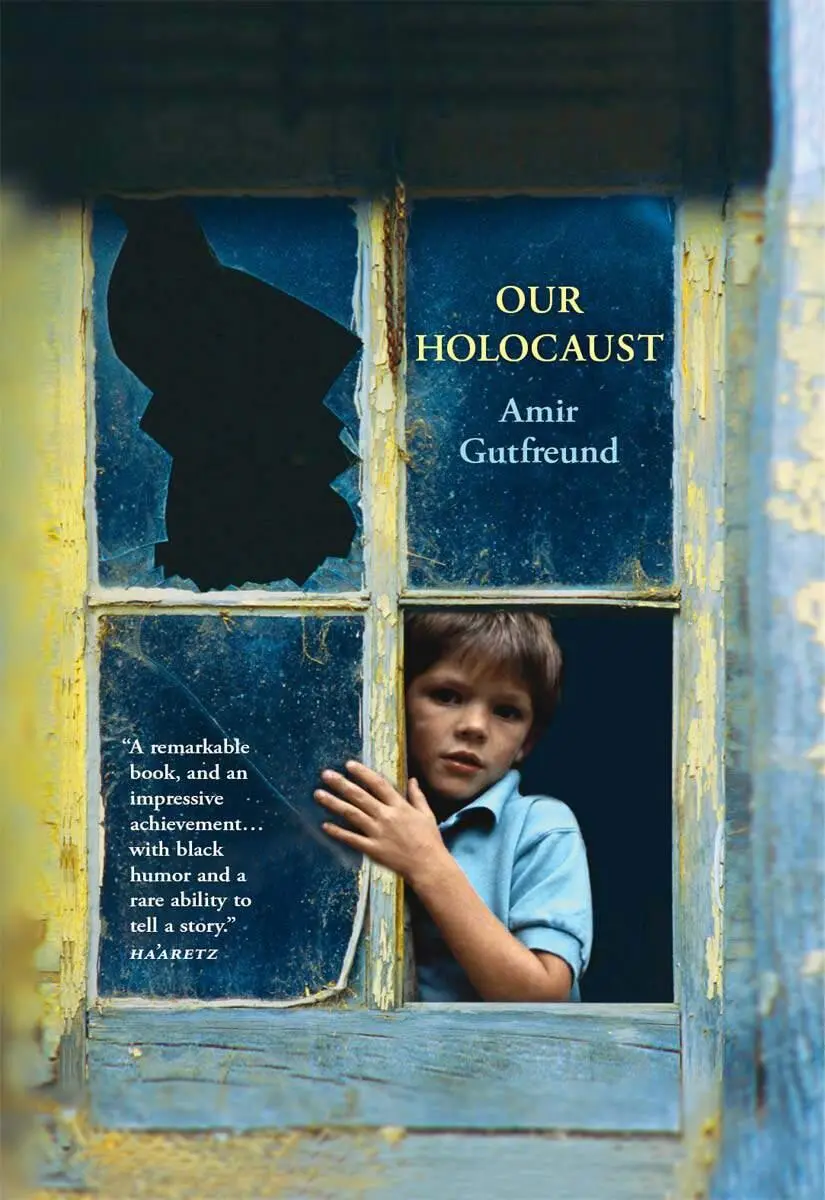
Amir Gutfreund - Our Holocaust
Здесь есть возможность читать онлайн «Amir Gutfreund - Our Holocaust» весь текст электронной книги совершенно бесплатно (целиком полную версию без сокращений). В некоторых случаях можно слушать аудио, скачать через торрент в формате fb2 и присутствует краткое содержание. Год выпуска: 2006, Издательство: Toby Press Ltd, Жанр: Современная проза, Прочая документальная литература, на английском языке. Описание произведения, (предисловие) а так же отзывы посетителей доступны на портале библиотеки ЛибКат.
- Название:Our Holocaust
- Автор:
- Издательство:Toby Press Ltd
- Жанр:
- Год:2006
- ISBN:нет данных
- Рейтинг книги:4 / 5. Голосов: 1
-
Избранное:Добавить в избранное
- Отзывы:
-
Ваша оценка:
Our Holocaust: краткое содержание, описание и аннотация
Предлагаем к чтению аннотацию, описание, краткое содержание или предисловие (зависит от того, что написал сам автор книги «Our Holocaust»). Если вы не нашли необходимую информацию о книге — напишите в комментариях, мы постараемся отыскать её.
Our Holocaust — читать онлайн бесплатно полную книгу (весь текст) целиком
Ниже представлен текст книги, разбитый по страницам. Система сохранения места последней прочитанной страницы, позволяет с удобством читать онлайн бесплатно книгу «Our Holocaust», без необходимости каждый раз заново искать на чём Вы остановились. Поставьте закладку, и сможете в любой момент перейти на страницу, на которой закончили чтение.
Интервал:
Закладка:
1989. She earned her M.D. An impressive ceremony. She stood in the heart of a proud family while one man, a hero of Monte Cassino, clicked the button on a black Leica as if finally shutting a stubborn lid. Then two years at Ichilov Hospital in Tel Aviv. A shabby job, her hands longing for patients but touching only sterile bottles. Later, a partial transition to Carmel Hospital in Haifa. In the meantime, a position at the General Sick Fund in one of the Haifa suburbs, until a full-time position opened up at Carmel Hospital. But the temporary job won her over. Like a scientific researcher who does not find his place in human society, but in the heart of Africa, with a tribe he discovers (and perhaps names after himself — a simple matter of finessing the reports), he suddenly finds tranquility and love. The simplicity of the people wins him over, their love is the emotion he never found at home.
The Sick Fund patients loved her, and affection breeds affection. Sometimes I went to visit, surprised to see Effi’s tribe at the entrance to her room, huddled in their troubles, talking about the doctor inside with a few complaints and a lot of love. They came bundled up in heavy clothing or flaccid robes, to gain her listening ear for their suffering, to present documents and test results. Among them were the shamefaced, the secretive. Apologizing for their illnesses, they kept their suffering folded up in little plastic bags. Their eyes were watery, frozen on a particular point on the floor (no doubt a puddle of memory had gathered there). Others were more demanding, masters of their illnesses. Standing in line, they regaled their fellow patients with the wondrous thicket of their aches and pains, and when their turn came they could barely bring themselves to leave the crowd — they had not yet given their opinion on the latest blood test. Determined, on the arc of a storm, they would sit down with Effi, charged with strength and courage, their illness practically escaping. Their debates were lengthy, involving pills, prescriptions, tests, forms — a hybrid treasure clutched in the palm of their hand, which they waved victoriously at the waiting congregation as they left.
The patients came to her one after the other, with more than simple illnesses to be treated. They did not always remember the true nature of their needs. Sometimes, like a watch forgotten at home, they left their complaints behind and came only with memories. They brought a mixture of backaches and service in the Russian military and new desires and the constraints of reality. Effi sat the mixtures down in a chair and talked to their memories. She had the depth to sense, to treat what needed to be treated. They acquiesced to her genuine compassion, to her concern for their welfare. Her fingers touched them and the touch said, “this body is important, someone cares that health should prevail here, too.” She asked questions, remembered minute grievances, the fingerprint of each of her patients.
There was one disadvantage to the relationship between Effi and her patients: Effi was the first to get any round of flu. She could easily have served as a public alarm system, like canaries in a coalmine. She always fell to bed and turned red, then pale, her breathing labored. Then her patients would come up against a note that said, “Out sick,” and would be referred to someone else, Dr. Reut or Dr. Mitelbien or Dr. Sachs, who were never sick. Whenever a flu outbreak began, the patients ran quickly to storm the clinic, hoping to beat Effi to it. But no. Already sick. Dr. Sachs instead. Her absences were no great crises. Most of her patients had flexible illnesses that happily accommodated delays. Only a small minority, a demanding handful, packed up their grudges in little boxes and came as soon as Effi was well to demand compensation. More pills, perhaps. Another test. Maybe the medication they were taken off that the doctor wouldn’t give them, now she had to! Effi did not give in. The hagglers left her office, roaring their complaints and sometimes cursing Effi. Horrible words were uttered. Neither hisses nor utterances of “you should be ashamed of yourself” from the crowd could calm them. And Effi forgave, always. The curses were never mentioned at the next meeting. How did she forgive?
The old people from Grandpa Yosef’s neighborhood could not come to see Effi. Sadly, the neighborhood had its own separate branch of the clinic. Only just over a mile away as the crow flies, but the distance of infinite Sick Fund bureaucracy. So they had to make do with naches , proud of Effi, whom they had known as a child, now with the most precious of gemstones in her hands: a prescription pad. Only one person in the neighborhood, Levertov of all people, somehow slipped through the fences of bureaucracy and got himself registered as a patient of Effi’s. He came and sat down in her office. The world does not change . Effi prescribed Formacil, knowing he needed it. Levertov said “thank you” and sometimes wanted to tell her about Treblinka. He wished her well. “May you marry soon.” He thanked her again and left.
I got married. Effi did not. From the beginning she took the path of multiple lovers, trying out men of all kinds. Almost every time we met she talked of someone new, predicting eternity for the new love, but completely aware that there was no eternity and that there was still a long list of men ahead. She was like a competitive eating candidate, preparing to eat a hundred and four crabs, two more than the current record (set by a Korean student). The rules were clear: every crab must weigh at least one pound after cooking. One ten-minute rest every hour, on the hour. Three hours at most. Water is allowed, with lemon. No alcohol. Someone set the rules and Effi obeyed. A long, observant attempt, whose chapters were conveyed to me in dry, embarrassed reports.
To transfer our relationship from childhood to adulthood, we sawed the connection between us in half so it could squeeze through. We assumed we could put it back together again on the other side. And indeed, here and there the halves came together. We remained wondrous, suspicious. The halves were in our hands, everything was intact, but the relationship did not connect. Something had gone wrong.
Time passed. Thunder slammed against the ground. The sounds of a drumbeat. My Yariv was born, fanning flames of naches in the family. An echo came from Netanya: Aunt Frieda’s Rina gave birth to her first son. Then Miri, then Ronnie. Roots erupted into the air. Grandchildren, great-grandchildren. You could take pictures, put them in your wallet, pull them out when necessary and proudly present roots. Fertility came easily. Not sadly, not sorrowfully. Children and more children. How many more would you like?
The family was stirred up with births and deaths. We could no longer take the stagnation. Something was about to change. We had to choose a moment of flux, a worldwide event that would give us momentum and cancel out the years-without-occurrences.
We chose the Gulf War.
In August 1990 the Iraqi army invaded Kuwait, shocking the world and surprising both experts and laymen. The cracks continued to emerge until 1991, alliances formed, tempers raged. In January the war broke out, but by then we were completely different than we had been in August 1990.

We were the first to understand Iraq’s intentions, to absorb their significance through the short moments of history.
In a game of Categories, the letter “K” was declared. Panic! We knew there were not enough countries beginning with K to go around! Years after we had disallowed Kurdistan because Iraq had stubbornly prevented the independence of the Kurdish region, forcing us to rely on the same old Kenya, Korea and Kuwait over and over again, often resulting in a draw, suddenly “Kuwait” was gone too. The plot of the dictator from Baghdad, a malicious step impenetrable by all strategic experts, was revealed as clear as crystal on our Categories score sheets. Alongside his plot, the events also exposed an ancient scheme of Grandpa Yosef’s. As if he had been waiting for the Iraqi tyrant to make his move so that he could comfortably complete a maneuver of his own, he stunned us by writing down “Kiribati” on Feiga’s sheet. It was a tiny republic in the Pacific Ocean. Disputes arose, the old Brawer atlas was summoned, and evidence presented itself on page sixty-five. How had it gotten away all these years? Grandpa Yosef hurried to Feiga’s room to report to the island princess how polished her game was this evening, how sweet her victory.
Читать дальшеИнтервал:
Закладка:
Похожие книги на «Our Holocaust»
Представляем Вашему вниманию похожие книги на «Our Holocaust» списком для выбора. Мы отобрали схожую по названию и смыслу литературу в надежде предоставить читателям больше вариантов отыскать новые, интересные, ещё непрочитанные произведения.







Обсуждение, отзывы о книге «Our Holocaust» и просто собственные мнения читателей. Оставьте ваши комментарии, напишите, что Вы думаете о произведении, его смысле или главных героях. Укажите что конкретно понравилось, а что нет, и почему Вы так считаете.