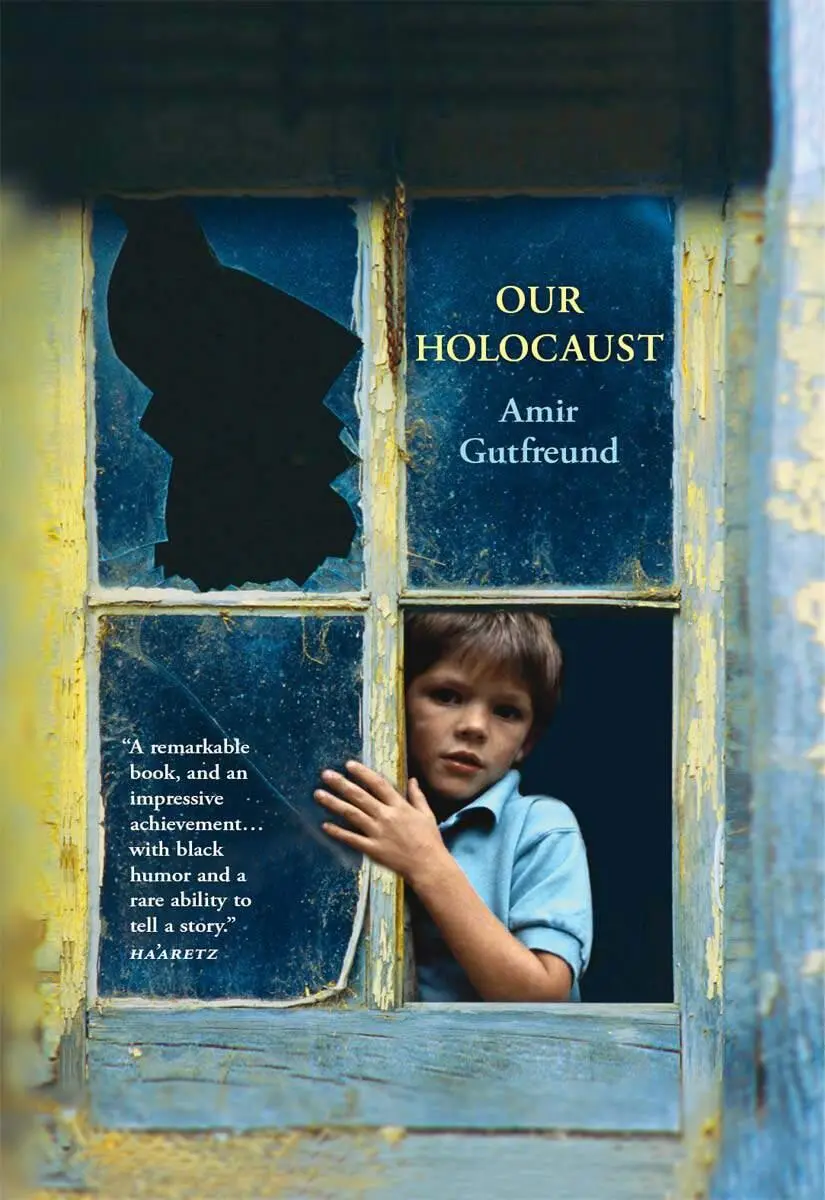
Amir Gutfreund - Our Holocaust
Здесь есть возможность читать онлайн «Amir Gutfreund - Our Holocaust» весь текст электронной книги совершенно бесплатно (целиком полную версию без сокращений). В некоторых случаях можно слушать аудио, скачать через торрент в формате fb2 и присутствует краткое содержание. Год выпуска: 2006, Издательство: Toby Press Ltd, Жанр: Современная проза, Прочая документальная литература, на английском языке. Описание произведения, (предисловие) а так же отзывы посетителей доступны на портале библиотеки ЛибКат.
- Название:Our Holocaust
- Автор:
- Издательство:Toby Press Ltd
- Жанр:
- Год:2006
- ISBN:нет данных
- Рейтинг книги:4 / 5. Голосов: 1
-
Избранное:Добавить в избранное
- Отзывы:
-
Ваша оценка:
Our Holocaust: краткое содержание, описание и аннотация
Предлагаем к чтению аннотацию, описание, краткое содержание или предисловие (зависит от того, что написал сам автор книги «Our Holocaust»). Если вы не нашли необходимую информацию о книге — напишите в комментариях, мы постараемся отыскать её.
Our Holocaust — читать онлайн бесплатно полную книгу (весь текст) целиком
Ниже представлен текст книги, разбитый по страницам. Система сохранения места последней прочитанной страницы, позволяет с удобством читать онлайн бесплатно книгу «Our Holocaust», без необходимости каждый раз заново искать на чём Вы остановились. Поставьте закладку, и сможете в любой момент перейти на страницу, на которой закончили чтение.
Интервал:
Закладка:
“The clerks asked if I had any further desires. Amazingly, I expressed my urgent desire — begging your pardon — for a place to relieve myself. My bladder could take no more. And thus began my time in the Lodz ghetto.
“The first days were terrible. All the ghetto streets were so clean as to be practically spotless. Countless people made it their business to clean them, countless others supervised their work. With untiring efforts, they scrubbed the streets to stop the spread of disease as much as was possible. But on top of this bed of cleanliness teemed terror and fear. Everything was crowded and morbid. People were hungry. The money on my person was of practically no use. I was afraid to take out a coin. I was among Jewish brethren, but there was hunger in their eyes, and thieving looks. And my own fear was dwarfed by everyone else’s fear of me. The rumor had already spread: the high priest of agents had come to the ghetto.
“At first I walked alone. Without a friend, without a living soul. Around me the streets bustled with the furor of life, thousands of people going about their business. Troubles and pleas and lobbying and attempts to deceive bitter fate. There was no going outside the ghetto. Closed off. But inside people flowed, together or alone, including a few strange creatures like myself. Who could imagine the travels that had led a driven leaf like myself from our little Bochnia to 32 Dolna Street in the Lodz ghetto? One way or another, all these scattered leaves seemed to gather together in their wanderings, and I quickly found myself some company. Not wise men. Good people, also lonely. We wandered the streets like ragamuffins, and it was good. We spoke of our loved ones, our homes. Each man extolled the place he had come from, his family, his loves. There were lies, and foolishness, and it was all in good spirits, to warm the heart. I alone did not have to lie: I described Feiga just as she was, unembellished.
“I found consolation in this gang. By all appearances, they were lonesome unworthies. But the closer our ties grew, the more confessions we made, and each man shone through with the miracles of his life. You would look at one of us, a lifeless man dressed in rags, the dregs of the dregs, and an unparalleled story of life would emerge, a unique, wonderful soul that could not be imagined.
“We walked and we talked. All like me, driven leaves. Brought from distant places, each with his own story, longing to tell it thoroughly, to amaze, to share, to sigh a little together. It seemed, at times, that life was not yet that bad. We were hungry, but a sweet sorrow lingered in the air. The two trees on Balut Street, where our ‘parliament’ met, were like an orchard to us. We did not imagine that on September fifth, 1942, the terrible Lodz ghetto Aktion would begin — the one infamously known as Sperre . Afterwards, the ghetto was untouched until 1944, the last of the ghettos allowed to live out its life. Outside the ghetto, Jews everywhere were taken to concentration and extermination camps, murdered and tortured, while the Lodz ghetto was left in peace. But the ghetto paid a price for this respite in the form of the Sperre .
“I have already said that I was naïve. I did not imagine that even as I was wandering around among the unknowns, I was not anonymous at all. Many in the ghetto took an interest in me, for various reasons. People often turned up in the ghetto like I had, sent by the Germans as agents. And just as suddenly, they disappeared. No one could keep track of all the movements and transports. But I had come straight from a general’s car to the police headquarters, and such a thing had never been witnessed before. People privately commented that this was no way to plant an agent — so publicly, wearing a pink shirt like some sort of peacock. And rumor soon spread that I had no shortage of money. There were many thieves in the ghetto, as well as real murderers. But apparently they were afraid of me. I am ashamed to say that I had gained a reputation as a high-ranking secret agent of the Germans who should not be messed with. All my efforts to refute the rumors were to no avail, and within a few days I began to comprehend that in fact I might be better off protected by them.
“I would walk through the masses, sad and hungry. All sorts of people attached themselves to me, mostly intrigued by my alleged role as chief agent, and undoubtedly also drawn by the rumors of my money. Fearful characters stole up to me, pressed my arm and offered me a piece of wax, or cabbage, or a lock. They tried to complete the transactions quickly, retreating in haste when I hesitated. In the morning I would hear that a supply of boots had been stolen from the warehouse, and in the evening a Jew would come up to offer me a pair for cheap. Others behaved like royalty. Malchus . Turning to me, they beckoned secretively, hinting at a proposal, expecting that we would gradually reveal our business to one another. The one would expose his money. The other would name a price for a fake authorization, for getting a letter to any address in Poland, for a special favor at the ghetto organization offices. They were surprised I did not want these services, which were offered only to the distinguished — to those who could pay gold for small favors.
“Not only merchants hassled me. Some came to me with complaints about this or that official, expecting the grievance to make its way to the powers that be. Some came with bubbling anger, regaling me with stories of wrongdoing. Demanding compensation, threatening, saying, ‘The day is not far…The day is not far.’ And some did not speak. They followed me around with hawk-eyes for a day or two. My money put them on my heels, the title of agent melted their hearts. For one or two days they did not dare approach, but did not give up. And every such attempt increased my resolution: I would cloak myself in the rumor and the thieves would stay away. Better that way. I had no idea of the danger lurking beneath the surface.
“There was in our gang a narrow-eyed Jew from Koźminek. His wife had died of typhus in the ghetto and he had lost his children to pneumonia. He hung around with us, not entirely belonging, sometimes talking of his wife, sometimes of his children, but his main concern was potatoes. His mind was completely obsessed with the topic, and he would stand among us discussing a shipment of potatoes he had seen being unloaded on Limanowa Street, which would probably go to the sycophants of the Authority. He discussed potatoes distributed in the public kitchens, which were damaged from faulty storage over winter. This was his entire preoccupation: potatoes that were, that would be, that he intended to get hold of. Potatoes. And between them, like drops of rain, a word or two about his children. Antek, three years old, had died in the hospital. His Rozka had not even seen the inside of a hospital. For two days she lay coughing at home, and suddenly one night she got a high fever. He wrapped her in a blanket and took her in the middle of the night, hoping they would treat her. They told him the hospital was overflowing with typhus and boils patients. She should have hot drinks and she would get better. He offered all his food stamps and a small treasure of hoarded potatoes as bribery. But the sacrifice did not help. She died in his arms, six-year-old Rozka. He would have given his entire stock of potatoes, but they did not want it. Why would they? Bursting with fatty foods, hiding huge storehouses from the masses, full of potatoes, only for them. And here the potatoes erupted again. The unfair allocations. The shipment rotting in a warehouse because a few clerks in the office were lazy. A certain type of potato that was a curse, causing the stomach to bloat, God save us, we had to watch out. And so on and so forth.
Читать дальшеИнтервал:
Закладка:
Похожие книги на «Our Holocaust»
Представляем Вашему вниманию похожие книги на «Our Holocaust» списком для выбора. Мы отобрали схожую по названию и смыслу литературу в надежде предоставить читателям больше вариантов отыскать новые, интересные, ещё непрочитанные произведения.







Обсуждение, отзывы о книге «Our Holocaust» и просто собственные мнения читателей. Оставьте ваши комментарии, напишите, что Вы думаете о произведении, его смысле или главных героях. Укажите что конкретно понравилось, а что нет, и почему Вы так считаете.