Amir Gutfreund - Our Holocaust
Здесь есть возможность читать онлайн «Amir Gutfreund - Our Holocaust» весь текст электронной книги совершенно бесплатно (целиком полную версию без сокращений). В некоторых случаях можно слушать аудио, скачать через торрент в формате fb2 и присутствует краткое содержание. Год выпуска: 2006, Издательство: Toby Press Ltd, Жанр: Современная проза, Прочая документальная литература, на английском языке. Описание произведения, (предисловие) а так же отзывы посетителей доступны на портале библиотеки ЛибКат.
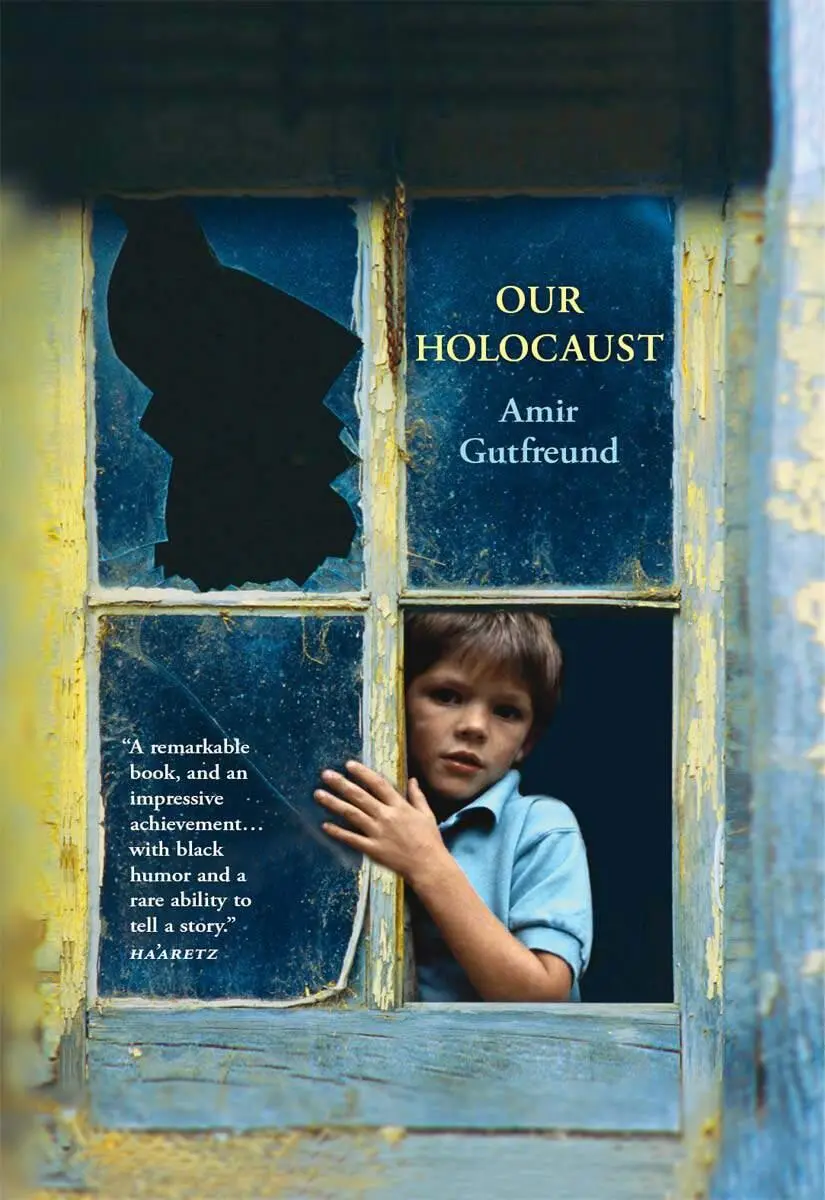
- Название:Our Holocaust
- Автор:
- Издательство:Toby Press Ltd
- Жанр:
- Год:2006
- ISBN:нет данных
- Рейтинг книги:4 / 5. Голосов: 1
-
Избранное:Добавить в избранное
- Отзывы:
-
Ваша оценка:
Our Holocaust: краткое содержание, описание и аннотация
Предлагаем к чтению аннотацию, описание, краткое содержание или предисловие (зависит от того, что написал сам автор книги «Our Holocaust»). Если вы не нашли необходимую информацию о книге — напишите в комментариях, мы постараемся отыскать её.
Our Holocaust — читать онлайн бесплатно полную книгу (весь текст) целиком
Ниже представлен текст книги, разбитый по страницам. Система сохранения места последней прочитанной страницы, позволяет с удобством читать онлайн бесплатно книгу «Our Holocaust», без необходимости каждый раз заново искать на чём Вы остановились. Поставьте закладку, и сможете в любой момент перейти на страницу, на которой закончили чтение.
Интервал:
Закладка:
“Silence.
“Suddenly a small, sharp sound. Forgetting my vigilance, I looked straight at him. Ahasuerus was cracking a nut. With the fingers of one hand, with Herculean strength, he broke the shell and removed the debris. Carefully, unrushed, he took out the fragments. The nuts cracked like skulls between his hands. I looked away from him, frightened. I remembered that he had forgotten to give me part of his dinner. He had been lost in thought when we left the last camp and forgot about me. But it was not hunger that rose in me — rather, it was fear. The smell of the nuts terrified me. Ahasuerus pressed on. Breathing slowly. Cracking nuts. Every nut got its turn.
“Thoughts rushed through my mind. Metzger the baker came back again, as if his body wanted to tell me something. Lying, shot dead, in front of the bakery where every Friday we used to feast our eyes on the window display, the soft challahs and the raisin bread. In our home, Mother baked the bread, the challahs too, but to this day I can smell the aromas from Metzger’s. Feiga used to go there to buy bread for her family and Metzger would give her a little crown of challah for good luck. I thought about Mother. The last time I had seen her she had fainted in the military lot. Who knew where she was. My heart filled with self-pity. My loneliness enveloped me. I took consolation in the distant memory of a walk I had taken with Feiga before the war. Against that backdrop I saw a scene from the last camp Ahasuerus had taken me to: a prisoner stands looking at me with wild eyes. His whole face is black. A skeleton of a man. He stands and stares as if it’s worth looking at the car despite the risks. He tilts his head for a moment, hearing a sound. Then he leaves. I, for some reason, wonder what his name is. As if there is any importance to the name of this suffering man behind the fences, who looked at me for two minutes and in a few days will be among the dead. And still I ask myself, Yanek? Hetzkel? Shmuel? Perhaps Yosef, like myself? Suffering and tortured and about to die, and his name is my name?
“Ahasuerus moved briefly beside me. He had collected his nuts and hid them somewhere. He sat erect but his weariness was now obvious. He had not shut his eyes for two days, maybe more. For his lover’s sake he overcame tiredness, hardened himself, but the car’s breakdown had collapsed everything. Now his eyes demanded sleep. Ahasuerus struggled, there was no salvation. I was tired too, but fear would not allow me to close my eyes. First the villain had to sleep, then we’d see.
“Ahasuerus gave in first. He prepared himself for sleep, wrapping his body in his officer’s coat and digging his hands in his pockets. He turned to look at me for a moment, as if remembering that this human package sitting beside him still existed. He seemed to be considering something. Suddenly he turned to me. Truly turned his head to me and spoke:
“‘I’ve always hated Jews, but not like this.’
“When he said ‘but not like this,’ his hand made a gesture in the air as if to envelop the entire world, the Aktionen and the torture and the blood of Rabbi Halberstam on the street in the ghetto. He turned his side to me, mumbled something and fell asleep.
“Those were his first words to me and, in my innocence, I thought that from then on we would talk. But I was mistaken. He never addressed me again as long as we were together, except one more time to say one sentence. But that day is still far off. Perhaps you’d like some more of the Swiss coffee? Tasty, isn’t it?”
I decline. Grandpa Yosef patters down to the end of the hallway. It’s night time here in the hospital ward. Absolute night. Ahasuerus is asleep with his hands folded beneath his black coat, and Grandpa Yosef has positioned himself as a guard. The night is dark and there are sounds of menacing creatures. Trees sway in the wind. Grandpa Yosef’s eyes will not shut. He sits and stretches, and thoughts pass through him unfettered.
Grandpa Yosef comes back from the vending machine, looking bitter. The machine is broken. Someone poked their fingers into the mechanism and stuck something in there and now nobody can get any coffee.
Grandpa Lolek sighs as something inside him stirs — perhaps the stroke, trying to heal — and his body emits a kind of whimper. Grandpa Yosef sits silently, his flow of talk ceased, wondering if there might be an awakening, a feeble word uttered. We watch Grandpa Lolek, lurking for a disturbance in his deep rest. Only the strange wink moves slowly. The eye opens to a narrow slit, then closes, as if satisfied by one open instant. His still body convinces us that there will be no more motion. Grandpa Yosef hurries on, reminded by the soft sigh that his time to tell the tale is not unlimited. If Grandpa Lolek wakes up, if he recovers, it will put an end to the time allotted for listening, for telling, for continuing his journey.
“The general slept the whole night through. His sleep was not peaceful. His head moved, sighs and whimpers erupted from his chest. I wondered if he was plagued by scenes of babies smashed, children with heads cracked open on the walls of houses. Or perhaps his Little Lover, the SS woman, who had fled him. And myself — if I closed my eyes, would I be in the arms of Feiga? Or would I too reach the walls of the ghetto, our elderly neighbors, like Bergman, shot in the back of their heads? My eyes would not shut. Forbidden. My eyelids kept drooping, but then I would see Kowalska Street, covered with people lying dead as I walk among them. And the eyes would shoot open. No sleep. By my side Ahasuerus moved his head restlessly. Two people suffering; around them, wilderness.
“Just before dawn, the birds began to chirp and a car approached. I looked at Ahasuerus. He did not wake up. He lay restfully, curled up in a dream, perhaps having found peace in the arms of his Little Lover. He had no idea that a car was about to pass us, that he would sleep away an opportunity. I asked myself if I should let the car pass and leave us there, the two of us, hungry and cold, perhaps unto death. That would be my revenge for Metzger the baker, for Yehezkel, for Rabbi Halberstam.
“The car was audible now, its sounds clear. My hand reached out and one finger impudently tapped his neck. Ahasuerus woke without even giving me a glance. He got out and stopped the car. The soldiers in the car were eager to help. They rescued us. A short soldier reached under the engine hood and did something in there that fixed the problem. In the meantime, they danced around the general, star-struck, offering him their food. They saluted him and asked if they could do anything. Confused, they saluted again. They shot glances at me but did not dare ask what the general was doing with a Jew in a pink shirt. But their looks were curious. Ahasuerus dismissed them and I thought we would set off on our voyage again, determined. The breakdown had cost us precious time. My body was slowly thawing, its heat eager to get to work, to find Feiga’s camp. But Ahasuerus was in no hurry. The moment the car was fixed, he began to plan the day ahead. From his coat pocket he gave me a hunk of bread. He had put it aside from what they had given him. Then, to my surprise, he went off to do his business.
“Even crouching behind a shrub, he still looked regal. Straight as an eagle. I allowed him some privacy, turning my face. But the odor of his bowel movement spread through the fresh air. The smell was unpleasant but I persisted in inhaling it, sensing his health — for months, begging your pardon, everything with me had been sick and watery. After a while he reemerged and walked toward me in his neat uniform. He rubbed his hands on the leaves of a bush and was spotlessly clean. He proceeded, not to his side of the vehicle, but straight to me, motioning with his head at the bush. I grew frightened. Was I to die there? But my fear was unfounded as I soon understood. There was a long way ahead of us, most likely, and I too, begging your pardon, had to relieve myself. My heart wished to lead me to a different bush, far from the one he had used. But my legs positioned me behind the very same bush. Nu . I pulled my pants down and looked aside. There were two of them, laying like babes in a cradle on the leafy grass, solid and identically sized. I hoped I would not emit the soft stream again, not the usual output, not in front of those two. But my bowels quickly erupted in a dirty, unpleasant flow. Flies had already appeared. I could barely stand up and tuck my pink shirt into my pants. Disgusted and miserable, I sat down beside him in the car. I recalled the sentence he had said to me and, for some reason in that moment my heart believed that the journey had somehow brought us closer, that perhaps we would talk. But the general’s concern was only for his car. He drove the marble angel back onto the road to his lover, to my Feiga.
Читать дальшеИнтервал:
Закладка:
Похожие книги на «Our Holocaust»
Представляем Вашему вниманию похожие книги на «Our Holocaust» списком для выбора. Мы отобрали схожую по названию и смыслу литературу в надежде предоставить читателям больше вариантов отыскать новые, интересные, ещё непрочитанные произведения.










Обсуждение, отзывы о книге «Our Holocaust» и просто собственные мнения читателей. Оставьте ваши комментарии, напишите, что Вы думаете о произведении, его смысле или главных героях. Укажите что конкретно понравилось, а что нет, и почему Вы так считаете.