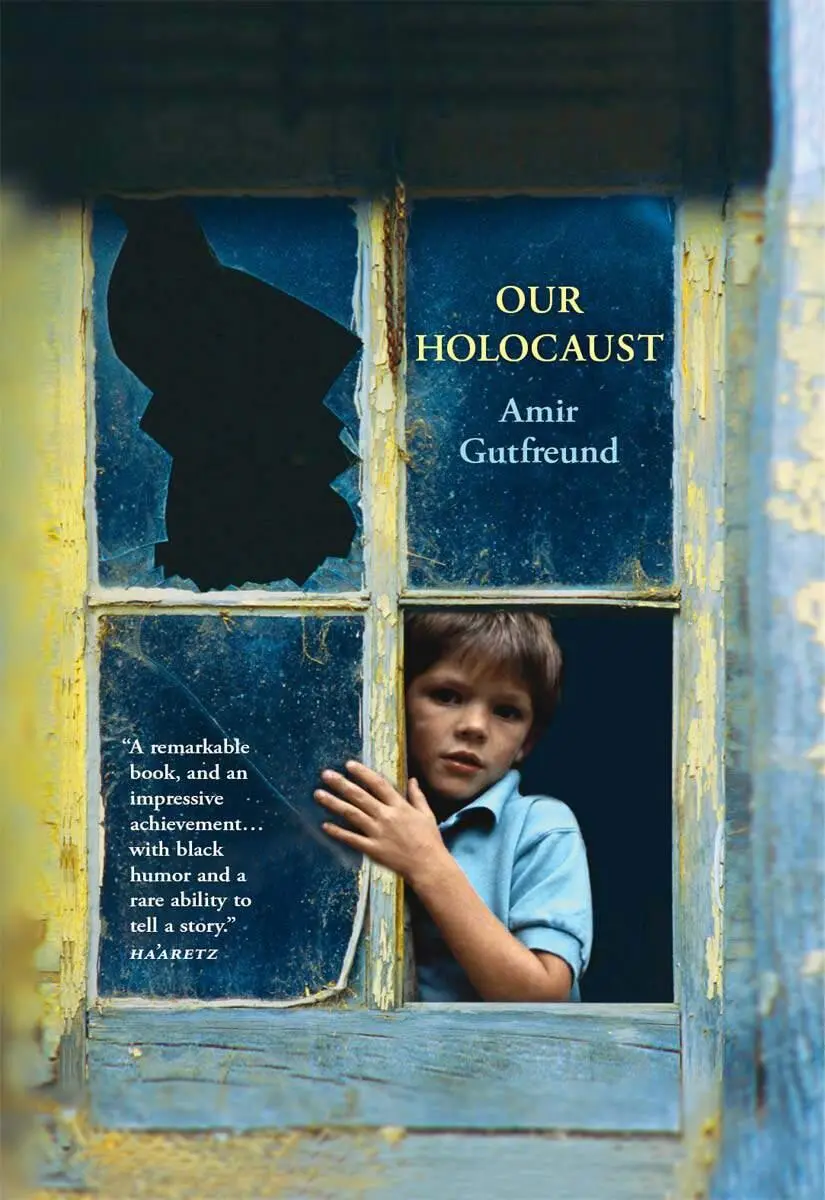
Amir Gutfreund - Our Holocaust
Здесь есть возможность читать онлайн «Amir Gutfreund - Our Holocaust» весь текст электронной книги совершенно бесплатно (целиком полную версию без сокращений). В некоторых случаях можно слушать аудио, скачать через торрент в формате fb2 и присутствует краткое содержание. Год выпуска: 2006, Издательство: Toby Press Ltd, Жанр: Современная проза, Прочая документальная литература, на английском языке. Описание произведения, (предисловие) а так же отзывы посетителей доступны на портале библиотеки ЛибКат.
- Название:Our Holocaust
- Автор:
- Издательство:Toby Press Ltd
- Жанр:
- Год:2006
- ISBN:нет данных
- Рейтинг книги:4 / 5. Голосов: 1
-
Избранное:Добавить в избранное
- Отзывы:
-
Ваша оценка:
Our Holocaust: краткое содержание, описание и аннотация
Предлагаем к чтению аннотацию, описание, краткое содержание или предисловие (зависит от того, что написал сам автор книги «Our Holocaust»). Если вы не нашли необходимую информацию о книге — напишите в комментариях, мы постараемся отыскать её.
Our Holocaust — читать онлайн бесплатно полную книгу (весь текст) целиком
Ниже представлен текст книги, разбитый по страницам. Система сохранения места последней прочитанной страницы, позволяет с удобством читать онлайн бесплатно книгу «Our Holocaust», без необходимости каждый раз заново искать на чём Вы остановились. Поставьте закладку, и сможете в любой момент перейти на страницу, на которой закончили чтение.
Интервал:
Закладка:
From the moment Grandpa Lolek began to command all horizontal attention as he lay in bed, Grandpa Yosef took the vertical attention, dashing this way and that, welcoming visitors and doctors, handling all the necessities. A great deal of motion circulated through Grandpa Lolek’s room, and in the center of it all was Grandpa Yosef. He hardly left the hospital, devoting himself completely to care-giving. His shirts were clean but a faint odor wafted up from them, and from his body too. His eyes were bloodshot, his cheeks damp with glistening perspiration. He chopped up the endless time into shifts and handed them out to anyone who asked. Uncle Lunkish turned up with two umbrellas — so what if it wasn’t raining — and got one shift, just one. Aunt Frieda came from Netanya, declaring, “ Nu , you know I never got along with Lolek, but family is family,” and demanded a shift. Uncle Menashe left the butcher shop and demanded a shift. Uncle Mendel came, inspected the mezuzah with his fingernail and sat down. Another shift.
Even at the end of the distribution, plenty of shifts were left over. Most of them were taken by us, Grandpa Lolek’s like -grandchildren. We were recruited in different permutations, usually linking up with Grandpa Yosef, the lead caregiver. The real family — Grandpa Hainek — was represented by Atalia. She demanded and received one shift every day. In the hospital Grandpa Hainek wandered restlessly. Haifa. The north of the country. It might snow. And he rushed back to his southern city of Beersheba before his Polish destiny could awaken and strike, taking Atalia away from him. Every day he brought Atalia at the beginning of her shift, drove back to Beersheba in a taxi with the windows rolled up, and showed up again when her shift was over. He was consistent in the way he gave the obligatory ten minutes which Atalia forced him to allot to his oldest brother. He sat there polished, heavy, boots sticking out, sternly scanning the place.
In light of the grueling job he had taken upon himself (twice-a-day-Beersheba-Haifa-and-back) for Atalia’s sake, and to ward off his fears, we hoped to discover something new in Grandpa Hainek. We looked at him and tried to comprehend. It was a good season for a little compassion. We thought about the beginning of the war. We tried to envision an eleven-year-old boy taken to a village he had never seen before, his father telling him this would be his new family, that he could not see his mother and father for a while. You mustn’t ever say you are a Jew . He had to memorize prayers. Here, this is your father, only him. Here, this is your mother, you cannot say she is not. Here are your brothers . An eleven-year-old boy, left alone despite his tears. The farmer takes him to the barn and silently shows him how to work. From that boy our thoughts returned to the man sitting here in heavy boots, and we tried to envelope him with understanding, with tenderness. The thoughts lasted a second or two but then fell apart with a clatter and we had to think again about the eleven-year-old boy — if we wanted to.
The obligatory ten minutes passed and Grandpa Hainek escaped to his taxi. He spent a few minutes looking for passengers to take to Beersheba, but either way he was soon headed south, before the flakes could begin to whiten Haifa and clog everything up with mud and snow.
In the world, meanwhile, it was a dry winter. No rain. Freezing at night time, sometimes warm during the days. People said, “It’s already November and no sign of winter.” They gazed at the sky with astonishment, even some pride, practically hinting at a secret partnership in this decision of nature to flood the days with what had not ended in summer — light, heat, and strange winds. A violent and sterile winter, trying with all its might, but forgetting the main point. It glanced at the deeds of the previous winter and reproduced the freezing winds, doing its best, but there was no rain. Every night leaves fluttered through the darkness. The sea opposite Grandpa Lolek’s room was full of great waves. Grandpa Yosef liked to stand at the window. At night you could hear the waves, and the wind sweeping paper from notice boards along the street.
In between visits, shifts, doctor’s examinations and nuisances, Grandpa Yosef’s journey continues. I try to time my shifts so I can continue on the voyage with him. My shifts are punctuated with essentially normal life. I come and go while the voyage waits. But gravity pulls the chapters together and the times between shifts are forgotten, dismissed from memory, leaving a continuity, an energetic and impatient journey.
Every time I come, Grandpa Yosef is in the midst of some burning matter, rushing past me, does-he-look-like-someone-who-has-time-to-sit-and-talk-about-what-happened-fifty-years-ago? Yet he is eager to talk of the voyage raging inside him, and very soon he sits me down, rids himself of all sorts of nuisances, including the ones I bother him with, and tells me offhandedly about Grandpa Lolek’s status. He looks at me sternly: What do I mean by coming here and demanding miraculous improvements in the health of someone lying in bed like a sphinx? What could be new? Then he reaches out with impatient fingers to the bag I’ve brought, pulls out the clothes Anat prepared for him, the neatly cut sandwiches with little stickers noting the content of each one and whether they should be refrigerated. He nods, mumbles, “Thank you very much,” and can’t resist biting into the first sandwich, supplementing it with some coffee from a thermos. He sips and munches.
It seems to me that we both try to time our shifts so that we are together. But in fact Grandpa Yosef does most of the shifts, sharing days and nights with Effi too. One morning, between shifts, she asks me, “How many Aktionen were there in Bochnia anyway?” Atalia, at the end of a shift, asks me something about the ghettos. And I slowly begin to comprehend that the voyage is taking place during their shifts too. Or perhaps there is a completely different voyage going on there. The same places, the same events, and yet a different voyage. Grandpa Yosef does not divulge — he divides and conquers.
I come to take over from Dad on one of my shifts and find him and Grandpa Yosef laughing. They were recalling a day in Dad’s childhood in Bochnia, when his mother sent him with his sister to the dayan-posek , the arbitrator, to check if the chicken for Shabbat was kosher even though she had found a tiny imperfection in it. Dad and his sister spoke only Polish, the dayan only Yiddish. With great effort they memorized their mother’s question, learning the words by heart: di mame hot geheysn fregn a shayle oyb dos hindl iz treyf oder kosher . But on their way to the store, the syllables scattered in disarray. The two walked on worriedly, rapidly losing their arsenal of words as they neared the dayan . By the time they arrived, only a few confused letters and one simple phrase remained, a few sounds at the end of the sentence.
Dad and Grandpa Yosef laugh as they reminisce, and I realize there is no happenstance here: Grandpa Yosef is in the same era with everyone, the era of the voyage. I am not enough for him. During Dad’s shifts the voyage slips through. It is planted in Atalia’s shifts too. In Effi’s shifts a twin voyage sneaks in. Grandpa Yosef is producing enough baby voyages to conquer the expanses of the family.

“Life went on after the Sperre . Those who had gone, were gone. Those who remained were overcome by hunger, thirst, and a will to live. It is hard to believe how quickly people went back to discussing the affairs of the day — potatoes, soup, the prospect of a cabbage shipment. Gradually the streets healed from the Sperre and, wondrously, new Jews flowed into the ghetto. As if the Germans had forgotten that they had evacuated Jews because of over-crowdedness, they continued to bring in more and more. Although I had not been taken away, I myself became a ghost after the Sperre . No one came close to me; they wouldn’t dare. But I needed friends. My town of Bochnia was far beyond the mountains and the darkness, and the Jews here did not want me. Feiga was gone. I was not going to find her. It seemed the hunger and loss had weakened me so much that I no longer had the strength to get up and continue searching for my little bird. My legs longed to take me to Feiga, to awaken my heart. But my heart, what could it do? I could not just pick up my hat and go. All I could do was tire out my legs. There was not a day when I did not roam the ghetto in circles. I needed people, needed to talk, to socialize. I wanted to pray, to share a prayer with other Jews. I wanted to join a prayer minyan , to contribute my voice. But after the Sperre all religious life was forbidden, holy studies punishable by death. Even marriage ceremonies, when permitted, were conducted by Rumkowski. He was given sort of captain’s duties. People gathered secretly to study and went on praying in underground groups. Me, they fled like the devil, exercising extreme caution.
Читать дальшеИнтервал:
Закладка:
Похожие книги на «Our Holocaust»
Представляем Вашему вниманию похожие книги на «Our Holocaust» списком для выбора. Мы отобрали схожую по названию и смыслу литературу в надежде предоставить читателям больше вариантов отыскать новые, интересные, ещё непрочитанные произведения.







Обсуждение, отзывы о книге «Our Holocaust» и просто собственные мнения читателей. Оставьте ваши комментарии, напишите, что Вы думаете о произведении, его смысле или главных героях. Укажите что конкретно понравилось, а что нет, и почему Вы так считаете.