Amir Gutfreund - Our Holocaust
Здесь есть возможность читать онлайн «Amir Gutfreund - Our Holocaust» весь текст электронной книги совершенно бесплатно (целиком полную версию без сокращений). В некоторых случаях можно слушать аудио, скачать через торрент в формате fb2 и присутствует краткое содержание. Год выпуска: 2006, Издательство: Toby Press Ltd, Жанр: Современная проза, Прочая документальная литература, на английском языке. Описание произведения, (предисловие) а так же отзывы посетителей доступны на портале библиотеки ЛибКат.
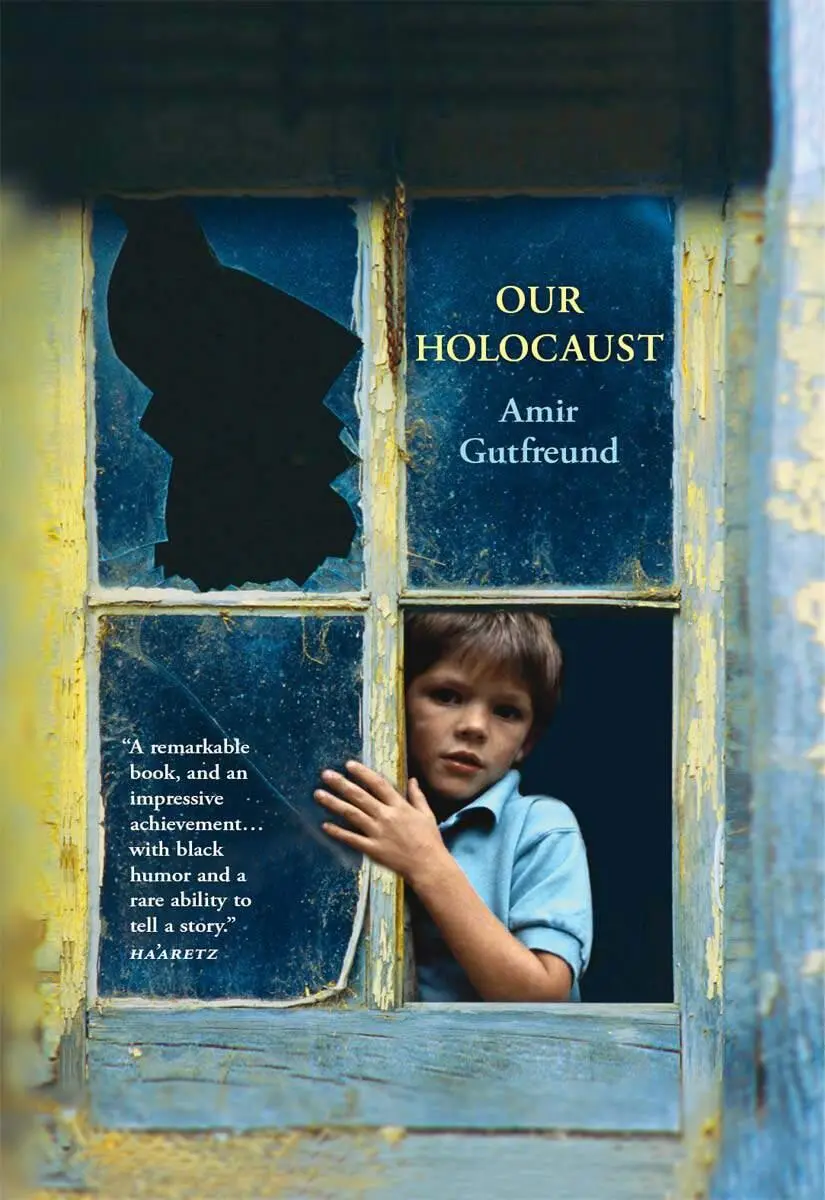
- Название:Our Holocaust
- Автор:
- Издательство:Toby Press Ltd
- Жанр:
- Год:2006
- ISBN:нет данных
- Рейтинг книги:4 / 5. Голосов: 1
-
Избранное:Добавить в избранное
- Отзывы:
-
Ваша оценка:
Our Holocaust: краткое содержание, описание и аннотация
Предлагаем к чтению аннотацию, описание, краткое содержание или предисловие (зависит от того, что написал сам автор книги «Our Holocaust»). Если вы не нашли необходимую информацию о книге — напишите в комментариях, мы постараемся отыскать её.
Our Holocaust — читать онлайн бесплатно полную книгу (весь текст) целиком
Ниже представлен текст книги, разбитый по страницам. Система сохранения места последней прочитанной страницы, позволяет с удобством читать онлайн бесплатно книгу «Our Holocaust», без необходимости каждый раз заново искать на чём Вы остановились. Поставьте закладку, и сможете в любой момент перейти на страницу, на которой закончили чтение.
Интервал:
Закладка:
“From that day forward I decided to take up my prayers again. Since being deported from Bochnia I had evaded all the duties of a Jew. I ate treif , I did not say the blessings, did not pray. But I made up my mind to pray every day for Adler’s soul, and to go back to saying the three daily prayers: shacharit, mincha and ma’ariv .”
Grandpa Yosef remembers it is time to pray now. He pauses the tale of his journey and is about to go to the end of the hallway, where he has found a corner for his prayers by the vending machine.
“What happened to Farkelstein?” I ask.
Grandpa Yosef stops in his tracks, annoyed. “What happened to Farkelstein? How would I know what happened to Farkelstein? And what happened to every single Jew I met? There were thousands and thousands there — how should I know what happened to them?”
He walks out briskly and prays. Then he uses the coins Anat sent for him (sometimes the thermos isn’t enough) for a cup of “Swiss coffee” from the machine. He comes back with a hesitant look on his face, slightly ashamed of his outburst, and says, “I don’t know about Farkelstein. There’s no way to know. But today I am Shoah-smart, you could say, and I know that people like Adler were marked men from the beginning. Who would live? Who would die? Was there any way to predict? That’s not what I’m saying. But there were those whose fate was marked on them from the beginning. The brazen would live, the pure would die. Adler, there were no two ways about it, was fated to die, as if the Angel of Death himself had seen to it.
“I did not have much time to mourn for Adler. The typhus plague did not subside, the SS themselves began to fear infection, and they started with the transports. At the beginning of March I packed up my belongings again, as they say ( nu , it’s a joke, I had no belongings at all), and I was sent with a large group to Sachsenhausen camp. Documents have shown that the men’s camp of Ravensbrück belonged to Sachsenhausen from the beginning. So once again we were transferred, probably to satisfy the cursed Nazis’ quotas and regulations. Sachsenhausen is less than twenty miles northeast of Berlin.
“In Sachsenhausen I learned a profession for the first time in my life. I softened leather boots for German soldiers. How? By walking. Instead of a German soldier getting a pair of painful new leather boots, they used our infinite supply of spare feet. Under the supervision of orthopedic specialists, we marched back and forth through the camp in new army boots, without socks, without rest. We walked and walked. When a boot was worn in and the experts decreed it suitable for the noble foot of a soldier, we were rewarded with a new boot to teach us new pain.
“Is it possible to describe such a deathly nightmare? Worse than working in the trenches of Ravensbrück. Endless. The routine was disturbed only by the occasional shot — another stumbler giving in to his body. Usually there were no shots. The stumblers did their best not to stumble. The guards did their best to kick, whip, and arouse in the prisoner, if not energy, at least the fear of death. They whipped and whipped until he would start walking again. Only seldom did they shoot. And for us, how can I put this aptly, the shots were a slight reprieve from routine. One’s mind, unwillingly, created a sort of anticipation of the shots. One side of your soul urges you to feel nothing, hear nothing, see nothing, think nothing — only march. The other side, secretly, with an inexplicable perversion, waits for the sound of the shot. Your head is stupefied and your body marches on, waiting. The shot rings out.
“We walked back and forth in straight lines. Every day we passed a wretched group of young Russian POWS, who for some reason had the letter ‘T’ imprinted on their foreheads. They were forced to march in a circle, handcuffed to one another in pairs, from morning to night. They did not march to wear in boots — only to die. They marched in an endless circle from which only one fate could remove them. Why did the Germans torture them so? Why not shoot them and be done with it? No way to know. German logic. But those poor wretches, they all met the same fate, and it was slow and hopeless. We never saw the same prisoner twice. And why only the Russians? Why did we walk in straight lines with army boots, people of many nations, Jews and non-Jews? German logic.
“Day after day I marched, and in Sachsenhausen too there were beatings, abuse, hunger, death. As we marched, at first our brains were in a daze. One could not think, could not do anything. We were forbidden to talk. Punishable by death. Later, just a little, I found myself thinking of Adler and his orphaned research. And wondrously, I found myself gaining strength from these thoughts, from the Jewish pirates on their glorious ships. I practiced my future, coming up with adventures for the pirates, inventing things from my soul, and also contemplating the halakhic problems posed by their profession. After all, this was no simple matter, the pirates and the 613 commandments! Every day I found myself embroiled in complex thoughts that reached dead-ends. It was beyond my Talmudic knowledge to solve such intricate issues. Not giving in, I scanned every aspect of a pirate’s life, identified the problems, debated them with myself until all possibilities were exhausted, and then made notes of what I would ask the rabbis once I was free. At night in bed, exhausted and hungry, I forced myself to stick with the pirates, divvying up their loot according to the laws of Gemara, muddling through the thicket of laws concerning hostages and the allowance of trade in the fruits of plunder. I was excited to realize that I was asking questions, and they were not small. These were large questions!
“My questions were large, but life, diminished life, did not arise in their wake. Adler’s theory was all well and good, but without food, without rest for one’s body, life had no chance. And Adler had not only empowered the spirit, he had also added the nightly portion of soup. Without the soup, what good were thoughts? The soul, you should know, needs a body. Wise men philosophize, they separate the spirit from the body, aspire to do away with the corporeal for the sake of the spiritual. But those who know hunger have no questions. A person needs a body.
“In the meantime, in Sachsenhausen, I sensed death approaching in my bones. The dysentery was back. There were days when I ate no more than a turnip leaf from morning to night. And my feet began to refuse to move. They swelled and cracked. I was growing weak. Day after day, Asmodeus came to claim what was his. I knew I would not last long. At night, I exchanged not a single word with my neighbors to the left or the right, and did not know who they were. Our bodies were so shattered, our souls so crushed. Every so often, a neighbor disappeared. Died, shot, replaced. A new one was thrown onto the cot and I remained indifferent, not knowing who he was, not wanting to know, even though he was my brother in this trouble and his suffering was a brother to my own suffering. But there was emptiness. The soul was empty, everything was empty. Death was so close. In the twilight of life, memories invaded, overcoming Adler’s prohibition, and my thoughts turned to the past. Even memories were too weak to go very far — the Lodz ghetto seemed as if it had happened many years ago. I could barely remember Bochnia. Only occasionally did childhood memories emerge, with the cheder, the tutor, and the stones we threw in the afternoon into the little Babica brook that flowed beneath the bridge.
“And where, you might ask, was Feiga in all of this? I did not have in me enough Yosef to contain Feiga. At the edge of the very edge, Yosef Ingberg ended. My soul made a decision: Tomorrow I will not get up from this cot. They may whip me to death, but I will not rise.
Читать дальшеИнтервал:
Закладка:
Похожие книги на «Our Holocaust»
Представляем Вашему вниманию похожие книги на «Our Holocaust» списком для выбора. Мы отобрали схожую по названию и смыслу литературу в надежде предоставить читателям больше вариантов отыскать новые, интересные, ещё непрочитанные произведения.









Обсуждение, отзывы о книге «Our Holocaust» и просто собственные мнения читателей. Оставьте ваши комментарии, напишите, что Вы думаете о произведении, его смысле или главных героях. Укажите что конкретно понравилось, а что нет, и почему Вы так считаете.