Amir Gutfreund - Our Holocaust
Здесь есть возможность читать онлайн «Amir Gutfreund - Our Holocaust» весь текст электронной книги совершенно бесплатно (целиком полную версию без сокращений). В некоторых случаях можно слушать аудио, скачать через торрент в формате fb2 и присутствует краткое содержание. Год выпуска: 2006, Издательство: Toby Press Ltd, Жанр: Современная проза, Прочая документальная литература, на английском языке. Описание произведения, (предисловие) а так же отзывы посетителей доступны на портале библиотеки ЛибКат.
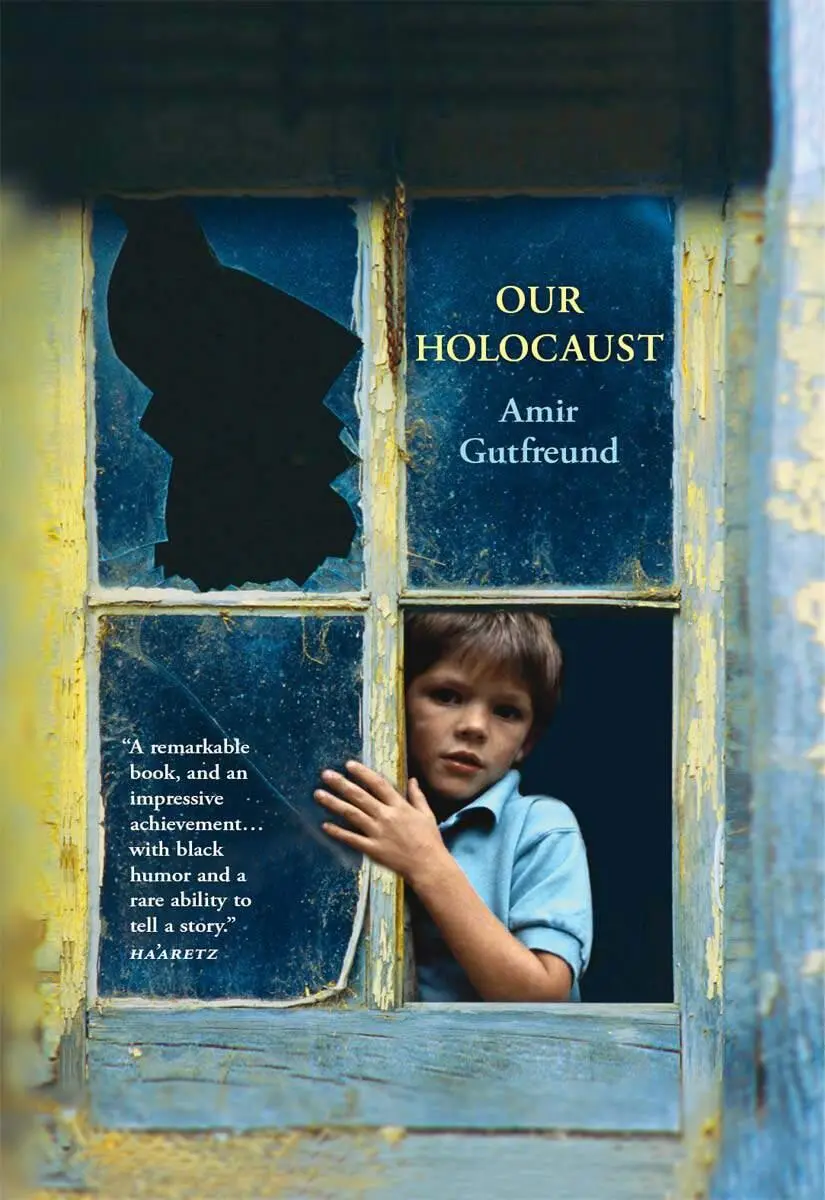
- Название:Our Holocaust
- Автор:
- Издательство:Toby Press Ltd
- Жанр:
- Год:2006
- ISBN:нет данных
- Рейтинг книги:4 / 5. Голосов: 1
-
Избранное:Добавить в избранное
- Отзывы:
-
Ваша оценка:
Our Holocaust: краткое содержание, описание и аннотация
Предлагаем к чтению аннотацию, описание, краткое содержание или предисловие (зависит от того, что написал сам автор книги «Our Holocaust»). Если вы не нашли необходимую информацию о книге — напишите в комментариях, мы постараемся отыскать её.
Our Holocaust — читать онлайн бесплатно полную книгу (весь текст) целиком
Ниже представлен текст книги, разбитый по страницам. Система сохранения места последней прочитанной страницы, позволяет с удобством читать онлайн бесплатно книгу «Our Holocaust», без необходимости каждый раз заново искать на чём Вы остановились. Поставьте закладку, и сможете в любой момент перейти на страницу, на которой закончили чтение.
Интервал:
Закладка:
Grandpa Yosef regulates his breath a little.
“In Buchenwald, finally, I had a little rest from my travels. I spent a whole year there, from November ’43 to November ’44. First we were sent to work in the quarry. Every morning we marched in rows, pounded rocks for sixteen hours, then marched back to the camp, where we had roll-calls and more marches. I no longer had any strength anyway, I was no more than a skeleton, and if not for Rothschild… nu . He soon joined up with the Russian POWS and the criminals, hardened people who would murder over nothing. Thanks to them he found easy work for both of us in a nearby town. Every day we were actually taken out of the camp into a German town where citizens lived their lives. Children peered at us through windows, and on the streets we passed women with baskets and gentlemen going off to work. A town, simply a town. We repaired the water reservoirs. Hard work, but only as hard as any manual laborer’s work.
“Rothschild cast his net here too, doing business, various corrupt transactions. Such a devil. He started to place his confidence in me, asked me questions, sought advice. He told me of his plans and deeds and secrets. His heart was completely unhesitant. He would do anything. He struck terror and fear in me — he could betray me at any moment, sell me for a potato.
“Only one thing did Rothschild ask of me, as ever. ‘Pray for me, Rabbi.’ His face would strain as he forced a smile, but he was entirely serious, and he took the trouble to make sure the prayer was being said.
“He grew tired of working at the water reservoirs very quickly. His business was not booming and the danger was too great, so he found himself a job in the kitchen. There, for those who dared, business was good. Rothschild traded, bribed, cheated, orchestrated transactions. In January there was snow and the ground was frozen, so they did not need us in the town. Rothschild tried to sneak me into kitchen duty, but was unable. Having no choice, we found ourselves the job of pushing the wagons that carried the dead. Throughout the camps, this job was done by the Ukrainian POWS, a hardened and frightening group. How Rothschild penetrated this evil band… nu , Rothschild. He was pleased with his accomplishment and could not understand the way my face fell when he told me. ‘The work is easy, no? We’ll survive. Gain some weight.’
“And so we took the dead out of the huts every morning. People I knew, the dying who had completed their process. One day I would look into the eyes of a dead man, nu , and the next day I piled his corpse onto the wagon. Worst of all was the inspection we had to do. Sometimes the man was not dead, but did not get up; he lay still, awaiting his fate — the hand that would put him to death. I was the wagon man. And then I had to deal with the corpses. I don’t want to talk about that.
“The months in Buchenwald went by. I survived. Rothschild was with me. I prayed, he took care of the rest. Thoughts of Feiga returned. Thoughts of Adler. I worked with the dead wagon and imagined the future in all its details. We did not gain any weight, none at all. A great hunger fell on Buchenwald. Rations were cut. The black water known as ‘soup’ was taken from us, the gray mess known as ‘bread’ all but disappeared. The hunger brought death to the huts and we were always busy. Those who did not die sometimes lit up with a fever like torches and became crazed. They drank mud and ate their own clothing. God help us, we even found gnawed bodies on the cots. Yes, gnawed bodies. And the eyes, everyone’s eyes, even those whose minds were still sound, were crazed and glimmering, their hearts wanted only a chance to nibble at some food, their souls ignited — when would the chance come? When would it come?
“One evening there was a commotion. We were crowded into the Appellplatz for a special roll-call. The officers surrounded us, there was shouting, dogs barking, something bad had happened. For a long time all we heard were paralyzing shouts. We were counted, then counted again, and the roll-call went on into the night and it was not clear what had happened, but we knew in our hearts that it would not end well. We slowly began to understand that we were being accused of stealing twenty candied apples. Twenty candied apples! They had been prepared in the kitchen for the birthday celebration of one of the senior SS men, and lo and behold, the apples were gone.
“We were left to freeze in the snow, tormented, and the SS did nothing, only walked among us shouting and threatening. It became evident that they would not be satisfied with killing someone. They needed the apples. They were frightened themselves — what would they do without the apples? They waited for someone to open his mouth and confess, or to turn in someone else. And we stood there, stupefied from cold and fear. But there was joy hiding in our hearts. Twenty candied apples! If it had been one apple, or one rotting potato, we would have been jealous, our empty stomachs would have demanded the kartoshka . We would have suspected one another, even hoped that a few would be shot, including the one who had stolen the apple, because then maybe later we would find the apple in his cot. But twenty candied apples! We had to whisper explanations to the villagers among us, stressing that this was not just an apple with sugar, but an apple dipped in boiling syrup bubbling in a cauldron, and the syrup is sweet like honey and it coats the apple and hardens like red glass. First the excess syrup drips down the apple, then the drops freeze as if ordered to stop and decorate the head of the apple like snow on a hilltop. Twenty such apples!
“Late at night the SS men gave up. This truly was a mystery, the thief was never discovered, even the informants couldn’t say. The roll-call commander ordered his officers to take out every fifth man and shoot him. A rustle of terror stirred among us. Our bodies began to awaken from the cold, the nausea of fear crept inside us. An SS officer walked among the rows, pushing aside certain men with his whip, instructing them to join the condemned. He walked in front of me and his whip touched me. Yes, the whip touched me. And the sergeant marching behind him motioned at me with his head to leave the row. But to my right Rothschild jumped out. The sergeant glanced at this exchange for an instant. He didn’t care, as long as the number added up nicely. I froze in my place without moving, and Rothschild was already standing at the edge of the condemned group. From the end of the line he gestured at me with his hands, mimicking a prayer stance, to remind me that I should continue to pray for him.
“They walked them to a clearing in the woods where the SS liked to execute people. As he passed me, with a real grin on his murderous face, Rothschild dared to call out loud to me, ‘I am Leibel Rothschild. If you have a son, call him Leibel!’
“And the group was swallowed up in the darkness. I remained among the living, owing my life to another man. How did my legs plant me down at that moment of the switch? How did I allow it to happen? Why did I allow… nu …
“They shot Rothschild. Gone. That’s all I can tell you. I don’t remember much of the days that followed. A long period, months, and the memories are gone. I probably continued to work with the dead wagons, since I was not dead myself. I was not taken to work at the quarry. And what else did I do? I believe I was entirely submerged in the future. I imagined it beautifully, and my aim was not bad. The present was not all that agreeable to me, so I turned my thoughts to the future, where things were good. I made aliya with Feiga to Palestine, to build a new life. And even if I never imagined my home in Kiryat Haim, and Ben Gurion, still, I did picture Palestine. Feiga and I were most certainly alive. We sat on the beach at Jaff a, gobbling down oranges in the sunshine, our feet reaching out to touch the convoys of camels, the local Arabs admiring our culture, our religion. I did not envision wars and conflicts, not like this. But in dark Buchenwald we definitely gobbled down oranges and tangerines.
Читать дальшеИнтервал:
Закладка:
Похожие книги на «Our Holocaust»
Представляем Вашему вниманию похожие книги на «Our Holocaust» списком для выбора. Мы отобрали схожую по названию и смыслу литературу в надежде предоставить читателям больше вариантов отыскать новые, интересные, ещё непрочитанные произведения.










Обсуждение, отзывы о книге «Our Holocaust» и просто собственные мнения читателей. Оставьте ваши комментарии, напишите, что Вы думаете о произведении, его смысле или главных героях. Укажите что конкретно понравилось, а что нет, и почему Вы так считаете.