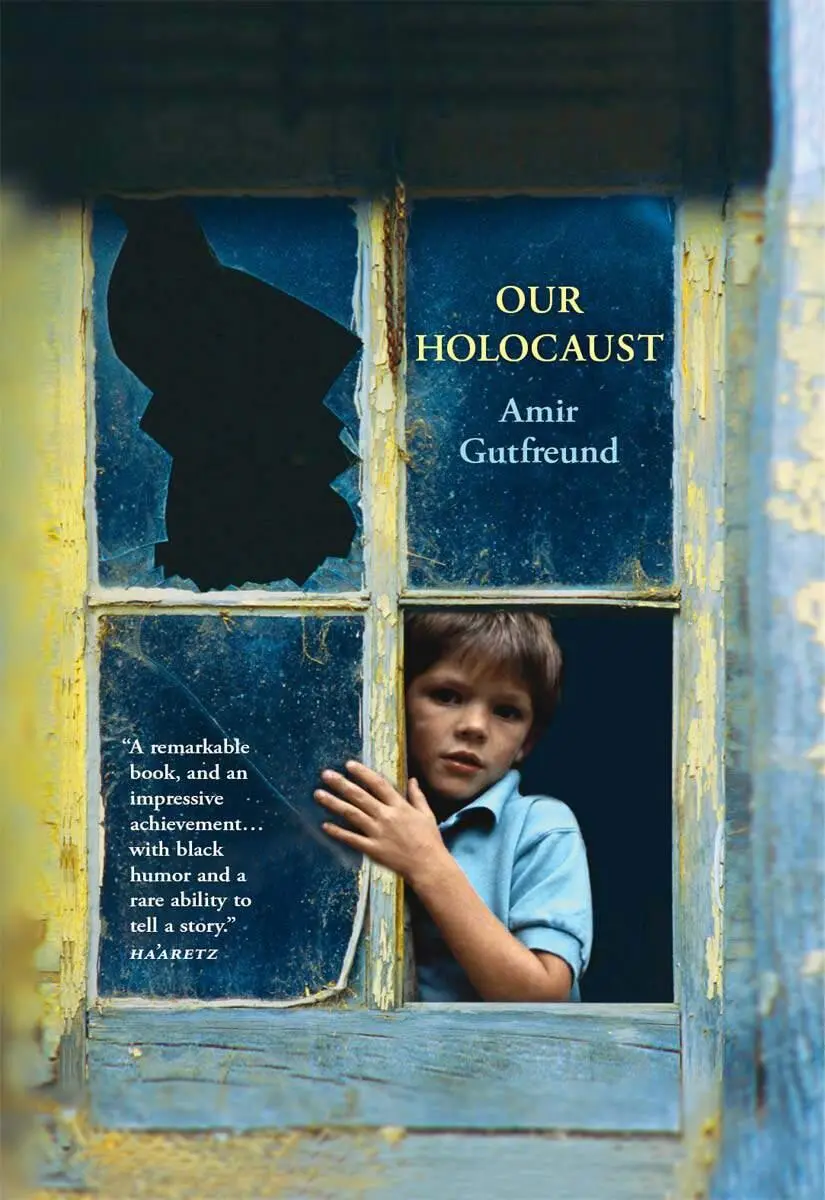
Amir Gutfreund - Our Holocaust
Здесь есть возможность читать онлайн «Amir Gutfreund - Our Holocaust» весь текст электронной книги совершенно бесплатно (целиком полную версию без сокращений). В некоторых случаях можно слушать аудио, скачать через торрент в формате fb2 и присутствует краткое содержание. Год выпуска: 2006, Издательство: Toby Press Ltd, Жанр: Современная проза, Прочая документальная литература, на английском языке. Описание произведения, (предисловие) а так же отзывы посетителей доступны на портале библиотеки ЛибКат.
- Название:Our Holocaust
- Автор:
- Издательство:Toby Press Ltd
- Жанр:
- Год:2006
- ISBN:нет данных
- Рейтинг книги:4 / 5. Голосов: 1
-
Избранное:Добавить в избранное
- Отзывы:
-
Ваша оценка:
Our Holocaust: краткое содержание, описание и аннотация
Предлагаем к чтению аннотацию, описание, краткое содержание или предисловие (зависит от того, что написал сам автор книги «Our Holocaust»). Если вы не нашли необходимую информацию о книге — напишите в комментариях, мы постараемся отыскать её.
Our Holocaust — читать онлайн бесплатно полную книгу (весь текст) целиком
Ниже представлен текст книги, разбитый по страницам. Система сохранения места последней прочитанной страницы, позволяет с удобством читать онлайн бесплатно книгу «Our Holocaust», без необходимости каждый раз заново искать на чём Вы остановились. Поставьте закладку, и сможете в любой момент перейти на страницу, на которой закончили чтение.
Интервал:
Закладка:
“What is it?” we demanded.
It was a letter from Moishe Finkelstein, a Jew from Bielsko-Biala, dated September 1 st, 1939. That was the day the war broke out — the occupation of Poland, the Big Bang. We had found a dark moon orbiting the glowing planet of Grandpa Lolek.
Uncle Menashe made light of the matter: all that had happened was that Grandpa Lolek had received a lot of gold from Finkelstein, which he was supposed to deliver after the war to Finkelstein’s son in America. Half was to go to the son, half to stay with Grandpa Lolek. “And if I know Lolek,” he added, “gold, he didn’t see, Finkelstein’s son. Oh well, not to worry. It’s only money. Believe me, Jews over there did worse things than that.”
“Worse?”
“ Nu , it’s not for children.”
We were not Old Enough. But we were reminded of Crazy Hirsch’s yell. Until that day we had not devoted sufficient attention to his recurrent question, “Only saints were gassed?”
We were not Old Enough.
Before childhood could end, we had to fit it all in:
Find out what happened to Finkelstein’s gold.
Understand the important things.
Discover all sorts of things.
Invent something important.
Find a profession for Effi, something that would combine her desire to always be tanned with her hatred of hard cheese.
Descend, finally, into Gershon Klima’s sewer.
Stand facing Hirsch. Without fear.
And for that we had to remain kids. We had to investigate. The tea bags, the mattress, the hidden gold, it all joined into one enigmatic picture of a land begging to be explored. Finkelstein’s moon hovered above us, dimming, shining, dimming, shining, trembling in its orbit. In order to understand the Kepler Laws of this astronomy, we would have to go back into the cellar.
Having no alternative, we landed — two small space-ships with reasonable grades — on Grandpa Lolek’s planet. A search party. Into the cellar. We forced ourselves. Sensing the uncompromising smell of hidden gold within the odor of a-punishment-we-could-not-even-imagine, we positioned ourselves on Planet Lolek. We replaced our deadly fear with a dry sense of purpose. We sorted items, catalogued. Over and over we went down to the cellar, creating opportunities out of thin air, plots hatched behind Grandpa Lolek’s back. One slip and we’d all be exposed. Once in a while, we delved deeper. The forest of dust revealed itself to us, vaults, treasures and all. We found camera parts arranged in towers, the smaller ones on top. Hundreds of neatly rolled mosquito nets. Metal objects that gave light in return for light. Aluminum strips robbed from windows, blinds, closet hinges. A washing machine engine leaning on its side like a sunken ship in the sandy floor. A fan with all its blades broken, like the prop for a bad joke. We found an accordioned roll of barbed wire that we tried, unsuccessfully, to unroll, and had to grow accustomed to it jumping up suddenly every so often, like Archimedes submerged in his bathtub, shouting, “Eureka! Eureka!” but without revealing a thing. Rapidly adapting, we learned to use the barbed wire to rake the cobwebs, forming dusty clumps. We exposed more and more. Empty bottles that always glistened, like a chorus hungry for the light of a flashlight. Empty packing crates. Matted bundles of rubber bands, sticky and crushed. And finally, a mouse on its back with its feet sticking straight up. Its eyes turned golden in the flashlight beam.
The mouse opened the door to desperation. Finkelstein’s moon was disappointed in us; we had not found wonders or secrets. Not even a note. Only worthless material treasures coated in dust. We hoped for a miracle, hoped to stumble upon a box containing Grandpa Lolek’s confessions, explaining what he had done with the gold, or an incensed communication from Finkelstein’s son demanding to know where the gold was. We looked for envelopes with American stamps, papers written in foreign languages, Polish letters.
In between one descent and the next, we continued to orbit within the gravity of Planet Lolek. We tried to approach the core issue — the gold — with words. Out of the blue, we would ask him about the price of gold. Where did they sell gold? How did you get gold? We talked to him about El Dorado, the mythical land of gold. We talked about golden retrievers and asked him to buy us a golden hamster. We showed him the picture in the Tarbut encyclopedia of the Indian chief whose wife and son fled his cruelty and drowned themselves in a river, and every year he threw gifts of gold into the river to plead for their return. To our surprise, Grandpa Lolek showed no interest in where the river was, how one got there, or how much gold exactly this Indian had thrown in there. He only wanted to know if the gifts had helped, if the wife and son came back.
Again and again we went down to the cellar. And once, as expected, it happened. Just as we were starting to roll up the rug, Grandpa Lolek, who-was-only-supposed-to-be-back-in-an-hour, caught us. In his hand was a glistening new camera and on his face a furious suspicion. “What goes on here?”
I was the first to respond, before Effi. “Grandpa Lolek, my pen got lost under the rug.”
That was practical-Amir, a distant relative of regular-Amir. He was hardly ever seen. Sometimes, at weddings, he would choose the furthest slice of cake from the one Aunt Ecka had touched.
Effi did not cooperate. She should have said, “Yes, the pen,” but instead she stood facing Grandpa Lolek with her hands on her hips and demanded, “We want to know, what did you do with Finkelstein’s gold?”
Eyes met eyes. One look said: more locks, more bolts, fewer guests. Two looks said: have mercy, Sir, take pity on these small children.
Flashes, looks, thoughts, prayers. A breeze passed through us as we stood sturdy as cypress trees.
Finally, “Finkelstein got the gold.” Simply put.
Meaning, no punishment (for now). Meaning, Grandpa Lolek was unaware of his entitlement to punish children when there was no other way out. When asked a question, he answered it.
“Got more than was he deserved,” he added.
“He deserved half,” Effi said, representing the parties in absentia.
“Half?!” Grandpa Lolek came closer, furious.
Effi continued cautiously, “According to the letter…”
Grandpa Lolek sat down slowly on the couch. A mistake. We immediately flanked him on either side.
“Tell us about Finkelstein. How much gold was there? How did you give him half? Was it hard? What happened to Finkelstein?”
Grandpa Lolek put his new camera in his lap and drummed on it with two fingers. Perhaps he was waiting for us to ask about it and forget about unnecessary questions. But he had no choice and so he spoke. He told us the entire story, omitting no detail, as if what we had found in the letter was needless, as if he had always been willing to tell us everything, but hadn’t thought anyone cared to know. He talked at length and also stole in a little bit of Joyce, her umbrellas, the dock, the rain, the damp rose in her hair.
“What do you understood about half? After war, no getting money out of Poland. No doing. Not allowed. And where I buried the gold, to send to America, to the son over there, a lot of money I gave people, so gold will arrive to America good. My head was having shiny with sweat, not with money, until there came for me a telegram that okay, that says to me thank you from Finkelstein the son, that his wife she says thank you also. Half mine, what was left, not so big this half, after the people took for them.”
“And what did you do with your half?”
We hoped to hear that he had kept the gold without touching it. We hoped he would open a secret door and reveal a room full of cobwebs with a stack of pale bars of gold on the floor.
Читать дальшеИнтервал:
Закладка:
Похожие книги на «Our Holocaust»
Представляем Вашему вниманию похожие книги на «Our Holocaust» списком для выбора. Мы отобрали схожую по названию и смыслу литературу в надежде предоставить читателям больше вариантов отыскать новые, интересные, ещё непрочитанные произведения.







Обсуждение, отзывы о книге «Our Holocaust» и просто собственные мнения читателей. Оставьте ваши комментарии, напишите, что Вы думаете о произведении, его смысле или главных героях. Укажите что конкретно понравилось, а что нет, и почему Вы так считаете.