Amir Gutfreund - Our Holocaust
Здесь есть возможность читать онлайн «Amir Gutfreund - Our Holocaust» весь текст электронной книги совершенно бесплатно (целиком полную версию без сокращений). В некоторых случаях можно слушать аудио, скачать через торрент в формате fb2 и присутствует краткое содержание. Год выпуска: 2006, Издательство: Toby Press Ltd, Жанр: Современная проза, Прочая документальная литература, на английском языке. Описание произведения, (предисловие) а так же отзывы посетителей доступны на портале библиотеки ЛибКат.
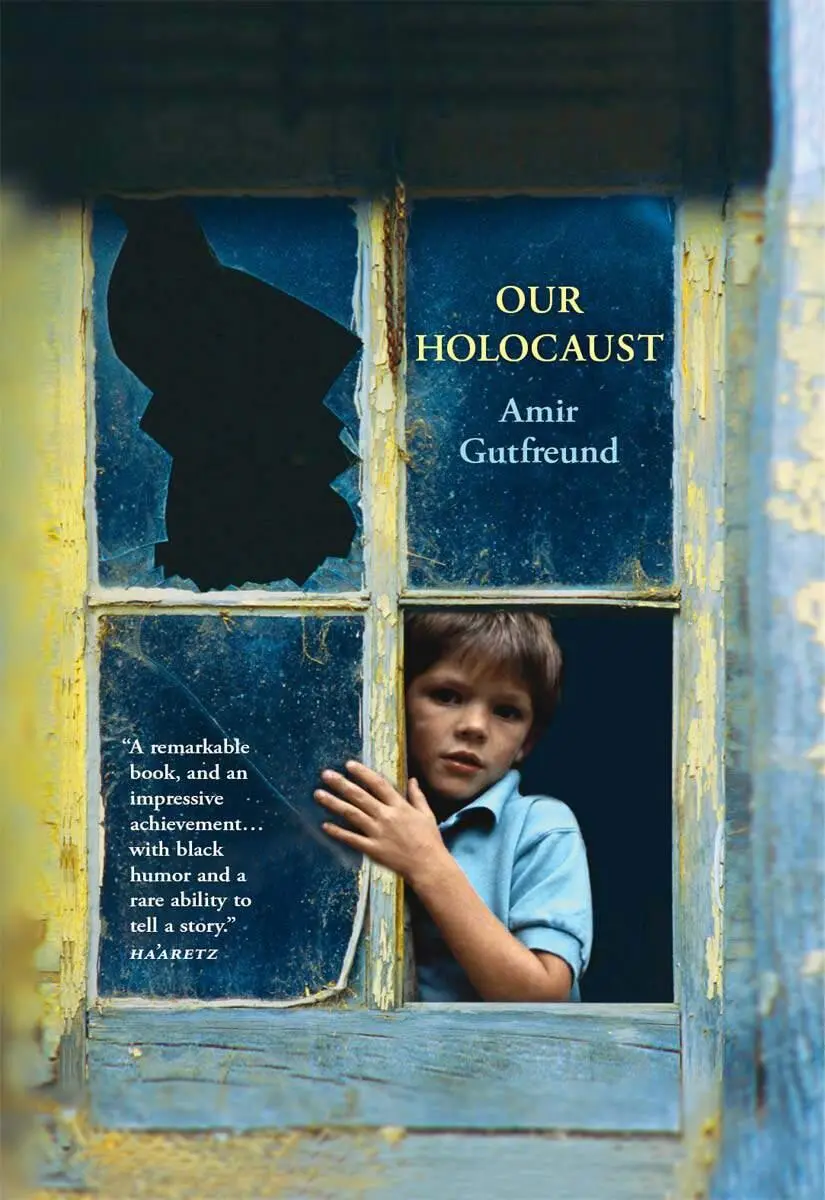
- Название:Our Holocaust
- Автор:
- Издательство:Toby Press Ltd
- Жанр:
- Год:2006
- ISBN:нет данных
- Рейтинг книги:4 / 5. Голосов: 1
-
Избранное:Добавить в избранное
- Отзывы:
-
Ваша оценка:
Our Holocaust: краткое содержание, описание и аннотация
Предлагаем к чтению аннотацию, описание, краткое содержание или предисловие (зависит от того, что написал сам автор книги «Our Holocaust»). Если вы не нашли необходимую информацию о книге — напишите в комментариях, мы постараемся отыскать её.
Our Holocaust — читать онлайн бесплатно полную книгу (весь текст) целиком
Ниже представлен текст книги, разбитый по страницам. Система сохранения места последней прочитанной страницы, позволяет с удобством читать онлайн бесплатно книгу «Our Holocaust», без необходимости каждый раз заново искать на чём Вы остановились. Поставьте закладку, и сможете в любой момент перейти на страницу, на которой закончили чтение.
Интервал:
Закладка:
We tried to ask him about the war.
“Grandpa Lolek, why won’t Grandpa Yosef tell us about what happened to him in Buchenwald?”
“Grandpa Lolek, what do you know about Adella Greuner?”
“Grandpa Lolek, what happened to my mom in the village when she hid with Christians?”
But we gave up in despair. Grandpa Lolek knew only one war, his, and it sounded very similar to the wars we had here. The Six Day War, for example. His description of the battle at Monte Cassino, May ’44, week after week after week, melted away the delight of chocolate cake and cocoa. Grandpa Lolek tried to impress us with descriptions of the final hilltop battle. “Seven days, we skip on foot, from rock to rock.”
“It was probably cheapest to travel by foot,” Effi whispered, her face a study of chocolate.
But I noticed the unusual words Grandpa Lolek used—‘skip’, ‘from rock to rock’—and it occurred to me that he might have read about Monte Cassino in books, impressed at his own feats.
Grandpa Lolek grew animated as he continued to broaden our education. “Monte Cassino, what do you know? Germans were positioned there, not to move. You move, you lose all of Italy, all the war. Fighting there, the Germans. Everybody against them, no good. No passing. They bomb from the sky, day and night. From the land we try to get up. Germans slaughter everyone. Through the rocks, not possible. Uphill. Difficult. Anywhere a soldier walks, a German is hiding, and bang-bang. They tried everything, the generals. No more soldiers of theirs left, and the Australians tried and the New Zealanders tried. Fighting, fighting, and no doing. All day, all night, they bring bodies down. No getting by the Germans. Strong, those Germans. Animals. They decided: Send the Poles in. Anders’ soldiers. Why not? Soldiers for free. In May, we start to conquer. Fifteen of May, the beginning of the end. Last battle, they said. Well, ask your father. That was the day when his mother, Rachela, went in Auschwitz. Exactly that same day. Fifteen of May. Ask him, ask him. And me on the hilltop, Monte Cassino, fighting the Nazis. There were casualties, you should know. For two weeks now, we, the Poles, on the mountain. The Germans were men, lions. Us Poles, we had more hate. Up we went, and took the Germans, one at a time, with bayonets. Until no more. We slaughtered the last German. Anders’ Army on the mountain. Me, the Jew, on the mountain. Your father’s mother, Rachela, a righteous woman, Auschwitz. Your father and his father in train car, to a new concentration camp, they have luck, not Auschwitz. Strong. Your father is good boy, his father sick already. But me, a Jew, on Monte Cassino, up top, and no one has bad word for me. Germans, only with bullet in the head, and if all Jews were like that, no Hitler. There would not have been…”
He calmly ordered another cup of tea, leaving us wide-eyed, with many new questions racing through our minds. For me, my mother’s birthday, May 15 th, now connected with the new date, the day of Grandma Rachel’s death in Auschwitz. I would have to ask Dad about it. But I soon forgot. The loyal mechanism worked every time: whatever we weren’t allowed to ask, we forgot to ask. Dad would continue to hide the date, celebrate Mom’s birthday with her and quietly think about his mother. Mom mustn’t know, not to ruin her celebration. Only after Mom died, did he tell us how all those years…
The cup of tea came. Grandpa Lolek stirred in three teaspoons of sugar (courtesy of the café) and jolted the teabag around in the boiling water to get everything out. After fishing out the bag, forgoing his usual Selektion process, he put it with its predecessors in the saucer and sighed. “Such a pity you cannot smoke what’s left of tea.” He stared at us with his crystal blue eyes and sighed again, from the depths of his chest.
Fake.
If not for our keen senses, he might have been able to trick us. But something about the sentence rang false, something in the sigh he had amateurishly copied from Grandpa Yosef. Since when did Grandpa Lolek sigh? As we left, we were not surprised to see him stealthily collecting the used tea bags in a little plastic bag, intending to produce another eight cups out of every bag, and then on to his great mattress plan.
We had fun at his house. We learned new shades of miserliness, ones that were not evident to us during regular encounters. In his kitchen window boxes we found herbs he had planted following the guidance of a television program, with plenty of sun and a little water. In his lamps he used only monastic low-wattage bulbs, which produced a brownish-golden light. In the kitchen, he required every match to last for three uses. When he tried to make us soft-boiled eggs, the first match completely failed and Grandpa Lolek looked at us accusingly. Before bed-time we took showers. We wanted baths with water up to our chins, but Grandpa Lolek recommended showers. “After beach, it washes better the sand.” We reminded him that we hadn’t been to the beach, but our protests were drowned out in a stream of water. He kept us apart (“No romances should be here”) and sent Effi in first. To pass the time until it was my turn, and since I was going to wash soon anyway, I helped him polish shoes, wash the dishes in the sink, throw out the trash.
After my shower, Effi and I shared our astonishment at the soap. We discovered that not only did he dilute the liquid soap by the sink down to nothing, but that the bar of soap for use in the shower had also been subjected to his artistry. In a painstaking process, he had hoarded and united the tail-ends of countless bars of soap, and with the skillfulness of a goldsmith had fused them into one multicolored lump, a bumpy hedgehog ready for use. This hedgehog, when it reached the end of its days, was also reduced to a soap tail-end and used, in turn, in a further welding. Through this process of reduction and fusing, Grandpa Lolek created a new entity, a bar of soap in which every particle had its own age and its own parent-soap. This alchemical creature, “a wise man’s soap” that resulted from the filtering down of hundreds of initial bars, astounded us with its multitude of colors. At home, our soap had only one color, usually a faded shade of brown.
And we discovered more rules. When he had a headache, he left his house to have a cup of tea with a neighbor. Then he would suddenly murmur, “Happen to have a pill for my headache?” That way, he also gained a glass of water to swallow the pill with. He was distressed by the red light on the hot water heater, which lit up every time it was turned on. Grandpa Lolek wanted hot water, not light. They explained to him that the light was in fact intended to conserve power, to remind him to turn the boiler off. Grandpa Lolek could not comprehend this. How could anyone leave the boiler on? Who would do that? He blamed the boiler for the waste, as if the hot water was designed to pamper the heating elements.
We came to believe that Grandpa Lolek existed on a level of miserliness that few could achieve. We could not have known that he was still only half-way up the peaks he was yet to scale. But even then, we sensed how to wind him up. “Starting next month, it will cost money to call an ambulance,” we told him. Or, “They said on the news there’s going to be a tax on bus fare.” (He rode the bus to preserve the Vauxhall.)
By the second day of our visit, Grandpa Lolek was shirking his duties. He handed a thimble-full of cleaning fluid to the maid who came in the morning, instructed her to wash everything twice, then hid the container. He took us for a measly trip to the Carmel Center, where he walked around with us impatiently. Too many hours had already been robbed from his life. When lunchtime arrived, he did not hesitate to set off to his regular restaurant. He left us at home without much remorse. The maid had left us a pot of mashed potatoes to heat up with beans, two rolls wrapped in plastic, and compote for dessert. In disgust, we ate nothing but the rolls, saving time for the main event: a thorough rummage through Grandpa Lolek’s house of wonders. We cautiously opened closets, bureaus, draws, cabinets. We found account ledgers and binders and lots of pictures of smiling people, including some of ourselves at Nathan’s bar mitzvah. We found a crystal swan with a broken neck — more precisely, we found only the hook of its neck and head, with no body. We found two envelopes stuffed with stamps, all in the same color, red. When I stood on a chair and Effi risked her life by climbing up on my shoulders, we discovered a treasure. From that height, Effi saw something in the rug on the floor. The rug was nicely spread beneath the table, with its edges under the armchairs and couch, but from up above she saw an indentation down the length of the rug. A bunker! We quickly uprooted the table, the couch, the armchairs and the rug, revealing a trapdoor that led to a cellar. And there it was. Our dreams had come true.
Читать дальшеИнтервал:
Закладка:
Похожие книги на «Our Holocaust»
Представляем Вашему вниманию похожие книги на «Our Holocaust» списком для выбора. Мы отобрали схожую по названию и смыслу литературу в надежде предоставить читателям больше вариантов отыскать новые, интересные, ещё непрочитанные произведения.










Обсуждение, отзывы о книге «Our Holocaust» и просто собственные мнения читателей. Оставьте ваши комментарии, напишите, что Вы думаете о произведении, его смысле или главных героях. Укажите что конкретно понравилось, а что нет, и почему Вы так считаете.