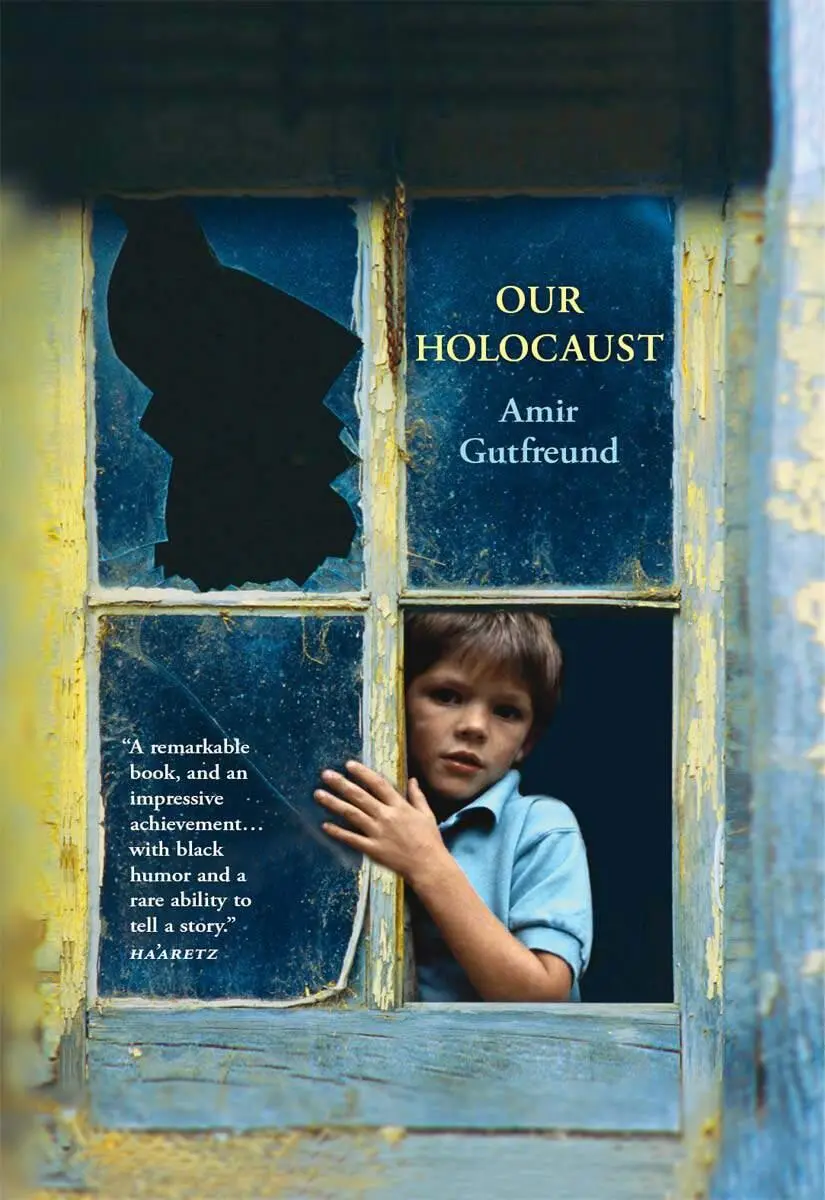
Amir Gutfreund - Our Holocaust
Здесь есть возможность читать онлайн «Amir Gutfreund - Our Holocaust» весь текст электронной книги совершенно бесплатно (целиком полную версию без сокращений). В некоторых случаях можно слушать аудио, скачать через торрент в формате fb2 и присутствует краткое содержание. Год выпуска: 2006, Издательство: Toby Press Ltd, Жанр: Современная проза, Прочая документальная литература, на английском языке. Описание произведения, (предисловие) а так же отзывы посетителей доступны на портале библиотеки ЛибКат.
- Название:Our Holocaust
- Автор:
- Издательство:Toby Press Ltd
- Жанр:
- Год:2006
- ISBN:нет данных
- Рейтинг книги:4 / 5. Голосов: 1
-
Избранное:Добавить в избранное
- Отзывы:
-
Ваша оценка:
Our Holocaust: краткое содержание, описание и аннотация
Предлагаем к чтению аннотацию, описание, краткое содержание или предисловие (зависит от того, что написал сам автор книги «Our Holocaust»). Если вы не нашли необходимую информацию о книге — напишите в комментариях, мы постараемся отыскать её.
Our Holocaust — читать онлайн бесплатно полную книгу (весь текст) целиком
Ниже представлен текст книги, разбитый по страницам. Система сохранения места последней прочитанной страницы, позволяет с удобством читать онлайн бесплатно книгу «Our Holocaust», без необходимости каждый раз заново искать на чём Вы остановились. Поставьте закладку, и сможете в любой момент перейти на страницу, на которой закончили чтение.
Интервал:
Закладка:
Dad was practical. “ Nu , but where would we have kept them? In the end they would have escaped, and then where would we be?”
But Attorney Perl had thought of everything. “Where? In the camps, of course. The barracks and fences were still standing. We could have housed the criminals there. Under guard. Why not? Every day we would have made them walk five miles to the testimony stand. In the freezing cold, yes. And we would have made them wear our clothes and eat our food, and walk in those ‘fine’ shoes, and they would have received medical treatment right there in their precious revier. And we would have whipped them. Yes! Whipped! Even unto death! Death to anyone who is careless with his testimony!”
He falls silent. His back hunches over, he shuts his eyes. A small vein throbs in his forehead.
We drink another cup of tea in silence. Birds of memory flutter overhead. Finally, my moment comes: Attorney Perl lets me choose whatever I want from the drawers of bolts, rubber bands and screws.
I don’t know where Effi was during those hours when I settled down on the little chair at Attorney Perl’s. Did her father also have a wise old friend who knew the names of all the Nazi criminals, the dates of their court cases, their sentences, and the extent to which those sentences were enforced? Did she sit in a little back room where the dense air was sweetened with tea, hearing about appeals, sentence mitigations, re-trials? Did she also hear a list of names — a long, long list naming criminals who had evaded trial and were living somewhere comfortably, hiding behind borrowed identities, ordinary members of communities— forgiven ? Attorney Perl was mine, all mine, and when he was invited to family affairs, I didn’t tell Effi quite how distinguished he was. It didn’t matter. Her side also had anonymous guests who would show up unknown, ever-changing, recurring, replaceable, eternal. We maintained a certain distance from one another, fearing our similarities might one day make us virtually interchangeable. Attorney Perl, with his sublime hatred and his neat lists of Nazis carved out like steps, was mine alone.
When I was about nine, Attorney Perl gave my brother Ronnie the Tarbut encyclopedia set for his bar mitzvah. In my world this was an incredible gift, more precious than anything I could conceive of. A great deal of the affection which they did not know how to express in the usual ways was embodied in this gift. The Holocaust was concealed within the pages of the Tarbut encyclopedia, overshadowed by other entries. “The Massacres of 1648–49” and “The Pogrom Horrors” were more impressive, more direct. But even more powerful than the pogroms was the colorful, illustrated world waiting to be deciphered. The entries were arranged according to an unfathomable order, each entry following a set outline. First, an introductory narrative composed by the author, recreating the private meditations of Alexander the Great, behind-the-scenes secrets from the French Revolution, an encounter with a gorilla. After the introduction, printed in a different typeface and composed in formal language, came the encyclopedic data, a refreshing assortment of information, explications and subplots. Each page was embellished with an illustration, whatever the entry. That was where we learned how dinosaurs fought and what the Vilna Gaon looked like, how the Battles of Hannibal were won and how Thomas Edison gazed at the first electric bulb as it shone on his desk. The Tarbut encyclopedia paved roads, expanded the world, colored it and outlined its rules. It also clipped the wings of the Holocaust’s voracity and defined its boundaries, demanding equal measures of attention for both tarbut —culture — and Shoah.
Grandpa Yosef wrinkled his nose when he saw Attorney Perl giving Ronnie the entire encyclopedia set, because he was the tree of knowledge in our family and encyclopedias were supposed to be his domain. When Grandpa Yosef himself bought me a very fancy book, Sayings of Wisdom , he suffered yet another setback, because that was exactly what Sammy the greengrocer had given me. When it turned out that Uncle Menashe had bought me yet another Sayings of Wisdom , an inquiry was conducted and all the Sayings of Wisdom givers issued a joint statement: It was on sale at Goldberg’s on Shapira Street. An appendix to the statement clarified that the book was still expensive even after the discount.
We forgave them quite easily:
Grandpa Yosef, because of the money, of which he had none. Whenever he had a penny, he would find someone who didn’t and give it to them.
Uncle Menashe, because he lived far away and there was an unwritten, dimly comprehended rule that defined a correlation between mileage and gift-size. Various distances and degrees of familial relationship were plugged into this formula, resulting in the appropriate expenditure for a gift.
Sammy, because when his son, Tzachi, had his bar-mitzvah, Dad had given him a very fancy Interpretations of the Torah and Prophets that was on sale at Goldberg’s on Shapira Street.
Besides, Dad could never be angry at Sammy, because of all the people with whom he bought lottery tickets (they faced God in pairs, hoping He would hand out a measure of good fortune in proportion to their joint rights), Sammy was the only one who didn’t cheat Dad when they won, or rely on his indulgence in financial matters. Hillel, the barber from Herzl Street, cheated him. And a guy from the army reserves cheated him. But Sammy would always run to find Dad and announce the winnings.
Sammy had a little fruit and vegetable store at the edge of Grandpa Yosef’s neighborhood. He wore a gold chain around his neck and had a thundering voice, and his potbelly always stuck out of the bottom of a shirt that proclaimed, in English, “Harvard University.” With his mustache and bald head, Sammy looked like a hardened thug, but he had small, green eyes that took on the color of tea in the sun. Inside the store, his eyes had a strained tone of green, sometimes Ganges-green, reminding everyone that Sammy was half-Indian. He kept two different kinds of tabs for his customers in the neighborhood: one for those who had to pay, and another for those who didn’t have to pay because they had suffered enough in the Holocaust. Sammy spoke of the Holocaust like normal greengrocers talked about soccer. The Holocaust, for him, was a physical entity, a body with character traits. A transparent globe which you could hold in your hands and gaze into to see figures and snowflakes and all sorts of colorful things. “The Shoah…” he used to say, and coming from his lips the word sounded different. Finally, here was the perspective of a man with both feet on the outside, with true compassion and unexaggerated kindness. “They suffered over there, the poor souls,” he explained, and nothing was hiding behind his words. “Suffered” did not conceal two-days-under-a-mountain-of-bodies-with-his-mother-and-father-dead-on-top-of-him-until-he-got-out-and-ran-to-the-forest. “Poor souls” was not their-children-died-in-the-ghetto-and-after-the-war-they-tried-to-have-children-and-could-not-something-in-her-body-or-her-mind-the-doctors-gave-up.
Sammy employed three assistants, and they were told to be nice to the customers. When he said “customers,” it was clear that he did not mean the ones in sunglasses who stopped their cars outside for a minute to run in and get something for Shabbat, but rather the ones like Gershon Klima, for example, who would sometimes stand among the crates of produce without any idea of what he wanted. They had to let him stand there like a waxwork, with his own rhythm of confusion, no urgency, until a healthy thought about plumbing drew him out of the confusion and instantly cured him, and as if on the wings of Superman’s cloak he would take hold of his six-inch pipe and emerge a regular customer, grumbling, “How much are the tomatoes today?”
Читать дальшеИнтервал:
Закладка:
Похожие книги на «Our Holocaust»
Представляем Вашему вниманию похожие книги на «Our Holocaust» списком для выбора. Мы отобрали схожую по названию и смыслу литературу в надежде предоставить читателям больше вариантов отыскать новые, интересные, ещё непрочитанные произведения.






Обсуждение, отзывы о книге «Our Holocaust» и просто собственные мнения читателей. Оставьте ваши комментарии, напишите, что Вы думаете о произведении, его смысле или главных героях. Укажите что конкретно понравилось, а что нет, и почему Вы так считаете.