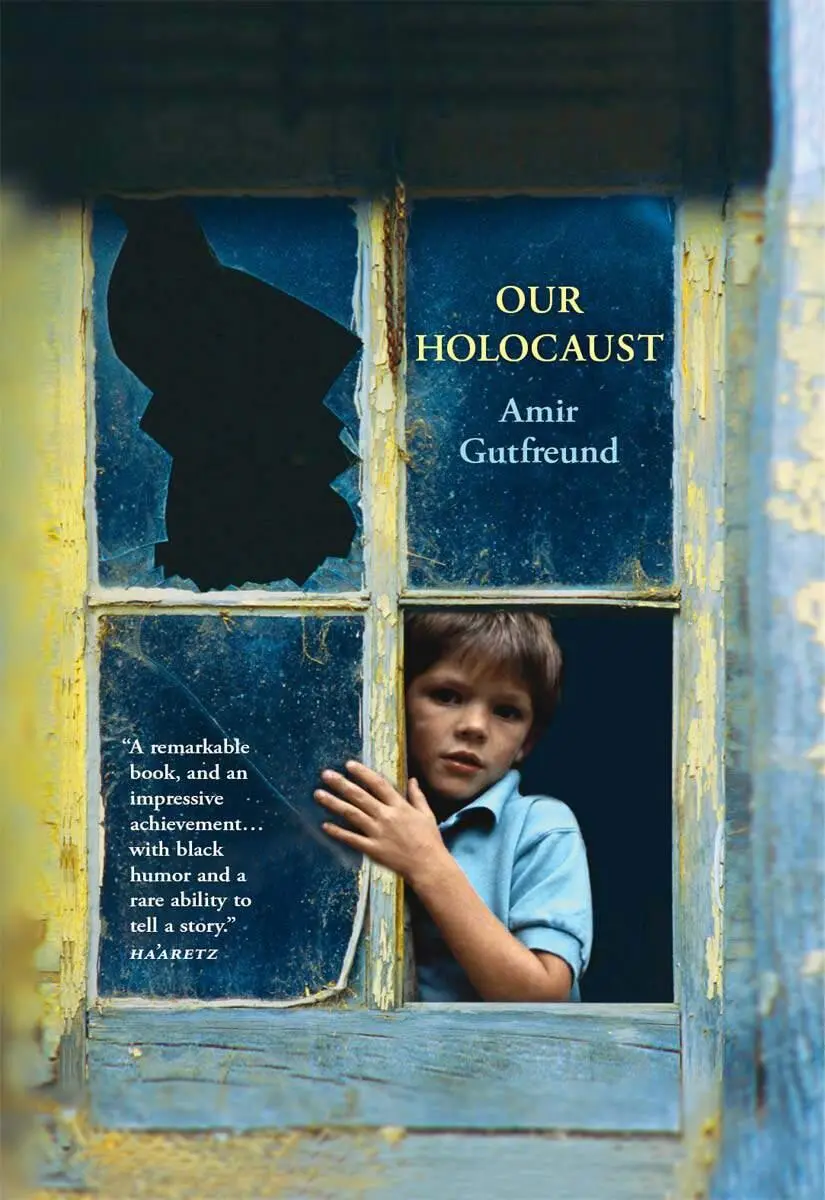
Amir Gutfreund - Our Holocaust
Здесь есть возможность читать онлайн «Amir Gutfreund - Our Holocaust» весь текст электронной книги совершенно бесплатно (целиком полную версию без сокращений). В некоторых случаях можно слушать аудио, скачать через торрент в формате fb2 и присутствует краткое содержание. Год выпуска: 2006, Издательство: Toby Press Ltd, Жанр: Современная проза, Прочая документальная литература, на английском языке. Описание произведения, (предисловие) а так же отзывы посетителей доступны на портале библиотеки ЛибКат.
- Название:Our Holocaust
- Автор:
- Издательство:Toby Press Ltd
- Жанр:
- Год:2006
- ISBN:нет данных
- Рейтинг книги:4 / 5. Голосов: 1
-
Избранное:Добавить в избранное
- Отзывы:
-
Ваша оценка:
Our Holocaust: краткое содержание, описание и аннотация
Предлагаем к чтению аннотацию, описание, краткое содержание или предисловие (зависит от того, что написал сам автор книги «Our Holocaust»). Если вы не нашли необходимую информацию о книге — напишите в комментариях, мы постараемся отыскать её.
Our Holocaust — читать онлайн бесплатно полную книгу (весь текст) целиком
Ниже представлен текст книги, разбитый по страницам. Система сохранения места последней прочитанной страницы, позволяет с удобством читать онлайн бесплатно книгу «Our Holocaust», без необходимости каждый раз заново искать на чём Вы остановились. Поставьте закладку, и сможете в любой момент перейти на страницу, на которой закончили чтение.
Интервал:
Закладка:
Effi was older than me. She was always a year ahead of me and always beat me at everything. A poem she wrote was published in Ha’aretz Shelanu ; mine wasn’t. She got work as a photographer for Maariv LaNoar magazine; I didn’t even get a response to my application. She managed to get herself a cast on her arm at least once every two years; I never even had one. She had braces and she was sent to have her eyes tested. Every other summer when she got her cast, everyone wrote lines and poems and signed their names with colorful markers. Every year I plucked up the courage to rebel, to reverse the order of things and try to lead. Effi would rise to the challenge. For that reason we set up a summer camp, an arena in which everything would be decided. Moshe attended our camp, and very quickly he also became the janitor and the judge. When Moshe wasn’t quick enough and the fights were too great, Effi would declare — to the woods! That was where I lost.
Above us the Carmel mountains towered, and behind them the woods of Minsk. We were partisans and we were American-Indians and we were ghetto-fighters, day in day out. Time was thrown into disarray. German trucks were attacked and taken down whenever a path met a road. The rivers flowed with opportunities to wade through the water and join the partisans. Uprisings broke out in the ghettos every day. We escaped to the woods and hid. We poked around all the houses of Katznelson, climbing through windows, invading closets. We opened sealed boxes and read impenetrable certificates in foreign Polish on paper that smelled like dead countries. We picked up the rules from the grownups’ conversations: if you get caught, better to be caught by the Germans. Worse to be caught by the Poles. Worst of all — Ukrainians or Lithuanians. We were afraid of Mrs. Dopochek, who was Lithuanian. We tried to find evidence to ascertain who was Ukrainian. We carved oaths of silence-if-taken-hostage on all the trees except Gershon Klima’s Indian bombax, which we regarded as slightly holy. And we celebrated our childhood, our wildness. Apart from Menachem, the only child in the neighborhood, we had no competitors there, and we sucked everything we could out of it. Every year, the same things. Momentous events tried, unsuccessfully, to distinguish the years from one another, but one year skipped into the next and they all turned into one huge, borderless year. A year in which everything happened, then, now, forever. A tremendous year, its details bursting forth, every memory picking out arbitrary details from many places; contradictions and amazements jostle, huddle, one thuggish version wins for a moment then disappears into the pile, kicking and screaming. The Great Year plays innocent: I am not one year, I am all of childhood. But we think only of the summers with Grandpa Yosef and the Great Year quickly stands at attention, buttons itself up into the measurements of a single year, barely standing, rocking on its heels.
Genia Mintz, the teacher, who kept a little parrot on her windowsill, comes to complain that we threw chewing gum and toffees into the bird-cage. (She dies on a Saturday; they wheel her out of the house and take her away in a black car.) In the middle of summer, she pets Effi’s head and asks math questions, questions for tanned skin and sandals. “Tell us about Ravensbrück, Mrs. Mintz.” Little Genia Mintz walks down Katznelson, alone.
Mr. Bergman is hospitalized for a whole year, allowing us to investigate the contents of his home. Grandpa Yosef goes over to return a book in Polish about Herod and we agree to just stand at the window. Mr. Bergman’s plants need to be watered, he’s been in “convalescence” near Jerusalem for two weeks, and Grandpa Yosef goes inside with us and a watering can.
During that Great Year we were American Indians and soldiers and illegal immigrants and astronauts. But mostly we were partisans, of the vengeful type. We sought out victims. Once, on the side of the road that ran between the two forests, we found an abandoned car whose driver had gone into the woods for a pit-stop. Bleary-eyed, we crawled into the car. We stole candy from the glove compartment, let the air out of one tire and spat on the seats.
The road at the edge of the first forest was, for me, the final frontier, never to be crossed. Something about the way it popped up after a long run among the trees was inexplicably frightening. Nature, nature, nature, then suddenly a break, a road — human presence. Effi used to mock me. Complacently crossing the road, she would disappear into the other forest, then come back and tell me how she’d gone “to the edge.” I didn’t know that just beyond “the edge,” behind another forest, was the Kiryat Haim soccer stadium where I went on Saturdays with Dad and yelled cheers that reached the heights of the treetops in the woods.
One day, when we accidentally discovered that the woods were where Crazy Hirsch lived, our blood curdled. We were too afraid to go back for a whole year. We made enquiries. Learned the facts. Pictured the hut he had built himself, with its wooden fences and the light coming from a little window. The next year there was a suffocating journey to the edge of the woods. Trembling steps. A darkening world, the scent of panic. More and more steps, until our surrender. We could not find the hut. In subsequent journeys we went deeper, further. Finally we found the hut. We fled with beating hearts and wild breath and footprints — that was what we thought about: the footprints, which would lead Crazy Hirsch all the way to Grandpa Yosef’s if he chose to follow us. We went back, our breath ragged, our courage compelled. We erased the footprints and made others, leading the soles of our shoes to Brachaleh’s empty house, to Gershon Klima’s house — no one would dare harm him. And the year after that we went back to the woods and took up our games again, steeped in the knowledge that Crazy Hirsch’s hut was right there, a gentle pattering of absolute terror, a suffocating veil descending upon our recreational pleasure.
When Crazy Hirsch suddenly appeared in the middle of the neighborhood, we would freeze as we waited, lifeless, for him to find an appropriate place to scream his question:
“Only saints were gassed?”
Then he would leave and we would breathe again. Children again, as usual, but those skeletal seconds before he left, long as the bones of a whale, exposed us to the true nature of the neighborhood. The character of the people. The family. The real truth. Stripped of the houses, the gardens, the paths, the trees, the sun, we clearly saw the people among whom we were playing. The dim message that could not be deciphered with words or with entries from the encyclopedia, like “tropical forest,” “first aid,” “the Stone Age.” For a moment we comprehended the real figure, the one morbidly pushed into a corner. The dwellers of these little houses, tied to one another in a wondrous braid. Elderly gods, sitting on the Olympus of a senior citizen neighborhood, spinning plots of flesh and blood, determining the fates of us mortals. They were free of weak spots. Afraid only of the mailman, oddly affected by his shiny cap. Dining on ambrosia out of faded crockery. Orbiting through zodiacal constellations. From the early sunrise of Mrs. Kempler in her window, through Grandpa Yosef’s route to synagogue, to the sunset of Adella Greuner’s face as she waited in the evening breeze behind angry drapes, rolling in the image of a burning comet, yelling, “Kalman, vi geystu? Vi geystu ?” Anonymous shouts discharged from dreams, shooting stars ineligible for wish-making. Grandpa Lolek like furious Apollo in his Vauxhall chariot, untouched by the suffering, a mischievous Pan in the forest of the miserable. And Neptune, Gershon Klima, his own brother, ascending from the water, a miracle being torn from its axis. The marching fire, Uncle Mendel, judging every being. And young Narcissus, crazy Itcha Dinitz. Saintly and amiable, walking to the grocery to the beat of an African drum, discovering new lands every day. Nobel laureates behind closed doors, sealed off geniuses living on pills. Their illnesses were picturesque, sprouting out of nothing. They went to the Sick Fund, that barn of pills, to ask the Pharaonic clerks to fill their prescriptions from the huge dark bottles on the upper floors. (We never got anything from the interesting bottles. No matter what disease we managed to catch we were always given syrup taken down nonchalantly from the lower shelf. The pitchers of pills, the wonders of the high shelves, were only for the patched up old people in slippers and layers of robes. And for Feiga, sometimes, there was even a trip behind the cabinet for a secretive pharmacists’ huddle, and a little bag that emerged from the darkness full of yellow pills that we once tasted and which Effi promptly threw up; I did not.)
Читать дальшеИнтервал:
Закладка:
Похожие книги на «Our Holocaust»
Представляем Вашему вниманию похожие книги на «Our Holocaust» списком для выбора. Мы отобрали схожую по названию и смыслу литературу в надежде предоставить читателям больше вариантов отыскать новые, интересные, ещё непрочитанные произведения.







Обсуждение, отзывы о книге «Our Holocaust» и просто собственные мнения читателей. Оставьте ваши комментарии, напишите, что Вы думаете о произведении, его смысле или главных героях. Укажите что конкретно понравилось, а что нет, и почему Вы так считаете.