Amir Gutfreund - Our Holocaust
Здесь есть возможность читать онлайн «Amir Gutfreund - Our Holocaust» весь текст электронной книги совершенно бесплатно (целиком полную версию без сокращений). В некоторых случаях можно слушать аудио, скачать через торрент в формате fb2 и присутствует краткое содержание. Год выпуска: 2006, Издательство: Toby Press Ltd, Жанр: Современная проза, Прочая документальная литература, на английском языке. Описание произведения, (предисловие) а так же отзывы посетителей доступны на портале библиотеки ЛибКат.
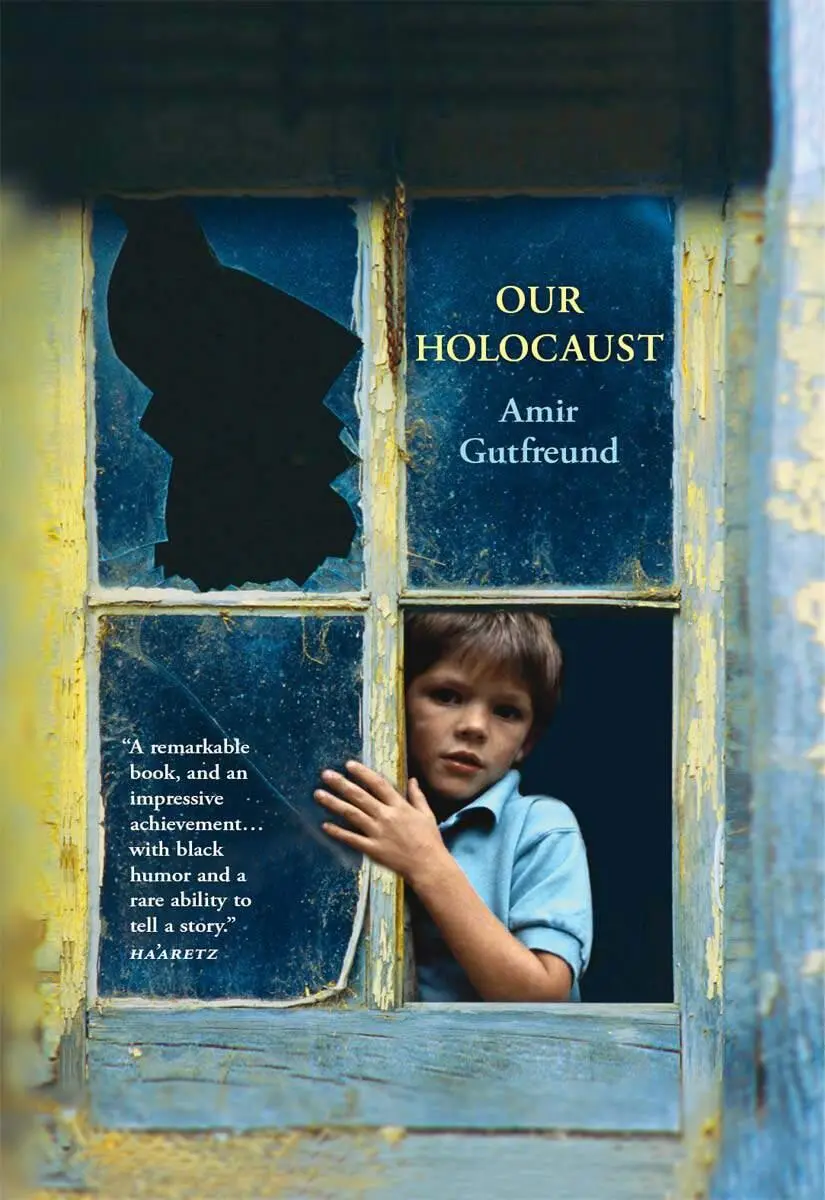
- Название:Our Holocaust
- Автор:
- Издательство:Toby Press Ltd
- Жанр:
- Год:2006
- ISBN:нет данных
- Рейтинг книги:4 / 5. Голосов: 1
-
Избранное:Добавить в избранное
- Отзывы:
-
Ваша оценка:
Our Holocaust: краткое содержание, описание и аннотация
Предлагаем к чтению аннотацию, описание, краткое содержание или предисловие (зависит от того, что написал сам автор книги «Our Holocaust»). Если вы не нашли необходимую информацию о книге — напишите в комментариях, мы постараемся отыскать её.
Our Holocaust — читать онлайн бесплатно полную книгу (весь текст) целиком
Ниже представлен текст книги, разбитый по страницам. Система сохранения места последней прочитанной страницы, позволяет с удобством читать онлайн бесплатно книгу «Our Holocaust», без необходимости каждый раз заново искать на чём Вы остановились. Поставьте закладку, и сможете в любой момент перейти на страницу, на которой закончили чтение.
Интервал:
Закладка:
“Will you really take us to Caesarea?”
“All the way to Caesarea, not just half-way?”
The promise was ratified and a bag of toffee candies placed in our hands, to fortify mind with matter.
Sometimes, usually at summer’s end, Gershon Klima surprised the neighborhood residents by appearing in an IDF uniform, thanks to the reserve duty for which he continued to volunteer even at the age of fifty-three. As soon as Gershon Klima turned up at his army base somewhere in the south of Israel, his fellow unit members showered him with respect and praise. They walked him inside and danced around him. Senior officers came up to shake his hand, quickly asking, “Gershon, where are the mains?” Because, as it turned out, Gershon Klima was the only person who knew how to find the water mains that united the water and sewage systems of the entire base, and he had been jealously guarding the secret since 1963. The visible mains, the straightforward ones, which any hand could touch, were nothing but an empty vessel — a superfluous component that had been maliciously circumvented and left completely without function. The real mains were hidden somewhere, probably in the thick of the earth, lording over the supply of water to the base with demonic whims. Only Gershon Klima could work his magic on them to make them keep working. A certain deviousness snuck into Gershon Klima when he put his IDF uniform on, a-completely-different-Gershon-Klima, and in order to keep the scandal to a minimum he was willing at any moment to turn up at the base and repair the mains, even if it meant leaving in mid-hospitalization. He had already been summoned by two base commanders to offices with brigade maps hanging on their walls, where, with grave expressions, they pressed, “Gershon, where are the mains?” The maintenance commanders, who were replaced every few years, hated him. One of them once spent thirteen thousand shekels on sophisticated equipment to locate the real mains. He reasoned, how difficult could it be? It was simply a matter of following the pipes. But the operation failed and the pipes lay still, never betraying Gershon Klima. As Grandpa Yosef served him a slice of watermelon, Gershon Klima recounted gleefully, “They almost struck oil with their thirteen grand, but they didn’t find the mains.” He chuckled, treating the thirteen thousand shekels as if he had donated them to an important cause.
Gershon Klima was unaware of the role his apartment played during his reserve duty days. In his absence, we reconstructed the terrorist takeover of the Savoy Hotel in Tel Aviv (we were both the late Colonel Uzi Yairi, the first of the forces to be killed), and we freed the Sabena airliner hostages at Ben-Gurion Airport (united against the terrorists but resentful of one another, since we were both the commanding officer of the Sayeret Matkal special forces unit, neither of us wanting to be a hostage). In ’76 we would have freed the Entebbe hostages seven days before a government meeting authorized a similar operation, were it not for Gershon Klima’s early return.
We needed Gershon Klima. His hands alone could uncover manholes to reveal the thrilling, multifaceted belly of the underworld. Ever since we had been given a Tarbut encyclopedia set, we had become acquainted with the properties of Planet Earth, and knew that it was made up of layer inside layer inside layer. We envisioned us humans as tiny people who stood on the outer layer, not knowing that down below it was burning — not even knowing that there was a below, that below was the source of everything that occasionally burst forth up here, volcanic eruptions and streams of lava, and steaming geysers and earthquakes, and a horrible smell of sulfur in ordinary-looking places. Our minds wrestled with the structure of the Earth’s layers, the thin layer we lived on, only its outer skin viable. Underneath was the cloak layer, in moderate burning colors, and finally the core, storing iron in a fluid state. Effi claimed Gershon Klima had never gone down deeper than the Earth’s layer. I believed the core of the Earth was within his reach, as evidenced by the fact that his clothes were covered with grey and brown stains, which must have come from the iron and manganese so plentiful in the Earth’s core. In any event, Gershon Klima had the key to the heart of Planet Earth.
He also held another key: if he was born in 1939, the time of the Big Bang, well then he must have known what had happened, and he was obliged to tell us.
We never walked up to him and asked questions just like that. We were conscious of the magnitude of caution required, of the once-in-a-lifetime opportunity we would be given one day in the future to ask the true questions, and of our obligation to wait, to ambush, to sense the right moment. We circled Gershon Klima, giving each other meaningful looks before each question and conducting silent consultations to avoid asking the wrong question, the kind that might destroy our chance to one day be able to ask: What happened to you in the war? How were you saved as a baby? How far down into the earth have you reached? Why do the people who come to take you away to the hospital call you ‘your own brother’? And above all, when will you finally take us on a tour inside Earth? We proceeded with caution. Edged around the nerve centers with a subtlety beyond our age, a concentration beyond our abilities.
“Gershon, how do you know when you need to go to the hospital? Do you feel it? Can anyone feel it when they need to?”
“Gershon, is Adella Greuner really a whore, or did she just do it once of her own free will?”
And the questions branched off:
“Gershon, what’s it like to be a whore?” (Effi.)
“Gershon, what exactly is a whore?” (Me. Whispered into his ear at an opportune moment when Effi wasn’t around.)
“Whore” wasn’t an entry in the Tarbut encyclopedia, despite illustrations of Cleopatra and pictures of amazingly curvaceous Romans, and an exciting picture of the French revolutionary Charlotte Corday murdering Jean-Paul Marat in his bathtub. Her stretched out hand, as it brandished the knife, revealed the curves of her breast beneath her blouse.
We investigated the Holocaust. Twelve years old, we charged into the barren wilderness, the murderous expanses in which Gershon Klima stood as a lone tree, and only rarely at that. We did not know how terrible and hostile the expanses were — we could not have imagined. We watched Grandpa Lolek play rummy with Holocaust survivors, winning money out of their compensation payments, and assumed the expanses were not all that hostile. We could step into their depths.
The case of Eva Lanczer exposed their true nature.
It was springtime, during Passover vacation. We were sleeping over at Grandpa Yosef’s on the night Eva Lanczer couldn’t bear it anymore. We were in bed by then, playing a game of “ten strokes for ten strokes,” when a massive scream pierced the darkness. The lights did not come on — one scream was not enough for that in this neighborhood — but a second scream, right on Katznelson, alerted Grandpa Yosef. We followed him.
Before they made us leave we had time to see, or so we imagined, Eva Lanczer on fire — almost on fire — in a dress turned orange by the light, her bare feet glistening on the lawn and her two arms, in sleeves of flames, clutching her shoulders as her painted fingernails dug into her flesh. Her lips were painted too and there was a smudge of lipstick on her cheek. Small white earrings hung from her lobes, their dangling more kinetic than anything that moved and bustled on the lawn — the people, the lights from the windows, and the shouting. Neighbors came out in their white night-shirts and hovered like moths by the lamp in crazed circles. Exclamations of “ Oy vey, oy vey ” punctuated their sentences. A confused Gershon Klima came down with his bag and sat on the bench. Grandpa Yosef tried to impose order and calm, almost succeeding, until an ambulance arrived and drove over the lawn and Eva Lanczer screamed again. We wouldn’t leave. We didn’t want to move and didn’t want to be in the world while this was happening. With our reasonably good grades and our teachers’ notes about good behavior and the Passover vacation, everything should have been fine in the world. But nothing was.
Читать дальшеИнтервал:
Закладка:
Похожие книги на «Our Holocaust»
Представляем Вашему вниманию похожие книги на «Our Holocaust» списком для выбора. Мы отобрали схожую по названию и смыслу литературу в надежде предоставить читателям больше вариантов отыскать новые, интересные, ещё непрочитанные произведения.







Обсуждение, отзывы о книге «Our Holocaust» и просто собственные мнения читателей. Оставьте ваши комментарии, напишите, что Вы думаете о произведении, его смысле или главных героях. Укажите что конкретно понравилось, а что нет, и почему Вы так считаете.