Amir Gutfreund - Our Holocaust
Здесь есть возможность читать онлайн «Amir Gutfreund - Our Holocaust» весь текст электронной книги совершенно бесплатно (целиком полную версию без сокращений). В некоторых случаях можно слушать аудио, скачать через торрент в формате fb2 и присутствует краткое содержание. Год выпуска: 2006, Издательство: Toby Press Ltd, Жанр: Современная проза, Прочая документальная литература, на английском языке. Описание произведения, (предисловие) а так же отзывы посетителей доступны на портале библиотеки ЛибКат.
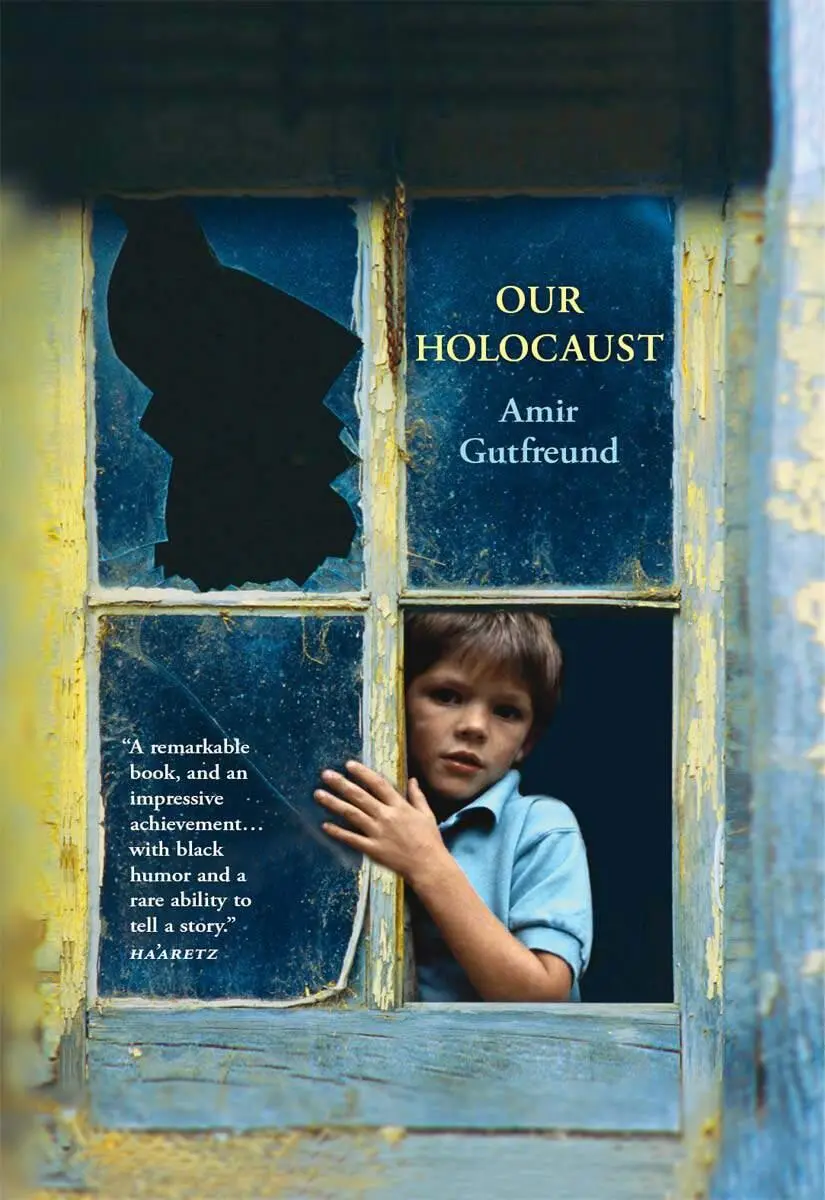
- Название:Our Holocaust
- Автор:
- Издательство:Toby Press Ltd
- Жанр:
- Год:2006
- ISBN:нет данных
- Рейтинг книги:4 / 5. Голосов: 1
-
Избранное:Добавить в избранное
- Отзывы:
-
Ваша оценка:
Our Holocaust: краткое содержание, описание и аннотация
Предлагаем к чтению аннотацию, описание, краткое содержание или предисловие (зависит от того, что написал сам автор книги «Our Holocaust»). Если вы не нашли необходимую информацию о книге — напишите в комментариях, мы постараемся отыскать её.
Our Holocaust — читать онлайн бесплатно полную книгу (весь текст) целиком
Ниже представлен текст книги, разбитый по страницам. Система сохранения места последней прочитанной страницы, позволяет с удобством читать онлайн бесплатно книгу «Our Holocaust», без необходимости каждый раз заново искать на чём Вы остановились. Поставьте закладку, и сможете в любой момент перейти на страницу, на которой закончили чтение.
Интервал:
Закладка:
Our trains would travel beyond the woods. We let them run over the tracks near our sleep, their chilling sounds setting music to our dreams. In our sleep we listened to the footsteps on the paths (someone walking), to the wanderers wandering (someone unable to find peace), to the quiet conversations, the calls into rooms, “Everything all right?” (someone worried about someone).
One person we could ask, even though he was officially insane, was Gershon Klima, his own brother. Three generations of psychiatrists had confirmed his madness and if anyone questioned him, Gershon Klima had the documents to prove it. He was one of the younger people in the neighborhood, born in fact in 1939, the year of the Big Bang. He came to Israel after the war with an older uncle and aunt and strayed through many places, living a virtually normal life, until he found the neighborhood. Gershon Klima was an expert plumber who worked for Kiryat Haim’s department of sewage. He spoke Hebrew like ours and worked for a living. He gave out toffee candies, and there was always the hope that he would take us on a trip through the sewage system. We worshipped Gershon Klima. His privilege of going down into the sewer, trivial as it may have seemed to other people, was inestimable in our world, in which every dark opening was a gateway to our hearts. We were drawn to the secrecy inherent in hollow spaces. We liked caves, burrows, tunnels and hovels. Nor were we indifferent to always-closed-doors, basements or attics. But in our heaven, had we been asked to come up with one, we would have given first priority to the sewer.
We went to see Gershon Klima often. Not in his house — no one went there. But to the open manhole that marked his whereabouts. We would sit with our legs dangling into the hole — a test of courage — and direct our questions downwards.
“Gershon, can we come down?”
“Why not?”
“Gershon, when will you take us on a tour of the tunnels?”
Gershon Klima did not answer. Busy. He poked his head out only when he felt comfortable, like a turtle whose shell is all the sidewalks and yards and gardens around the manhole. He smiled at us. Asked how we were. Asked us to move a little so he could climb out, and told us what kind of problem he was fixing down there and why he was officially barred from letting anyone in. It later turned out that, officially, Gershon Klima himself was barred from going in because the neighborhood wasn’t even his work area. But the Kiryat Haim sewage authorities turned a blind eye: Gershon Klima solved all their problems, and besides — you didn’t mess with Gershon Klima.
Gershon Klima was a quiet, wise man. But he did peculiar things and lived a peculiar life, so he had a bad reputation. No one in the neighborhood wanted to talk about Gershon Klima and no one wanted to talk with him, apart from Grandpa Yosef, who was above the normal rules. People thought Gershon Klima was scary just because he lived such an utterly different life. But Gershon Klima was a wonderful friend and a very useful one. Before Brandy, whenever someone had to find Captain Moshe, it was usually Gershon who came through. He had a sense.
His craziness came in an orderly fashion. Usually Gershon Klima beat the craziness to it, arranging his own hospitalization with one calm telephone call. Neatly following an internal debate that led to a clear-cut decision, he would leave his house after dawn and sit on the little bench beneath the huge Indian bombax tree. A little bag lay beside him. In the bag, Gershon Klima had packed a few clothes, some medications and a large, heavy pipe wrench. His skilled hands were exploited even at the mental institution in Tirat HaCarmel, where there was always a repair or two for him to do. Of all things, it would be the arrival of the four male nurses which enraged him. He would leap up like a demon at them, thrashing against their grip. The struggle was quickly decided. Gershon Klima calmed down. Mumbling, his arms slowly waved in the air. “Never mind, never mind…” he would reassure himself, the commotion with the nurses suddenly seeming needless and inappropriate. He would drape his arms over their shoulders, then smile and mutter, “It was…that was it,” as if having explained something fundamental, something that had always darkened his sunlight. Now he could rest. But then he would squirm in their arms again, almost wrenching one arm free, his eyes glistening with the possibilities should he be able to free one arm. The nurses would overcome him and Gershon Klima was swallowed up inside the ambulance.
Once or twice we went out at night and were able to see Gershon Klima being institutionalized. When he caught our eyes, he stopped fighting his captors. He smiled at us like a rabbit slung over a hunter’s shoulder. “Everything…it was…it’s all right…” And he was taken away.
We wanted to know why he was known as ‘his own brother.’ But no one would tell us. You could peek into his home from 17-B Katznelson, or boldly climb the huge bombax that rose from his modest yard halfway up the sky. He had an empty apartment. Utterly empty. No furniture, no tables, no boxes. Nothing. Walls and whitewash.
“I’ve always lived this way, this is how I like it,” he explained. He didn’t ask how we knew what the inside of his apartment looked like, just smiled sheepishly and promised to take us down the sewage tunnels one day.
“How far?” we wanted to know.
“Caesarea. Or Tiberias.”
He debated pros and cons to which we were not privy, then secretly settled them in his mind. “I lived like this on the kibbutz too.” A late-blooming thought to explain his empty apartment.
A few years after immigrating to Israel and bouncing around various places until the age of twenty-five, Gershon Klima had joined one of the most severe of the Shomer HaTzair movement’s kibbutzim. There, his request to live in a room without objects was reviewed and they allowed him to live between bare walls in a drafty room. They were impressed. His name was even mentioned at one of the national conferences as a model of ascetic extremism. Gains were reaped. Gershon Klima was briefly upheld as a paragon but was soon forgotten, to the relief of the kibbutz representatives. Better to suffice with brief symbolism and not expose the embarrassing flaw in his character, his insistent tendency to collect expensive fabrics as bedding. In the center of his room, on the bare floor, he scattered lengths of utterly non-socialist fabrics: satin, velvet, brocade and silk. A princely bed was formed from these broad sheets of fabric with cascading folds which, if not for the sour odor of perspiration and hay that clung to it, might have engendered thoughts of a harem. When he was kicked off the kibbutz because of something that happened, he gathered up his fabrics and came to the neighborhood. Peering through his window from the bombax branches, one could just make out his luxurious bedding in the corner of the room. We once stole a few silk shirts from Grandpa Lolek and gave them to Gershon Klima for his pile. He was touched.
“It’s a gift,” he explained our deed to us. He promised to get a permit and take us on a tour of the sewage tunnels.
“How far?” we pressed.
“Caesarea.” This time he was determined. “Too hot in Tiberias.”
His voice heralded a prediction about to come true. Caesarea! We could not immediately digest all the fun of anticipating this walk. For weeks and months we sat daydreaming, breaking the walk down into smaller units. We imagined a dark passage, numerous dangers and enemies, a treasure trunk. Arguments broke out — would there be bats? Would they bite? How many candles should we take? Were flashlights allowed? Would we ever return to our worried families? A sewage-full Caesarea was about to cleave our souls before we could even see it. Every few days we had to unload a dose of excitement upon Gershon Klima:
Читать дальшеИнтервал:
Закладка:
Похожие книги на «Our Holocaust»
Представляем Вашему вниманию похожие книги на «Our Holocaust» списком для выбора. Мы отобрали схожую по названию и смыслу литературу в надежде предоставить читателям больше вариантов отыскать новые, интересные, ещё непрочитанные произведения.











Обсуждение, отзывы о книге «Our Holocaust» и просто собственные мнения читателей. Оставьте ваши комментарии, напишите, что Вы думаете о произведении, его смысле или главных героях. Укажите что конкретно понравилось, а что нет, и почему Вы так считаете.