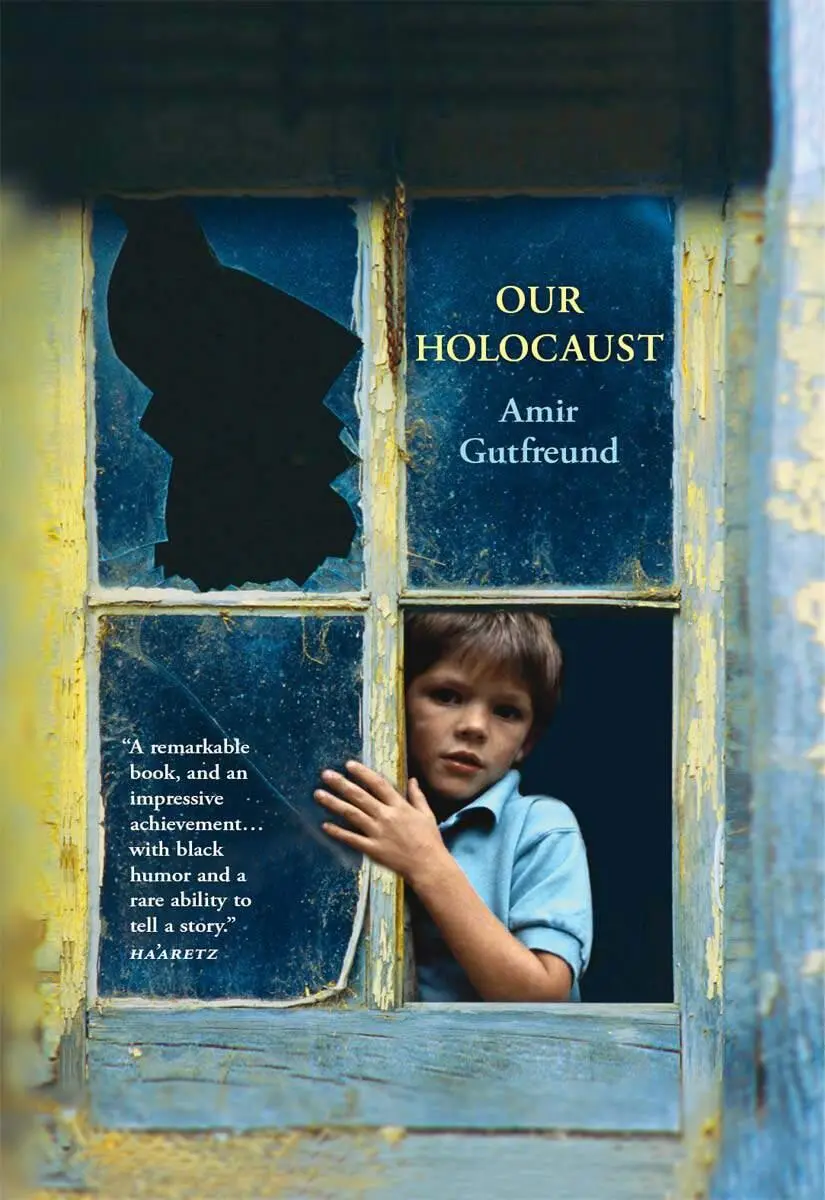
Amir Gutfreund - Our Holocaust
Здесь есть возможность читать онлайн «Amir Gutfreund - Our Holocaust» весь текст электронной книги совершенно бесплатно (целиком полную версию без сокращений). В некоторых случаях можно слушать аудио, скачать через торрент в формате fb2 и присутствует краткое содержание. Год выпуска: 2006, Издательство: Toby Press Ltd, Жанр: Современная проза, Прочая документальная литература, на английском языке. Описание произведения, (предисловие) а так же отзывы посетителей доступны на портале библиотеки ЛибКат.
- Название:Our Holocaust
- Автор:
- Издательство:Toby Press Ltd
- Жанр:
- Год:2006
- ISBN:нет данных
- Рейтинг книги:4 / 5. Голосов: 1
-
Избранное:Добавить в избранное
- Отзывы:
-
Ваша оценка:
Our Holocaust: краткое содержание, описание и аннотация
Предлагаем к чтению аннотацию, описание, краткое содержание или предисловие (зависит от того, что написал сам автор книги «Our Holocaust»). Если вы не нашли необходимую информацию о книге — напишите в комментариях, мы постараемся отыскать её.
Our Holocaust — читать онлайн бесплатно полную книгу (весь текст) целиком
Ниже представлен текст книги, разбитый по страницам. Система сохранения места последней прочитанной страницы, позволяет с удобством читать онлайн бесплатно книгу «Our Holocaust», без необходимости каждый раз заново искать на чём Вы остановились. Поставьте закладку, и сможете в любой момент перейти на страницу, на которой закончили чтение.
Интервал:
Закладка:
Like Mr. Pepperman, whom we visited just to tell him that Grandpa Yosef had been to the Municipality for him and everything would be fine, but he offered us grape juice and told us he had had two children our age, and his daughter had eyes like Effi’s. He told us, without being forced, how they took her in the Aktion at Kovno. Ruchaleh, ten years old. Then he said it was no story for children and that we shouldn’t tell Grandpa Yosef he’d told us.
The fonts of knowledge were well-hidden. Sometimes we passed by blocked-up walls without sensing that behind the wall was a spring yearning to burst. Still, we developed subtle senses, able to know who was worth hanging around, and we learned to listen. The stories were not straightforward. The old people mixed up their timelines. They jumped years ahead to the final moments before Liberation, then suddenly remembered the ghetto, their children, the camp commandant’s dog, the Passover Seder before the war even started. Suddenly, a train journey, scared to death, no ticket. How could they have a ticket? It was only 1940, before the exterminations, before they closed them off in a ghetto, and Jews were no longer allowed to ride the trains. They talked about the Death Marches, a moment before Liberation, snow and summer got mixed up and they mentioned a man and the store he owned before the war, so they could tell about how he was shot in front of their eyes during the Death March two hours before Liberation. He didn’t make it.
The stories were complicated, non-linear. But we were experts by then, knowing that time marched in a straight line only for those who slept at night. We listened quietly and later unraveled the stories and re-stitched them in the right order. We were not picky; it was hard to find people who would talk. The kaleidoscope of memories accumulated both successes and failures. Ella Pruchter, who wouldn’t talk, went to Grandpa Yosef to complain — not only about that but also about what we did to her plants. Beady-eyed Uncle Antek, wearing a white undershirt, smiled when we asked what happened in Auschwitz. He spread his hands out. He couldn’t help us. Auschwitz? Who could tell? He gave us toffee candies and went to snitch on us to Grandpa Yosef. And in contrast to them, at the last minute there was Zvi Alpert, who had already left the neighborhood with a new wife. He didn’t mind talking. His father threw him out of the train on the way to Belzec. A Polish farmer took him in, a six-year-old boy with broken legs.
Sometimes there was no choice. We came to Grandpa Yosef embroiled in the tangle of a story, a congestion of details whose every partial component put fear in our hearts.
“Grandpa Yosef, we need to know about Kurt Franz from Treblinka for a school project.”
But Holocaust Remembrance Day was still a long way away — we had barely scraped the mud off our boots from planting trees on Tu B’Shvat. Grandpa Yosef interrogated us. Where had we come up with that question? He didn’t believe the school project story. His expression was stern. Who had told us about “Doll”? He tracked down the source of the leak and Mr. Levertov was caught. Grandpa Yosef picked him up by the scruff of his neck like a bunny and extracted an oath that he would never talk to us about the war again. Children shouldn’t hear about Untersturmführer Kurt Franz, known as Doll.
But Kurt Franz had sunk in. Levertov’s transgression had been brief and incidental, barely two sentences as he stood outside the grocery with a bag of milk in his hand. But Kurt Franz, Doll, had been sown within us. Slowly but surely he would sprout. Slowly but surely he would grow. We would yet suffer because of him. Doll joined the heap of fragments — Majdanek, Belzec, Birkenau — and the names that kept reappearing — Warsaw, Lodz, Vilnius — among the terrible screeches of glass — Herman Goering, Ilse Koch, Dr. Mengele. From the center of the kaleidoscope an inviting hand was outstretched by Untersturmführer Kurt Franz, Doll. He drew us in.
We never stopped trying to outsmart them. We counted the days until Holocaust Remembrance Day and then came to Grandpa Yosef, a pair of scoundrels. Effi spoke for us both.
“Grandpa Yosef, everyone in class has to have someone tell them about the Shoah, so we can write essays about it. Everyone else has already done theirs.”
“Everyone?”
“Everyone.”
“Even Yossi, Avraham Buskila’s son?”
Grandpa Yosef knew the names of all the children in the classes and the names of their parents, because he had once glanced at the registers.
An awkward moment.
And then, without batting an eyelid: “The teacher said we could do it in pairs, and Yossi Buskila did it with fat Dorit whose dad was in the Shoah.”
“But the two of you aren’t even in the same class!” Grandpa Yosef pointed out, embarrassing us again.
We went for double or nothing.
“That’s why we need two stories!”
And we won.
But Grandpa Yosef merely scratched off some stories from the outer peel for us, not even a hint of the burning core. Disappointment. He tried to interest us in the structure of the microscope, the life and times of Rashi, American Indians, and the 1920 riots in Palestine. But we demanded Shoah stories. The misshapen Shoah, the one on the other side of the fence, the one we were not yet Old Enough for. We weren’t happy with what we were allowed and our senses picked up on what was beyond, the bigger Shoah, where the pale neighborhood characters turned into protagonists in a plot.
We were twelve years old when we began to rebel. Up to then we had settled for the random stories, the hidden fountains, what little our family consented to give — what they thought was appropriate for our age. At twelve, our sense of internal order began to make its own demands. We tossed out childhood materials to make way for consciousness. We wanted to know what our parents had been through, to know about the people who had been lost, the people that looked out at us from black-and-white photographs with handsome moustaches and serious eyes. We wanted Grandpa Yosef’s story. What had he been through? Why had he gone through so many ghettos and camps? How was he saved? Everything we knew was punctured, perforated, full of pauses. Stories lacking continuity, with torn out pages, one episode after another after another, but between the events lay chasms. There was no integral whole, only a kind of Morse code, dot-dash-dot dash-dash-dot. Our rebellion declared: If we can’t know about your Shoah, we’ll find out about everybody else’s.
We began to study, to acquire knowledge. We went to public libraries every day after school, just the two of us. Our day truly began after English and Grammar were over. We read, we studied. We made good use of our reading glasses. Auschwitz and Buchenwald, Treblinka and Majdanek flew across the pages of our books. Eternal, perpetual, in a solar system whose maps were becoming clearer. Now the questions burned in us from two directions. Not only, “Dad, what happened to you in the Aktion in Bochnia?” but also, “What did the Commandant at Magdeburg do to the prisoners with his dog?” Not just, “Why did Adella Greuner’s husband complain to a Nazi general about the handsome ghetto commander?” but also, “What was the difference between the regular Bergen-Belsen camp and the exchange camp?” We cultivated questions at an age that did not yet enable us to completely understand them. We collected stars and comets, and later we would figure out the laws, the paths.
We wanted to bring what was written in the books to our family, to the neighborhood, to find out what we might read if they wrote books. We couldn’t, we weren’t yet Old Enough. Grandpa Yosef sealed off the shores better than the British had — illegal immigrants hardly dared approach. People knew how to close themselves off uninstructed, intuitively, a perk for anyone who had been through a life like theirs. We didn’t have many chances, we were up against too many enemies, like the heroic Paladins in our Tarbut encyclopedia. But we declared an emergency mobilization. We mustered all our resources. Courage and schemes and flattery and lies and blackmail and planning. All orchestrated from the rear by a level-headed mechanism, relying on a childish confidence that our punishment would not be too severe. We collected what we could, picked everything that could be picked. We created a shape. Established a shuffled world of Shoah, a valid world in which the Holocaust was a geographical area, a district with a postal authority and a written history. Whatever we knew about the family, about the elderly neighborhood residents, found a place and was given citizenship and land. It was not organized research, it was begging. No — it was a hunt.
Читать дальшеИнтервал:
Закладка:
Похожие книги на «Our Holocaust»
Представляем Вашему вниманию похожие книги на «Our Holocaust» списком для выбора. Мы отобрали схожую по названию и смыслу литературу в надежде предоставить читателям больше вариантов отыскать новые, интересные, ещё непрочитанные произведения.



Обсуждение, отзывы о книге «Our Holocaust» и просто собственные мнения читателей. Оставьте ваши комментарии, напишите, что Вы думаете о произведении, его смысле или главных героях. Укажите что конкретно понравилось, а что нет, и почему Вы так считаете.