Amir Gutfreund - Our Holocaust
Здесь есть возможность читать онлайн «Amir Gutfreund - Our Holocaust» весь текст электронной книги совершенно бесплатно (целиком полную версию без сокращений). В некоторых случаях можно слушать аудио, скачать через торрент в формате fb2 и присутствует краткое содержание. Год выпуска: 2006, Издательство: Toby Press Ltd, Жанр: Современная проза, Прочая документальная литература, на английском языке. Описание произведения, (предисловие) а так же отзывы посетителей доступны на портале библиотеки ЛибКат.
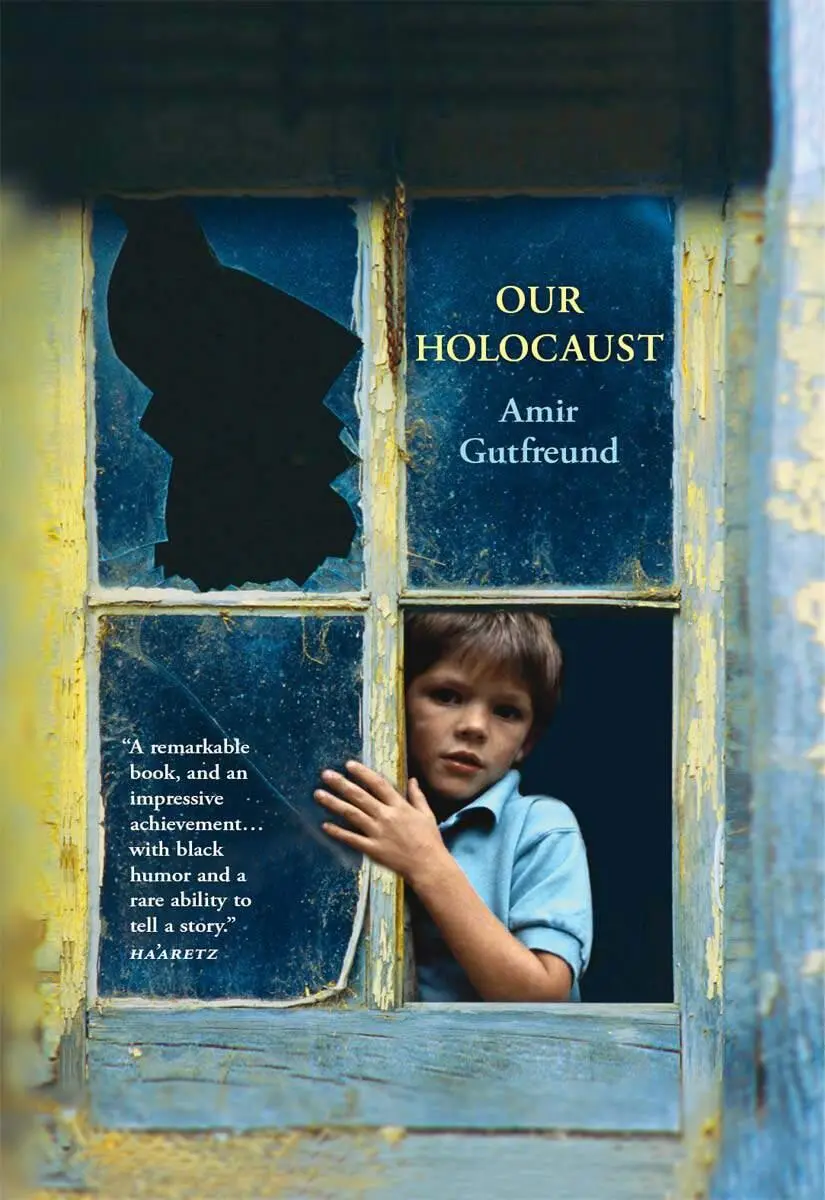
- Название:Our Holocaust
- Автор:
- Издательство:Toby Press Ltd
- Жанр:
- Год:2006
- ISBN:нет данных
- Рейтинг книги:4 / 5. Голосов: 1
-
Избранное:Добавить в избранное
- Отзывы:
-
Ваша оценка:
Our Holocaust: краткое содержание, описание и аннотация
Предлагаем к чтению аннотацию, описание, краткое содержание или предисловие (зависит от того, что написал сам автор книги «Our Holocaust»). Если вы не нашли необходимую информацию о книге — напишите в комментариях, мы постараемся отыскать её.
Our Holocaust — читать онлайн бесплатно полную книгу (весь текст) целиком
Ниже представлен текст книги, разбитый по страницам. Система сохранения места последней прочитанной страницы, позволяет с удобством читать онлайн бесплатно книгу «Our Holocaust», без необходимости каждый раз заново искать на чём Вы остановились. Поставьте закладку, и сможете в любой момент перейти на страницу, на которой закончили чтение.
Интервал:
Закладка:
With slanted rifles and hunting caps, we marched through the forest on the lookout for prey. On the paths, in the branches, in the bare patches, we hunted. We hunted Mr. Orgenstern (1914–1991), Jezupol Aktion , and we hunted Mr. Cogen through the Vilnius woods, Majdanek, Sobibor. We hunted Littman, Buchenwald, and Mrs. Rudin. We hunted Genia Mintz (1920–1976), Krakow ghetto and Ravensbrück, and we hunted Olinowsky (1921–1980), Kovno. We walked up proudly to the fruits of our hunt and held out our hat for a penny.
“Mrs. Rudin, is it true you were in Stutthof? Tell us about Stutthof camp.”
“Mr. Cogen, is it true that Ilse Koch used to mark up the Jews before the gas chambers, to make lampshades out of their skin?”
“Mr. Orgenstern, Dad says thanks for the pruning shears, and we wanted to ask, what happened at Magdeburg? In the book it says there was a dog that ate prisoners.”
Once in a while, as we entered the thicket, we came across Crazy Hirsch, but we were loath to conquer that lying beast. We wanted none of Hirsch. We were after the nimble deer like Gershon Klima. We wanted our arrows to strike Adella Greuner, Mr. Bergman, Itcha Dinitz, one of the burrow-dwellers who might — if we could only penetrate their habitat — provide the magic key.
Disobeying the librarian, we furtively read Ka-Tzetnik’s novel, Piepel , and we knew then what Itcha Dinitz was and what the kapos did with young boys. We read testimonies from the Vilnius ghetto. Now Mr. Cogen’s mumblings began to make sense. Needy people from the testimonies had come to his father’s pharmacy. The testimonies confirmed that the pharmacist Cogen had taken a hundred final pills with his wife and son. Mr. Cogen explained to us that he spat them all out when his father wasn’t watching, went to sleep and woke up an orphan.
And once a year, there was a big surprise. Grandpa Yosef’s font of knowledge opened up.
On the same day every year he would go to Tel Aviv. He wore a white shirt that was smarter than the usual ones, and insisted on taking the train. Despite three-days-closed-up-standing-upright-in-a-traincar-between-Ravensbrück-and-Sachsenhausen, despite the deaths on the way between Dora-Mittelbau and Buchenwald, between Buchenwald and Gross-Rosen, he rode the train. Against his better judgment, he took us with him. Once we arrived, he left us with a man by the name of Yehezkel, nicknamed Hezi, and disappeared for a few hours while we ran around the amusement park with its Ferris wheel and motorbike show and cotton candy. Meanwhile, Grandpa Yosef took part in the annual memorial service for the Jews of Bochnia. On the way home, with us still flushed from the haunted house and the rollercoaster and the bumper cars, he became a gushing fountain. Later there were regrets, but on the train, instead of telling us about magnetic fields or King Solomon, he spoke of kiddush Hashem and Buchenwald and the Warsaw ghetto uprising. He suddenly took an interest in what we were learning at school and what we knew (somewhat surprised). Unable to dam up his flow of stories, his Shoah erupted: the Lodz ghetto, children starving to death, the child he saw ripped to shreds by dogs, little bodies covered with lime so they wouldn’t spread diseases.
Small stations pass by outside, faces on platforms, and the landscape sticks it tongue out at us. Large buildings with cranes above them, railway sleepers in heaps, trees as yellow as a lemon-ice (“Not now, we’re listening”), and the stories somehow involve a real puppet show in a concentration camp and a lion trainer whom Grandpa Yosef knew and a merry-go-round on which Grandpa Weil rode in the middle of his escape from a death march, and there’s snow in different colors and someone who ate twenty candied apples (“Not now, we’re listening to Grandpa Yosef’s Shoah”), and we wait for the story to come back to him — his story. The train charges on. Grandpa Yosef talks. Down below the pistons chug doubtfully, the get your lemon-ice strawberry-ice here man comes and goes, ticket collectors flow through the cars, passengers search for their tickets. Grandpa Yosef gushes. Outside, platform signs smear by—“Netanya North,” “Hadera West”—many towns in all directions, all with train stations we must pass, and trains rush by in the opposite direction, their rows of windows as long as Katznelson, the air trapped between the two trains transparent, tremulous. Again the Lodz ghetto, again children starved to death. Again the boy devoured by dogs, again the bodies covered in lime.
By the time we get to Haifa it all falls apart. Grandpa Yosef dozes off. We go to the snack bar and use the coins he gave us. Kibbutz Ma’agan Michael has passed us by, Atlit floats behind the dusty window. Southern Haifa welcomes the train, finding a spot for it between the ocean and the neighborhood houses. The train whistles as it enters the station, waking Grandpa Yosef. A little confused, a little alarmed, he looks at our faces that are dotted with powdered sugar from cold donuts. The board says the train goes on to Kiryat Haim and Kiryat Motzkin, but Grandpa Yosef ignores these facts. As far as he is concerned there is no train to Kiryat Haim. As far as he is concerned we’d be better off without any trains. He waits for the train to stop so he can get off first, his body still a little slow, his face sleepy. On the platform, we flank him on either side, in charge of the bags, the packages, the bonbons from Tel Aviv. Our hands, sticky from juice, grasp his sleeves. Grandpa Yosef slowly restores himself, awakens, next to the eternally inaccurate clock, recovering just in time to explain why in our country we should have done without trains.
Grandpa Yosef was impassioned about this idea. Even though you had to take two buses to get from the Haifa train station to his house — a journey that twice defeated you — and even though he insisted on taking the train to Tel Aviv, he obstinately claimed that in our country we should have done away with trains. Trains could be used to transport anything you wanted, far away from people. Things should not be allowed to be transported far away from people. Everything should be on the main routes, on the roads, among cars, so that everyone knows what’s going on. Year after year, Grandpa Yosef’s explanation glimmered in the kaleidoscope of memories, recording itself as something-we-must-remember. Year after year, with slight variations, it asserted itself at the schedule board or on the way out as we passed by the kiosk without buying anything. Once Effi lost a ball while we were still on the train — we were the last ones in the car, hoping to find the ball before the train set off for Kiryat Haim. Even when we stood in crowded buses, dripping with uncomfortable sweat and holding too many packages and gooey boxes of bonbons, Grandpa Yosef insisted.
We would barely listen to him, still breathless from our Tel Aviv adventure at the amusement park and from the gushing well of Grandpa Yosef now sealed off, now regretting his words. But it was too late, the stories were already inside us, being marched down the road like hostages to a large camp, and new hostages were added every year. There was no choice, this was the only way to gather information. But the hoarded material still did not form a clear picture. The events, the people, the acts, were all fragments and crumbs, meaningless on their own, but an abstract picture emerged from their collective. Not a picture we could explain or describe, but a rich image whose details had no significance. Everything we learned, each additional story, formed a new sliver for the kaleidoscope, where the pictures spun around, erased themselves, and a new model was created.
We spent the nights after the trips to Tel Aviv at Grandpa Yosef’s, lying wide-eyed in the dark, listening. Every so often we heard trains faraway. And in later years, when I was a soldier taking ordinary train rides, catching a nap on the way, suddenly there would be a click and the trains would change with the light whisper of a well-oiled machine. Something full of innocent passengers was taken away, lunch-boxes-scattered-newspapers-do-you-have-the-sportspage-and-children-running-around-yelling-and-even-an-impudent-spit-ball-flying-out-the-window-hitting-a-stunned-face. All this was replaced with narrow-high-windows-no-air-down-there-bodies-squirming-devilish-siren-who-knows-what-village-passing-by-long-stops-hours-and-days-without-moving-tiny-sobbing-stops.
Читать дальшеИнтервал:
Закладка:
Похожие книги на «Our Holocaust»
Представляем Вашему вниманию похожие книги на «Our Holocaust» списком для выбора. Мы отобрали схожую по названию и смыслу литературу в надежде предоставить читателям больше вариантов отыскать новые, интересные, ещё непрочитанные произведения.







Обсуждение, отзывы о книге «Our Holocaust» и просто собственные мнения читателей. Оставьте ваши комментарии, напишите, что Вы думаете о произведении, его смысле или главных героях. Укажите что конкретно понравилось, а что нет, и почему Вы так считаете.