Amir Gutfreund - Our Holocaust
Здесь есть возможность читать онлайн «Amir Gutfreund - Our Holocaust» весь текст электронной книги совершенно бесплатно (целиком полную версию без сокращений). В некоторых случаях можно слушать аудио, скачать через торрент в формате fb2 и присутствует краткое содержание. Год выпуска: 2006, Издательство: Toby Press Ltd, Жанр: Современная проза, Прочая документальная литература, на английском языке. Описание произведения, (предисловие) а так же отзывы посетителей доступны на портале библиотеки ЛибКат.
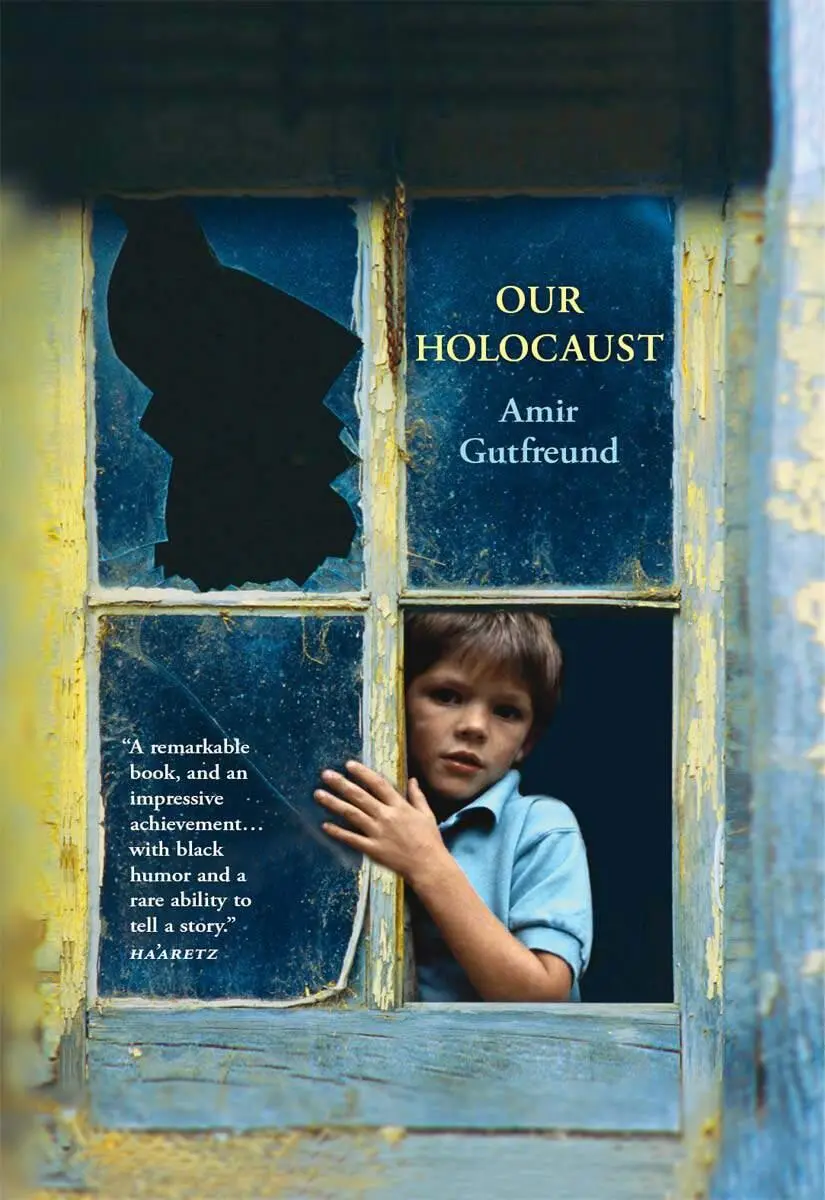
- Название:Our Holocaust
- Автор:
- Издательство:Toby Press Ltd
- Жанр:
- Год:2006
- ISBN:нет данных
- Рейтинг книги:4 / 5. Голосов: 1
-
Избранное:Добавить в избранное
- Отзывы:
-
Ваша оценка:
Our Holocaust: краткое содержание, описание и аннотация
Предлагаем к чтению аннотацию, описание, краткое содержание или предисловие (зависит от того, что написал сам автор книги «Our Holocaust»). Если вы не нашли необходимую информацию о книге — напишите в комментариях, мы постараемся отыскать её.
Our Holocaust — читать онлайн бесплатно полную книгу (весь текст) целиком
Ниже представлен текст книги, разбитый по страницам. Система сохранения места последней прочитанной страницы, позволяет с удобством читать онлайн бесплатно книгу «Our Holocaust», без необходимости каждый раз заново искать на чём Вы остановились. Поставьте закладку, и сможете в любой момент перейти на страницу, на которой закончили чтение.
Интервал:
Закладка:
These prematurely old people waiting mutely on benches at the Sick Fund, spinning their memories around and around, were aqueducts that carried life and memories. Afterwards, at home, they philosophized quietly in their rooms, men and women of ideas (some were modest, having only one idea). Dam-builders, forest-choppers, mountain-climbers, gold-miners, land-birthers. A multitude of gold and wine-like light in impenetrable eyes — only memories could light sparks in those eyes. Crinoline dresses danced tenderly to the sounds of the radio at Adella Greuner’s. The margosa trees dripped with barren fruit that turned yellow as it fell. Only the yard of Gershon Klima, his own brother, was blessed with a massive Indian bombax. Feiga also had a tree by her window, a mad poinciana whose branches groaned in the wind. As if her real demons were not bad enough, in the rain she imagined devils hanging from the stems of the leaves.

The Holocaust extended its reach beyond the neighborhood. Traces of Shoah lurked in the most surprising places, like the little shops where Dad went to order wallpaper or buy light bulbs. He often took me with him to Attorney Perl’s hardware store on Yonah HaNavi Street. Apart from buying plaster or little boxes of screws, it was a place where you could talk, ask questions and watch Attorney Perl at work. People used to stand with their elbows on the counter and gaze at the wall behind Attorney Perl, which was a patchwork of small metal drawers, each containing its own peculiar occupants: nails, screws, nuts, bolts, hooks, latches, washers, rubber bands. Attorney Perl would be up on the ladder in his blue smock, scaling the length and height of the wall like Spiderman, filling the customers’ orders. Words cannot adequately convey the splendor of his motion. The slowness. The precision. His serene voice enquiring from above, “I’ve only got half-inch ones. Will they do?” Clinging to the wall as he moved up and down, right and left, Attorney Perl would descend for a brief moment to hand over the goods and take the customer’s money. Then up the ladder again to retrieve something from another metal drawer. Measure out the contents. Wrap the correct amount in a small paper bag. Climb down. Deliver the goods.
Attorney Perl was born in 1900. Before the war he was a practicing attorney. In his town of Stanislaw, near Lvov, he was known even among the goyim as an expert in business, commerce, and property law. His voice echoed beautifully through the courtroom, as if the dimensions of the space had been designed precisely for his vocal chords. Had he not been Jewish, he might have been appointed a judge in Lvov. At the beginning of the war he lived in the Bochnia ghetto, in the same house as Dad’s family, 7 Leonarda Street. Then he was sent to Auschwitz, and later to work in Dora-Mittelbau. This camp, with its tender, womanly name, is hardly mentioned in Holocaust stories because very few of its inhabitants survived. Attorney Perl would have been lost too, if he hadn’t found his way to one of the Dora-Mittelbau satellite camps, where he operated Obersturmführer Jürgen Licht’s puppet theater. After the war, he came to Israel. His days in the camps had not only left the attorney barely more than skin and bones, but had also rendered him skeptical of the validity of the law. So he opened a little hardware store. But even after all those years, even to people who knew nothing of his aborted career as a lawyer in the courtrooms of Lvov, when he called out from up top, “Coated or uncoated, the nuts?” he still exuded a stifling sense of eminence. People answered cautiously. Put their hands to their chins. Pondered.
Sometimes he would take Dad and me into the little chamber behind the wall of drawers. He would tell his assistant, “Yakov, mind the store for a while” (his assistants were always called Yakov), and take us to the back room. There, to my surprise, was a mirror image of the store. On the reverse side of the wall was another wall of drawers, containing the store inventory. The space below the counter looked just like its front-end counterpart. But the width of the chamber was different, and I soon noticed other dissimilarities, including a black-and-white photograph of a woman, a tea kettle, two fountain pens, and a book in Latin.
Sometimes Attorney Perl would point to the picture of the woman and ask Dad if he remembered her, forgetting that he had asked the same question many times. Dad would answer politely, “No, I don’t remember her,” and Attorney Perl, astonished, would wonder how this was possible. After all, they had lived together in the same house in the Bochnia ghetto until she was taken away. During those brief moments, Attorney Perl found the world to be a strange place. His fingers caressed the kettle as he contemplated how it could have happened. In Stanislaw, before they were married, half the town had courted her. Everyone knew her. And here, now — no one. Not even the people from the ghetto. Gradually, he would regain his composure. We would wait patiently as he went about making us tea in his calm manner. He talked with Dad, and a little with me. I liked to listen to the majesty in his voice, especially when he argued. He could quote from books in all sorts of languages and knew every minute detail of Polish history, as if it had been tailor-made for him. The only match for him was a wizard like Grandpa Yosef. Occasionally, one of Dad’s responses to his questions would leave Attorney Perl hesitant, momentarily disarmed, but he would soon perk up and produce a witty retort, replete with dates and quotations. Still, there was respect in his eyes when he looked at Dad ( Nu , and this is the boy who was so mischievous in the ghetto!).
I sat between them, coveting the appreciative looks. The kaleidoscope of memories came by like a large fish, swallowing up the flakes: Attorney Perl argues with Dad. Dad wins. Attorney Perl slurps his tea and says nothing . Colorful flakes. Soon they would be gone and I would no longer remember them. But the scenes still echo, chipped and crushed, inside the kaleidoscope.
Sometimes the arguments led to the topic of Attorney Perl’s great plan — his despoiled, lost plan. He wondered out loud, now did they understand how far-reaching his predictions had been? At the end of the war, when Jews were thinking only of themselves, of food and of family members who may or may not have survived, Attorney Perl was busy scurrying back and forth among offices and embassies. His feverish momentum thwarted any notion of throwing him out onto the street. He was surrounded by desperate people trying to slip into offices and present their documents with trembling hands, petitioning bureaucrats on their own behalf or for a family member. Negotiations were attempted in reception rooms between a certain Yakov Zweig, tailor, and the government of the United States of America. People retreated in despair, sighed and went to try their luck elsewhere. They took no notice of retired Attorney Perl — his skin covered with eczema and his body little more than a skeleton — as he proclaimed his sacred mission at every embassy and bureau: Clemency must be granted to all the Nazi leaders. Under no circumstances should they be hanged.
This was the essence of Attorney Perl’s position and the impetus for his bureaucratic endeavors. Fifty years from now, he explained, we will regret not having kept them alive, not having bothered to collect their versions. Not the rushed testimonies obtained from shattered officers during two weeks of interrogation. Not the court rendering, but rather a version for the history books. So that we might comprehend what exactly they were thinking, which orders were spoken, who said what. We must not be satisfied with the statements they give in court before they are hanged, their mouths contorted in contempt or terror. We must leave them to patiently document every tiny detail. Because if we hang the wretches, we shall never know both sides of the truth. We will keep digging our heels into our own versions. Historians born after the war will try to understand the other side based on the inconsequential utterances of junior officers. We will all stand in front of the mirror that reflects us, our side, and we will deny the other side, the dark one. Regrets will be of no use. It is the heart’s duty — humanity’s duty, to keep these criminals alive, and it will be far more useful for us than any revenge could ever be. Many years after it had failed, after the Nuremberg hangings had disastrously killed all those who could testify, Attorney Perl never tired of his plan. What exactly were they thinking? What orders were they given?
Читать дальшеИнтервал:
Закладка:
Похожие книги на «Our Holocaust»
Представляем Вашему вниманию похожие книги на «Our Holocaust» списком для выбора. Мы отобрали схожую по названию и смыслу литературу в надежде предоставить читателям больше вариантов отыскать новые, интересные, ещё непрочитанные произведения.






Обсуждение, отзывы о книге «Our Holocaust» и просто собственные мнения читателей. Оставьте ваши комментарии, напишите, что Вы думаете о произведении, его смысле или главных героях. Укажите что конкретно понравилось, а что нет, и почему Вы так считаете.