Amir Gutfreund - Our Holocaust
Здесь есть возможность читать онлайн «Amir Gutfreund - Our Holocaust» весь текст электронной книги совершенно бесплатно (целиком полную версию без сокращений). В некоторых случаях можно слушать аудио, скачать через торрент в формате fb2 и присутствует краткое содержание. Год выпуска: 2006, Издательство: Toby Press Ltd, Жанр: Современная проза, Прочая документальная литература, на английском языке. Описание произведения, (предисловие) а так же отзывы посетителей доступны на портале библиотеки ЛибКат.
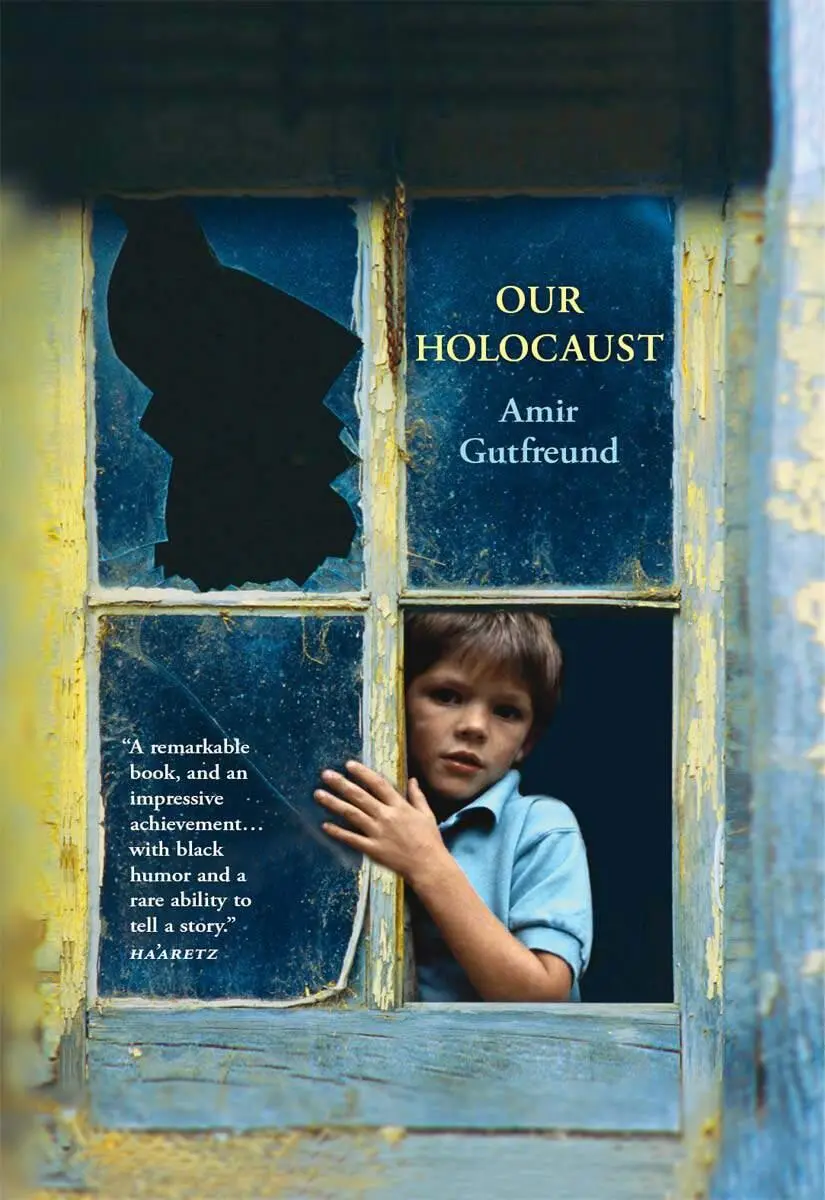
- Название:Our Holocaust
- Автор:
- Издательство:Toby Press Ltd
- Жанр:
- Год:2006
- ISBN:нет данных
- Рейтинг книги:4 / 5. Голосов: 1
-
Избранное:Добавить в избранное
- Отзывы:
-
Ваша оценка:
Our Holocaust: краткое содержание, описание и аннотация
Предлагаем к чтению аннотацию, описание, краткое содержание или предисловие (зависит от того, что написал сам автор книги «Our Holocaust»). Если вы не нашли необходимую информацию о книге — напишите в комментариях, мы постараемся отыскать её.
Our Holocaust — читать онлайн бесплатно полную книгу (весь текст) целиком
Ниже представлен текст книги, разбитый по страницам. Система сохранения места последней прочитанной страницы, позволяет с удобством читать онлайн бесплатно книгу «Our Holocaust», без необходимости каждый раз заново искать на чём Вы остановились. Поставьте закладку, и сможете в любой момент перейти на страницу, на которой закончили чтение.
Интервал:
Закладка:
Effi dragged me into the oleander shade. She did not speak. She was breathing heavily and I saw a strange look in her eyes, beneath fluttering eyelids. Without warning, she lay down on her back on the slightly putrid bed of leaves, and slowly took off her blouse, crushing the leaves as she squirmed. Her nipples were presented to me with the hem of her blouse still draped over her forearms. Curiously, I surveyed the revelation, the fair mounds which bore her nipples on their peaks, and my heart did not demand a thing. Effi ordered me to come closer, laid down the law. She let me touch her with my tongue, but only on her belly-button, her earlobes, and the tip of her nose. She warned me against deviating from this crucifix of flesh. I knelt, examining my options, looking for interest in them. Effi breathed heavily. Nerve endings bustled just beneath the surface of her skin, invisible channels of sweetness perceptible only in her rosy blush. I kissed her earlobes undesiringly, cautiously touched the edge of her nose, then licked her navel. I sat up straight.
Effi sighed with her eyes closed. “Again.”
I was scared. “Again?”
Effi felt for my hand. She dragged it over her skin, letting me find the tracks on my own. “Use your tongue too,” she ordered.
I chose the safest looking path, the four points that had already proven themselves. I flitted over her navel, her ears, her nose. I sniffed. Effi exuded a new scent of budding perspiration. I gained courage and touched a nipple. I put my lips to it and tried to drink. I placed my hand on her abdomen and attempted to draw out a single drop, the way we had once both sucked on the udders of Lassie, the barn dog. She had not put up much resistance as we removed her puppies and tasted her udders, only a look that said, “Kids, it’s not pasteurized,” and slight amazement, perhaps also resentment at the temporary suspension of her puppies. (We didn’t drink much. It was a little bitter and unpleasantly warm. Unlike Romulus and Remus, we preferred grape juice.) I could not find a drop in Effi’s nipples. And she too, fairly soon, grew bored. But a new idea glistened.
At my cousin Zevik’s wedding, Grandpa Hainek’s son Eitan had been kind enough to explain to me about the schlong. He pulled me aside at one of the tables and went into great detail regarding whom he had given his schlong to, whom he was planning to give his schlong to, and how one gives one’s schlong. Later, in the restroom, he pulled down his pants and showed me this mysterious creature, the schlong, which had-been and was-being and would-be given according to a carefully implemented plan. I discovered with Columbus-like excitement that I too had a fragile schlong in my pants, and that its thus-far monotonous functions (sometimes, to my chagrin, at night in bed) were merely a spiritual weakening whose time was up. Now I looked at Effi and was guided by an unspoken sensation — her fluttering eyelids, her trembling lips, her expectant look. I put my worlds together and enquired, “Do you want to get my schlong?”
The days were days of Buchenwald, and I was dizzy from barely eating, and Effi’s slap sent me reeling into deep darkness. I could not believe how much Jewish strength still remained in the hand of this girl who had been testing her limits by starving herself for a week. Years later, she told me I was the only one who had been in the throes of Buchenwald starvation. She was secretly gobbling down double meals, fattening herself up in the dining room and at Dov’s. “I thought about it,” she generously explained, “about whether both of us really needed to do it, to understand.” And she had a complaint too. “Do you have any idea how many apples I had to eat, to make you those scraps?”
I woke up alone. Effi had left and gone to Dov’s room, where she sat comfortably eating jam and loquats, preparing me some apple rinds as she munched her way through a bag of toffee candies. The sun stole in between the oleanders, striking my face. I opened my mouth wide, feeling singed. Voices came from afar, people walking. My eyes could not see, shadows were distorted, glimpses of color danced around. I vomited, still lying on my back, almost choking. I could not open my eyes. How would I get up? I lay helpless, wanting to drink just one drop. I tried to move again, in vain. Nausea. I wanted to pass out, not to suffer the dizziness, the thirst. At the last minute, before giving in, I made one more effort. I rolled onto my side and sat up on my knees. Things were dripping inside my head. Circles running in my eyes. I vomited again. I got up very slowly and opened my eyes. I walked, lightly touching the branches, anchoring myself in the spinning world. I followed the shrubs all the way to where the path began and made my way to Dov’s room. Got to survive.
I ate three dinners that evening, and for the next two days I kept drinking from every tap I came across, just in case. But at the moment when I touched the door to Dov’s room, on the border between an Israeli kibbutz and Cell Block 55 in Buchenwald, I touched a speck of Shoah. Only a hint, just for a moment, but I will never again be as close. The Buchenwaldian moment was over as soon as I washed my face, but a glowing spot remained inside of me. And there remained Effi’s look when I turned up at the door, my face and shirt stained with vomit and blood, my eyes vacant, unresponsive, as I walked to the sink with a strange quaver. A speck also remained deep inside her. I had been to Buchenwald, she had not. A solid stain of failure that no future victories could melt away. An Archimedean point that marked new directions in our relationship.
To console herself, she stood on the peaks of Monte Cassino with Grandpa Lolek the hero. When we went back to school, she brought him in to tell his story to her class. Despite his broken Hebrew and the hollow ring of his tales, when he faced an audience of thirteen-year-olds, Grandpa Lolek might as well have been a recruiter for the Israel Defense Forces: six armor officers, five paratroopers, two pilots and one Mossad agent were ready to sign up. At the end of the class, Effi stood beside him on that glorious mountaintop with her eyes lowered modestly, basking in admiration. He wouldn’t come to my class. Even one free appearance was beyond his emotional strength. For Effi, he agreed. She was always his favorite. He had plans to marry her off for a good price one day. “What a beauty! My woman! Men will be around her like flies!” The object of these compliments, barely fourteen years old, was less excited. Men were always like flies. Sometimes the compliments were dual. He would gather us both in his arms and gush, “You are mamelach , like my children.” He shoved the word like to the front, its prominence thwarting any ideas of offspring-hood we might have.
Later that summer the anarchy continued. Due to a coordination mishap, we were sent to spend two whole days with Grandpa Lolek. There was no telling what he was promised, and he usually collected his debts promptly and firmly. In any event, he managed the first day nobly, took us to the Carmel Center and with a flourish of generosity bought us each two swimsuits. He even took us out, like grownups, to a café, where he let us order chocolate cake and hot cocoa while he smoked his cigarettes and sipped a cup of tea. The cakes and cocoa were our reward for listening to him once again recount the story of Joyce the American dancer, the one who came with a troupe from Kentucky to entertain the soldiers, but one of the generals took a liking to her and she was ordered to stay behind when the troupe left and entertain him alone. Once he was sufficiently entertained, he wanted to send her to entertain another general, but our Queen Esther responded with a stinging slap on his cheek. Lonely and tearful, she walked the streets until she met her savior, Grandpa Lolek, a soldier in Anders’ Army waiting to be deployed to the front. On the rainy dock, she danced for him with two umbrellas in her hands, etc., etc., etc.
Читать дальшеИнтервал:
Закладка:
Похожие книги на «Our Holocaust»
Представляем Вашему вниманию похожие книги на «Our Holocaust» списком для выбора. Мы отобрали схожую по названию и смыслу литературу в надежде предоставить читателям больше вариантов отыскать новые, интересные, ещё непрочитанные произведения.











Обсуждение, отзывы о книге «Our Holocaust» и просто собственные мнения читателей. Оставьте ваши комментарии, напишите, что Вы думаете о произведении, его смысле или главных героях. Укажите что конкретно понравилось, а что нет, и почему Вы так считаете.