Amir Gutfreund - Our Holocaust
Здесь есть возможность читать онлайн «Amir Gutfreund - Our Holocaust» весь текст электронной книги совершенно бесплатно (целиком полную версию без сокращений). В некоторых случаях можно слушать аудио, скачать через торрент в формате fb2 и присутствует краткое содержание. Год выпуска: 2006, Издательство: Toby Press Ltd, Жанр: Современная проза, Прочая документальная литература, на английском языке. Описание произведения, (предисловие) а так же отзывы посетителей доступны на портале библиотеки ЛибКат.
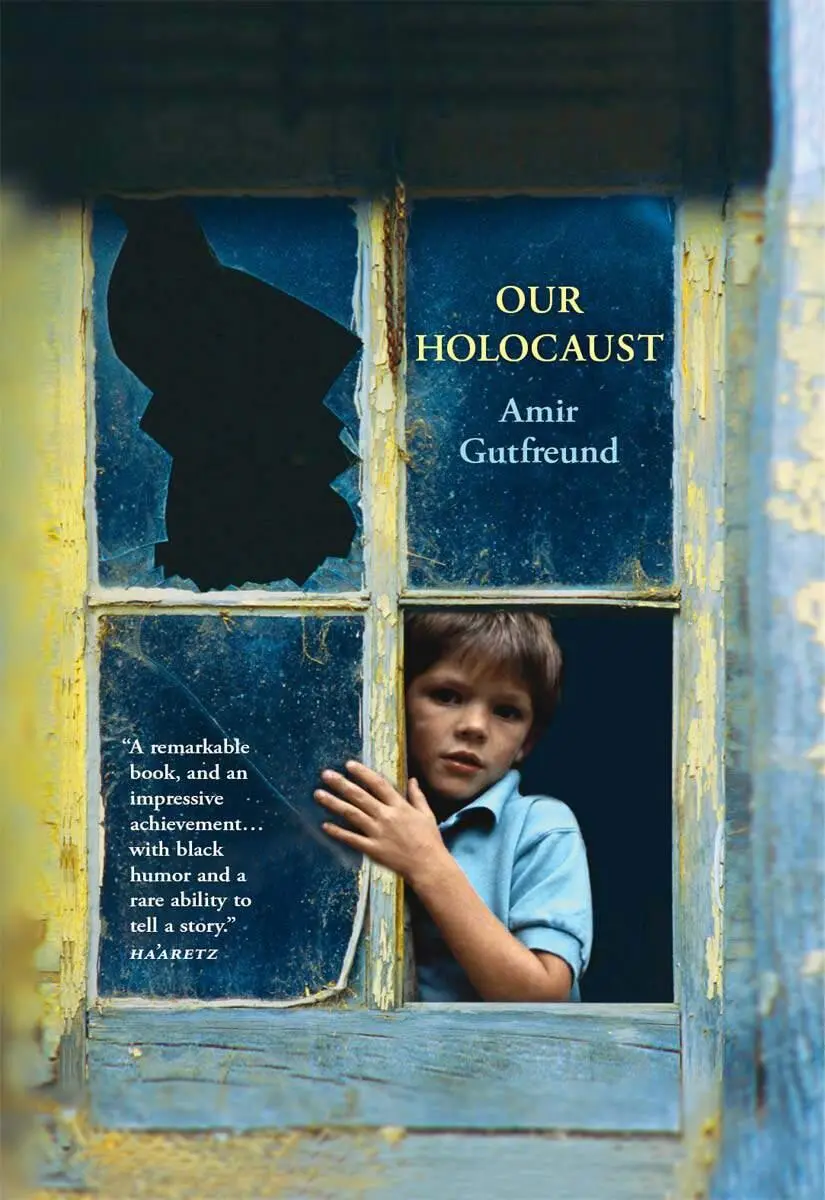
- Название:Our Holocaust
- Автор:
- Издательство:Toby Press Ltd
- Жанр:
- Год:2006
- ISBN:нет данных
- Рейтинг книги:4 / 5. Голосов: 1
-
Избранное:Добавить в избранное
- Отзывы:
-
Ваша оценка:
Our Holocaust: краткое содержание, описание и аннотация
Предлагаем к чтению аннотацию, описание, краткое содержание или предисловие (зависит от того, что написал сам автор книги «Our Holocaust»). Если вы не нашли необходимую информацию о книге — напишите в комментариях, мы постараемся отыскать её.
Our Holocaust — читать онлайн бесплатно полную книгу (весь текст) целиком
Ниже представлен текст книги, разбитый по страницам. Система сохранения места последней прочитанной страницы, позволяет с удобством читать онлайн бесплатно книгу «Our Holocaust», без необходимости каждый раз заново искать на чём Вы остановились. Поставьте закладку, и сможете в любой момент перейти на страницу, на которой закончили чтение.
Интервал:
Закладка:
Sammy worshipped Grandpa Yosef, and personally delivered his groceries for free. In the middle of the workday he would sit down with Grandpa Yosef and discuss the affairs of the day, the political situation. They explored various possibilities, like a truce between Sammy and Littman from the corner store. (Sammy’s fight with Littman, who owned the corner store next-door to the vegetable store, had been going on for thirty years, ever since the business with the pickles. Sammy had attempted to market pickles made by his sister-in-law, thereby diverging from his legitimate domain of fresh vegetables.)
Littman was also a saint. Prices, with Littman, were a flexible matter. Bills were totaled in pencil on a little roll of paper, quick computations in Yiddish, impossible to follow. The neighborhood residents came, looked at a product, and whatever was reflected in their pupils — their past in the camps, the sum of their compensation payments, their pensions — formed an image that was turned into a price. They ran tabs that sometimes lasted a lifetime. Debts were dropped, erased. At Littman’s, they could come and chat, and he would always ask how they were doing; this was as important as the shopping. His corner store was a valley of sorts, where shepherds came to rest with their herds in a place virtually untouched by the winds. Even Crazy Hirsch found refuge at Littman’s, where he would idle with his elbow leaning on a barrel of pickles. Sometimes Linow Community and Sarkow Community came too. Littman encouraged them, reminding them that he had seen the greengrocer in the Turkish market buying spoiled pickles and then putting them in hot water to make them look fresh.
In the conflict between Littman and Sammy, the neighborhood’s heart leaned towards Littman, who, after all, had a number on his arm from Auschwitz, and had also been in Buchenwald. But I preferred Sammy because he looked normal, like Dad, and a couple of times he took me to play soccer on the beach with his team, “Maccabi Sammy Vegetables and Son.” Sometimes, when the store was empty, Sammy would ask me to toss him a mandarin orange, and he would cheerfully head-butt it back to its place. Sometimes he missed. Then we would look sheepishly at the mandarin as it rolled across the floor.
“You shouldn’t throw away food,” I said.
“You shouldn’t say ‘yuck’ about food,” Sammy retorted.
“People died for a bit of cabbage,” I escalated.
“Bread is sacred,” Sammy giggled.
We shouted out all the battle-cries, only after making absolutely sure we were alone.
A little of Sammy’s hegemony was disrupted in favor of Littman during one of our trips to Tel Aviv with Grandpa Yosef, when we were delivered into the caring hands of Hezi for our day at the amusement park. We found Hezi in a garrulous mood. Until that day, we had believed that Hezi was created only once a year to welcome us in Tel Aviv and take us to the amusement park, then disappear into thin air until the next year. But there he was, not only talking and taking on the form of flesh and blood, but very quickly also revealing a solid connection to our life: he announced that he was the son of Littman from the corner store, didn’t we know? He told us offhandedly about Buchenwald and the mad hunger. The people who ate corpses. Ate clothes. Ate wood from the hut walls. Their teeth crumbled as they gnawed on the wood but they could not stop. Only those who gained the protection of criminals or Russian POWS, the kings of the camps, could survive.
Hezi was an utterly unexpected fountain of information, and an incautious one. He was apparently reprimanded by Grandpa Yosef because the next year he was completely silent, as if the Hezi who had snuck into the previous year’s amusement park day had been an impostor. We failed to see how he could be Littman’s son, and how he could suddenly have talked. The year after that, Hezi was abolished altogether.
Hezi was abolished, but not the impressions of Buchenwald. We had finally found a magic key to the Shoah: hunger was something we too could experience. Hunger. That, we could do ourselves.
But it was hard to stop eating just like that. Mom’s radar eyes would have picked up on it immediately, and things were no different in Effi’s household. We waited for our chance, knowing that we had to taste Buchenwald. The opportunity did not come quickly, but it came. We were sent to the kibbutz.
The original plan was to spend summer with Grandpa Yosef as usual, but a severe deterioration in Feiga’s health necessitated a change of plans. We oscillated between the threat of a session at camp (after already having announced that we were through with camp — thirteen years old, enough is enough), lounging around at my place, lounging around at Effi’s place, or going to the kibbutz. We wanted to stay with Grandpa Yosef, even prayed for Feiga’s health, but this time her decline was so severe that all the pale bones at the foundation of her illnesses were exposed, revealing a ruined network of body-soul connections. The die was cast: kibbutz.
The kibbutz was where Grandpa Hainek’s eldest sons lived. Ze’ev had already been killed. It was the year in which Dov was to be killed, in November, but that summer he still welcomed us warmly. His task was to host us for a month, and he did just that, with the help of Eitan, Grandpa Hainek’s third son, who was well-suited to the mission. He had just finished his army service and he liked to talk once in a while, which, by family standards, made him garrulous.
Most of the time we were left to our own devices, and we made the most of it: this was what we had been waiting for. Buchenwald. The rules of the game were simple: no eating. Then we replaced the absolute rule with less severe derivatives: eating was allowed, but only scraps from the kibbutz trash-cans, fruit peel, waste, bones. We were willing to be disgusted, to get ill. We toughened our spirits. It was not a game played for immediate victory, but in the service of the senses, to acquire skill, depth, and the possibility of touching the truth. Then we added another rule: we could eat whatever we stole.
It was not an easy time between Effi and me. She was fourteen, I was at bar mitzvah age (“Comfort, comfort my people,” began the haftorah I was learning to recite), and all sorts of things were erupting in my body. Strange discoveries emerged constantly, everything seemed peculiar, in constant flux. Effi had begun to hide things from me and was often busy. She had recruited a staff of girlfriends. When I wanted to go to the library, she would say she was busy, and eventually she confessed: “I’m kind of sick of the Shoah.” I felt betrayed. With great anger, I would go alone to read in the library, more diligent than ever, now representing the righteous, the neglected, the abandoned. I traded horrible thoughts and self-pity for studious reading. What I found out, I kept to myself, a little treasure for the treasureless.
On the kibbutz, the rift was somewhat healed. We knew it was Buchenwald time. Effi put her new interests (which, to my horror, had begun to take on the corporeal form of Yaron from the ninth grade) on hold. We played Buchenwald. We fasted and did not drink. We licked water from leaking taps, slipped behind the dining hall, stole old hunks of cheese and ate with trembling hands. We even sucked on straw, like Littman had done when he had escaped. We shared a sour, blackened banana peel in a tender moment of mutual destiny. Then, one day, there was an event of a different kind.
At the burning hour of midday we went to the distant fields near the entrance to the cowshed and the dairy. The heat was relentless. Our breath was lethargic from the Buchenwald hunger and the oppressive heat, colorful circles of sunlight hovered in front of our eyes. No one dared go outside in the heat wave. Only a few stunned pigeons wandered on the lawns and in the shade of the oleander shrubs, and the cows mooed plaintively in the distance. We walked slowly. I felt as if my legs were acting of their own accord. A strange sensation. Hunger had weakened my thoughts. For four days it had been nothing but sour banana peels, straw, cheese from a discarded container, and some apple rinds Effi had got hold of — the most nutritious thing I had consumed.
Читать дальшеИнтервал:
Закладка:
Похожие книги на «Our Holocaust»
Представляем Вашему вниманию похожие книги на «Our Holocaust» списком для выбора. Мы отобрали схожую по названию и смыслу литературу в надежде предоставить читателям больше вариантов отыскать новые, интересные, ещё непрочитанные произведения.








Обсуждение, отзывы о книге «Our Holocaust» и просто собственные мнения читателей. Оставьте ваши комментарии, напишите, что Вы думаете о произведении, его смысле или главных героях. Укажите что конкретно понравилось, а что нет, и почему Вы так считаете.