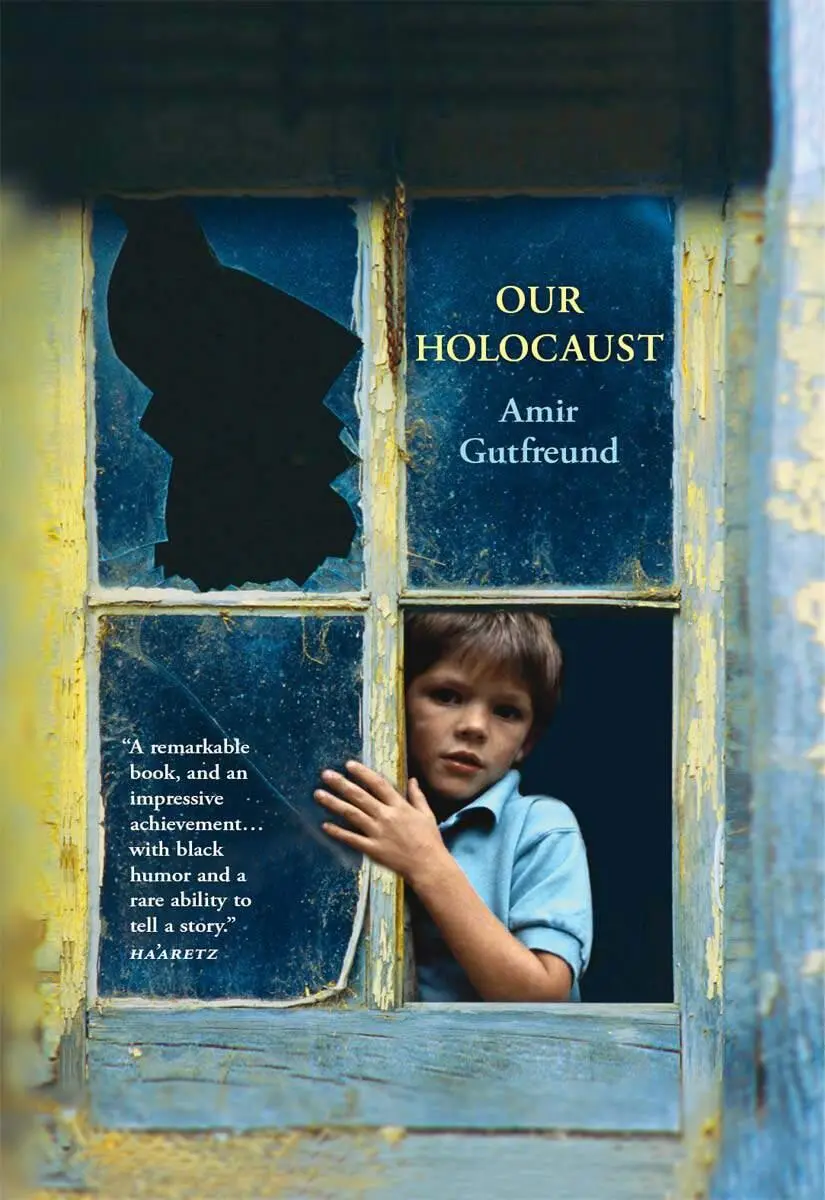
Amir Gutfreund - Our Holocaust
Здесь есть возможность читать онлайн «Amir Gutfreund - Our Holocaust» весь текст электронной книги совершенно бесплатно (целиком полную версию без сокращений). В некоторых случаях можно слушать аудио, скачать через торрент в формате fb2 и присутствует краткое содержание. Год выпуска: 2006, Издательство: Toby Press Ltd, Жанр: Современная проза, Прочая документальная литература, на английском языке. Описание произведения, (предисловие) а так же отзывы посетителей доступны на портале библиотеки ЛибКат.
- Название:Our Holocaust
- Автор:
- Издательство:Toby Press Ltd
- Жанр:
- Год:2006
- ISBN:нет данных
- Рейтинг книги:4 / 5. Голосов: 1
-
Избранное:Добавить в избранное
- Отзывы:
-
Ваша оценка:
Our Holocaust: краткое содержание, описание и аннотация
Предлагаем к чтению аннотацию, описание, краткое содержание или предисловие (зависит от того, что написал сам автор книги «Our Holocaust»). Если вы не нашли необходимую информацию о книге — напишите в комментариях, мы постараемся отыскать её.
Our Holocaust — читать онлайн бесплатно полную книгу (весь текст) целиком
Ниже представлен текст книги, разбитый по страницам. Система сохранения места последней прочитанной страницы, позволяет с удобством читать онлайн бесплатно книгу «Our Holocaust», без необходимости каждый раз заново искать на чём Вы остановились. Поставьте закладку, и сможете в любой момент перейти на страницу, на которой закончили чтение.
Интервал:
Закладка:
“What I used, when was needed,” Grandpa Lolek said disappointingly.
But we were relieved. “So you weren’t a bad Jew?”
“Bad Jew?”
“Who did bad things in the war…?”
“Who do you think you are, Haim Nachman Bialik?! There is no bad Jew, good Jew. There is alive and there is dead. That’s it.”
Grandpa Lolek’s philosophy. A dogma handed down from on high. Dead Germans, bodies of Anders’ soldiers. All our lives, Grandpa Lolek showered us with sayings coined on that mountain:
“What you take, you have not give back.”
“Hold in your teeth, and not yet is yours.”
“If hit, hit back. No hit, very good. That means, you hit.”
We disagreed. “No bad Jew, good Jew” was too simple. We had stored up enough thoughts of Adella Greuner, Mr. Bergman, Itcha Dinitz. For too long we had become acquainted with Finkelstein, with Crazy Hirsch’s words. Something strong, an evil Jew, had to exist — the opposite of Grandpa Yosef. The war could not have sufficed with bad Germans. We rejected Grandpa Lolek’s philosophy but felt that he himself was becoming purer, not a bad Jew or a good Jew, but rather, our grandfather. We breathed a sigh of relief that flung open floodgates, an eternal, lucid horizon, over which anything could gallop, anything could fly. Spotless light flowed easily. Two little spaceships with reasonable grades could finally let go and Finkelstein’s moon lifted off like a balloon and disappeared. We felt like going out with Grandpa Lolek so he could buy us popsicles, or so we could buy them, whichever — as long as we could sit and lick them and no one would be to blame.
Only a single letter in Polish stayed on its course through space. What had the textile merchant Finkelstein written to his son in America? For many years in the dark, Polish characters concocted a frightening truth. The letter opened with the hackneyed lines, “When you read these words, son, your mother and I will not be among the living…” Then more words, Finkelstein the textile merchant’s explanations of what was about to happen in the world, why he did what he did, and what the son should do.
Today, now that I am Old Enough, I know. Finkelstein realized, days before the war broke out, what the Holocaust would be. His thoughts were lucid, with none of the enveloping mist of illusion. Crystal clear. Even before the Nazis imagined how far they would go, before Adolf Eichmann hatched his ingenious plans, before Hitler conceived the only solution to the world’s troubles, the textile merchant from Bielsko-Biala knew— knew , not guessed — the future in great detail. He sold his business. He instructed his only son to stay in America despite the hardships. He had all his gold fillings removed and forced his wife to do the same. Even before Auschwitz was built, before the incinerators, before the Sonderkommando and the “Kanada” commando that collected belongings from the dead, he had deprived himself of the immediate reasons to send him to his death. He melted down the gold from their teeth, from his wife’s jewelry, from the sale of his shop. Then he waited for an opportunity, for a man to whom he could give the money, someone he could trust who wouldn’t ask questions and would survive the imminent war. On the street in town he met a hardened corporal from the Polish army, a Jew by the name of Feuer, son of the headmaster of the Hebrew Gymnasium in Kielce. Finkelstein the merchant looked the Jewish corporal up and down and knew he had found his man. They settled on the terms. Shook hands. Corporal Lolek Feuer went back to his unit. The next morning, the war broke out, inflicting six years of suffering upon the world. Finkelstein the textile merchant and his wife perished. At a certain point during those years they joined the six million Jews, perhaps in a ghetto, perhaps in a concentration camp, perhaps in a death camp. They may not have been killed as Jews but simply, without ideology, like the ten million other citizens who died in the war. One moment they were human beings, parents of a son in America, and the next — dead.
One Jew, before the war, knew everything. And even in 1942, with the extermination at its height, Jews would disbelieve living witnesses and refuse to accept the impossible. A man by the name of Rosenthal would manage to send a postcard to the Bochnia ghetto from Belzec, reporting explicitly what befell those who went to Belzec and exposing the true purpose of the transports to “resettle the Jews in the East.” People would doubt him. Suspicions would flicker, fear too. But they would refuse to believe. A letter from the Rabbi of Grabow would be smuggled into the Lodz ghetto, explaining precisely what the Chelmno camp on the Ner River was. People would not believe. At the height of the war, the Aktionen , babies’ heads smashed against walls, still they would not believe that there could be such a thing as death camps, such a thing as gas chambers, such a thing as industrial use of hair, skin and fat. War, people perpetrating horrors on other people, yes. But gas chambers? Incinerators? Not possible.
Zagazowani.
That was what Rosenthal would write from Belzec to the residents of the Bochnia ghetto. The first word that would explain that people were being put to death with gas. (Dad tried to explain the Polish grammar to me, the way the noun gas is inflected as a verb that kills people. Zagazowani. ) A word that would be a gateway to the coming years. Secretly, the congregation leaders in the ghetto would pass the postcard from hand to hand. My father, a curious child, playing down among the chair legs, would listen. Above him there would be doubts, suspicions — why would the Germans let someone send a postcard out?
Only one Jew, in 1939, the textile merchant Finkelstein, knew everything, and he wrote a letter to his son. Not a historical or scholarly record, but a practical abstract of thoughts. The textile merchant had no spare time to sit and write at length. What good would writing do? Leave the writing for the intellectuals. All he needed was to explain to his son what would happen, what to watch out for, how much gold to demand from the soldier and where to invest it.
Once I became Old Enough and was allowed to know more, I asked Dad about 1939. That year, just before it all began, when only Finkelstein knew, is more frightening than anything Dad could tell me about “afterwards.” Because 1939 is similar to the years I live in. In 1939, level-headed Jews had moderate opinions. They had worries that could be dismissed by reason. Sensible people made assumptions, felt apprehensive, found solutions. The Jewish newspapers were full of keen, thorough editorials. Everything was so reasonable, so progressive, so modern. In the cemeteries, deceased Jews were led to their eternal rest. Kaddish prayers were whispered. A little before September 1939 they still recited, Let He who makes peace in the heavens grant peace to all of us and to all Israel , and the congregants responded, Amen . The year 1939 is the year I could be living in. Every year could be 1939. Everything around me is so democratic, so reasonable. A world of public statements, petitions, strong protests. Everything could be reversed in the blink of an eye. Sometimes I know that if a totalitarian regime were to be established here, decimating minorities, only time and a few moral convulsions would delay a Jewish incarnation of the Reich. Here too, it could rise. There would be opponents, yes, even in the mainstream. But they too would disappear. Not straight away, but all of them. I recognize around me the types who would construct the new regime. They are all here already: the king of the black market, the collaborator, the informer with eyes torn wide in terror. The chief of police, the loyal soldiers, the implementers of orders. They are here, they are living and multiplying. They are decent citizens concealed by comfortable circumstances. Never (one assumes) will their dark natures be exposed. Throughout their lives, perhaps only a moment or two will touch the core of their souls. Commonplace life produces moderate versions of these people, the outcome of routine and of the flourishing State of Israel. The king of the black market will be no more than a crooked insurance agent. The collaborators will be tailors, policemen, physicians. The chief of police will be an unlikable man, perhaps the manager of a supermarket, that’s all. If the day comes and reality is overturned, Grandpa Yosef will be an intellectual opposing the regime. His skull will be cracked in the public square, crowds will cheer. Or in secret, three thugs will knock on his door in the middle of the night. The car will drive away. Neighbors will murmur sorrowfully. Someone will make a derisive comment about him and a few will nod in agreement. The regime will provide them with material and they will recite it. They will forget.
Читать дальшеИнтервал:
Закладка:
Похожие книги на «Our Holocaust»
Представляем Вашему вниманию похожие книги на «Our Holocaust» списком для выбора. Мы отобрали схожую по названию и смыслу литературу в надежде предоставить читателям больше вариантов отыскать новые, интересные, ещё непрочитанные произведения.







Обсуждение, отзывы о книге «Our Holocaust» и просто собственные мнения читателей. Оставьте ваши комментарии, напишите, что Вы думаете о произведении, его смысле или главных героях. Укажите что конкретно понравилось, а что нет, и почему Вы так считаете.