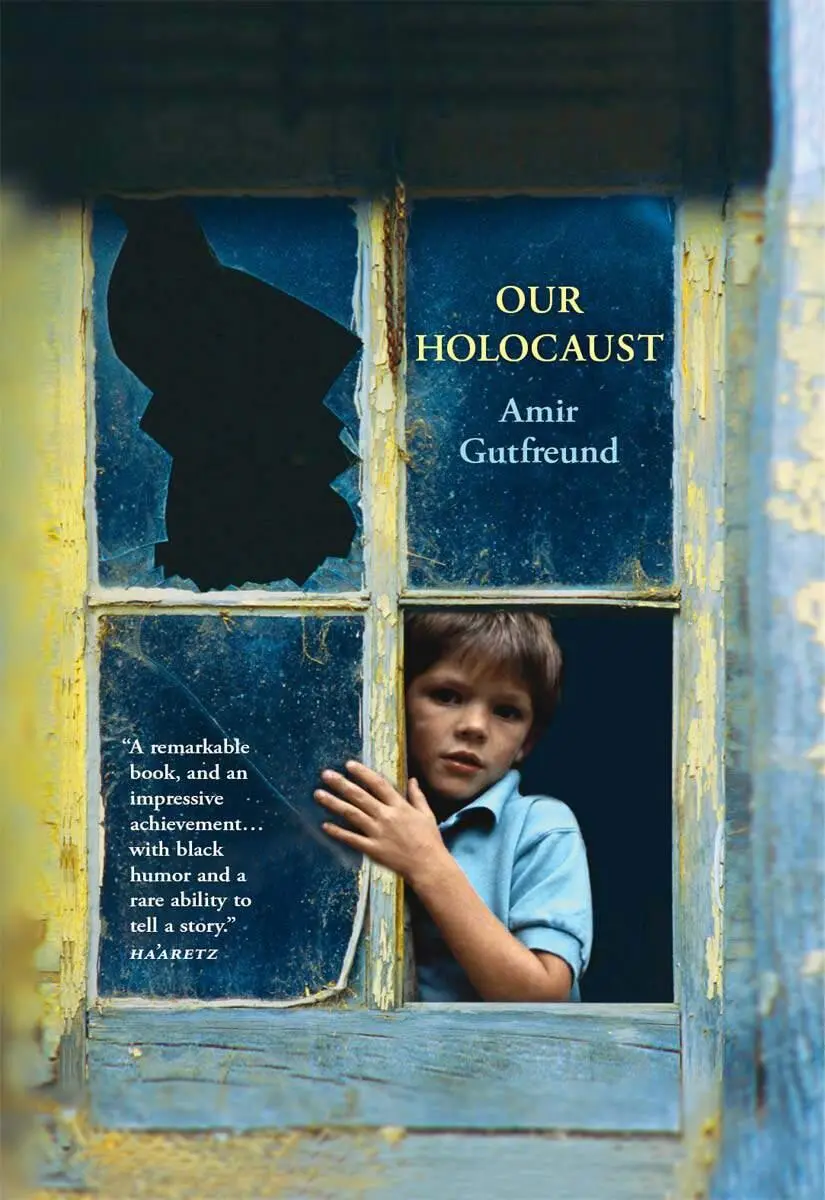
Amir Gutfreund - Our Holocaust
Здесь есть возможность читать онлайн «Amir Gutfreund - Our Holocaust» весь текст электронной книги совершенно бесплатно (целиком полную версию без сокращений). В некоторых случаях можно слушать аудио, скачать через торрент в формате fb2 и присутствует краткое содержание. Год выпуска: 2006, Издательство: Toby Press Ltd, Жанр: Современная проза, Прочая документальная литература, на английском языке. Описание произведения, (предисловие) а так же отзывы посетителей доступны на портале библиотеки ЛибКат.
- Название:Our Holocaust
- Автор:
- Издательство:Toby Press Ltd
- Жанр:
- Год:2006
- ISBN:нет данных
- Рейтинг книги:4 / 5. Голосов: 1
-
Избранное:Добавить в избранное
- Отзывы:
-
Ваша оценка:
Our Holocaust: краткое содержание, описание и аннотация
Предлагаем к чтению аннотацию, описание, краткое содержание или предисловие (зависит от того, что написал сам автор книги «Our Holocaust»). Если вы не нашли необходимую информацию о книге — напишите в комментариях, мы постараемся отыскать её.
Our Holocaust — читать онлайн бесплатно полную книгу (весь текст) целиком
Ниже представлен текст книги, разбитый по страницам. Система сохранения места последней прочитанной страницы, позволяет с удобством читать онлайн бесплатно книгу «Our Holocaust», без необходимости каждый раз заново искать на чём Вы остановились. Поставьте закладку, и сможете в любой момент перейти на страницу, на которой закончили чтение.
Интервал:
Закладка:
No.
Me neither then.
The poster stayed with me, a hostage for an apology never given.
It had started two years previously, when news came that Mike Brandt had committed suicide in Paris. I was overcome with grief. He was from Haifa, one of ours, and had become a famous singer in France and in the world. Then suddenly they said he had jumped out of a window, and despite all his success in Paris it was decided that he would be buried here in Haifa, in the same cemetery where Aunt Zusa owned a plot. Effi said, “So what?” and showed no understanding. I was used to national grief, when everyone was sad for a lot of people, but this time I felt a new sadness, only for Mike Brandt, the way I felt when I read in the encyclopedia about Katznelson the poet, the Katznelson for whom we had named the neighborhood street. It said that he had managed to escape the Warsaw ghetto and get to Paris, and there he sat, a brand snatched from the burning fire, lamenting his perished wife and children. He wrote poems, expressed hope — if only he had died with them. And it was this prayer that was heard, of all the prayers uttered in all those years all over the world. A train came especially to take him from Paris to Auschwitz, to the gas chambers. A whole train for one weeping Jew, while war was raging and trains were an expensive commodity.
I thought about Katznelson when they brought Mike Brandt back here. It was a sorrow that Effi could not comprehend. We fought, with hatred. We found more and more things to divvy up. We halved joint collections and erased each other from important lists. We left no detail in our lives that did not bear the stamp, “Inspected. Proper procedures followed.” We even divided the grandparents, all of whom had been tirelessly collected under the Law of Compression. Borders were demarcated. Partitions that had previously symbolized mere preferences were lined with barbed wire fences: No Entry. Grandpa Lolek and Grandpa Weil went to Effi. Grandpa Menashe to me. Grandma Eva was divvied up as an afterthought. Grandpa Yosef was undecided. It seemed that if there had to be a decision, Grandpa Yosef would prefer me, because of the scholarliness. But we found Grandpa Yosef high above territorial borders, even during this nationalistic frenzy of the separation of grandparents. Grandpa Yosef remained the only thing that would still connect us.
Agreed.
And what about Grandpa Shalom? After all, he was my real grandfather, only mine, my mother’s father. The only actual grandfather. Ostensibly there was no question that Grandpa Shalom was mine. At my briss on the ninth of Av he had held me in his arms. He had looked at me, his second grandchild, and seen yet another root struck in the new land. He had watched me grow up, not knowing that inside of him someone had already rapped three times on the door, that in the dressing room his disease was already preparing for its performance. One final moment before it came out. A glance in the mirror. A long breath. And the curtain began to rise. Grandpa Shalom got Parkinson’s disease and sunk into his trembling body. The Gestapo tortures, the room in which he awoke on the floor after being interrogated, bathed in his own blood, would be portrayed in a symbolic illness — his body was now his prison. Grandpa Shalom the strong man, championed by all, helper of the needy, a poor man in aid of the poor, would become Grandpa Shalom who smelled of medicine, his tortured body emitting vapors of rotten fruit. Barely walking, barely talking, only Grandma Chava could understand what the thin purple lips were saying. And the cold mouth that tried to kiss us, which we dreaded even before leaving home and on the way there. Grandpa Shalom, who loved through all obstacles, but whom we could not love. We simply could not.
Effi could. When we came to visit (preferably during Chanukah; on Passover Seder and Rosh Hashanah we had no choice), only she hugged and kissed him without hesitation. It was not courage or purity of soul — she simply had no problem doing it. Effi with a camera round her neck and complaints about everything. How could we not have seen how obvious it was that she would grow up to be a doctor? A merciful mother to the Sick Fund patients. She did not photograph Grandpa Shalom in rows of people, but always alone, looking straight at the camera.
How would we divide Grandpa Shalom? It seems we did not. We left a grey area, a demilitarized zone in the interest of both parties. After a while there was a truce of sorts. We emptied out our pockets into one joint pile of grandparents for us both. What did we need the silly division for? We reconstructed from memory what we had been before the fights. We gathered the strength needed for what was about to occur in just a few weeks, the affair of Levertov and the Formacil pills.
In Grandpa Yosef’s neighborhood, medicine healed the body and uplifted the spirit. Prescriptions were status symbols, property, business cards, legal tender. Your medications were who you were. Everyone in the neighborhood knew their neighbors’ prescriptions. A few who had unique prescriptions were modest in their pride, walking along their Mount Everests, shrugging their shoulders — they really didn’t know what they’d done to be so fortunate. But it was a dynamic world. Prescriptions were renewed and terminated at doctors’ whims, based on pharmaceutical trends. Everyone in the neighborhood knew the rules well and they knew they needed to stay vigilant. You had only to look away for a second and a prescription could be lost. And then no amount of pleading (“it was so good with the old pill,” “the new one’s no good”) would help. Dishonest complaints during medical exams wouldn’t help. Does it hurt here? Yes. Here? Yes. And here? Yes. Everything hurts? Yes, but with the pill from before it didn’t hurt at all! Narrow-mindedness grew naturally, like weeds on the edge of a puddle. If you were taken off a pill but your neighbor was not, the insult was threefold — where was justice?
Feiga’s prescriptions were a relatively constant anchor. Her diseases complicated one another and no physician dared touch this house of cards — one false move could bring it tumbling down. This stability was a thorn in the side of some of the neighbors. People were jealous. Sometimes we heard remarks. We stored them up as if sensing that one day we would make use of them.
It happened with Mr. Levertov.
It happened with the Formacil.
It happened during a ceasefire. And during the days when we had stopped wondering about the Shoah: There was a war, and the Germans wanted to murder all the Jews, and they managed to murder six million, and the ones who survived lost so much that even they did not emerge completely alive. That was it. That explained it. The questions had settled down to a lower level. We were able to connect the Shoah we found at home with the one we learned at school, the black placards, the recitations, the minute of silence. For a moment we believed everything was clear. And it was then, of all times, just when we didn’t want to ask anything more and everything had become simple, that Untersturmführer Kurt Franz from Treblinka, known as “Doll,” emerged like a sandbank for us to run aground on. Something made us think of him again. Levertov had once tried to tell us something about him but Grandpa Yosef had put an end to it. And now, despite what we’d thought we wanted, we simply had to know everything about him.
The idea percolated for a long time. Two river banks faced each other. On the one was Levertov, yearning for the Formacil they had taken away from him — Why did Feiga still have hers? On the other bank was Treblinka, where Levertov had been with Untersturmführer Kurt Franz, Doll. The two banks glistened, the water turned silver at night, churning and rising in daylight. One ferry ride with the Formacil in our possession, and Levertov would agree to tell us about Untersturmführer Kurt Franz, Doll, the Commandant of Treblinka, despite Grandpa Yosef’s prohibition. Levertov was afraid. He had already turned us down twice. But he was the only one in the neighborhood who had been in Treblinka — one of the few who had been with Doll and survived. We had to know.
Читать дальшеИнтервал:
Закладка:
Похожие книги на «Our Holocaust»
Представляем Вашему вниманию похожие книги на «Our Holocaust» списком для выбора. Мы отобрали схожую по названию и смыслу литературу в надежде предоставить читателям больше вариантов отыскать новые, интересные, ещё непрочитанные произведения.







Обсуждение, отзывы о книге «Our Holocaust» и просто собственные мнения читателей. Оставьте ваши комментарии, напишите, что Вы думаете о произведении, его смысле или главных героях. Укажите что конкретно понравилось, а что нет, и почему Вы так считаете.