Amir Gutfreund - Our Holocaust
Здесь есть возможность читать онлайн «Amir Gutfreund - Our Holocaust» весь текст электронной книги совершенно бесплатно (целиком полную версию без сокращений). В некоторых случаях можно слушать аудио, скачать через торрент в формате fb2 и присутствует краткое содержание. Год выпуска: 2006, Издательство: Toby Press Ltd, Жанр: Современная проза, Прочая документальная литература, на английском языке. Описание произведения, (предисловие) а так же отзывы посетителей доступны на портале библиотеки ЛибКат.
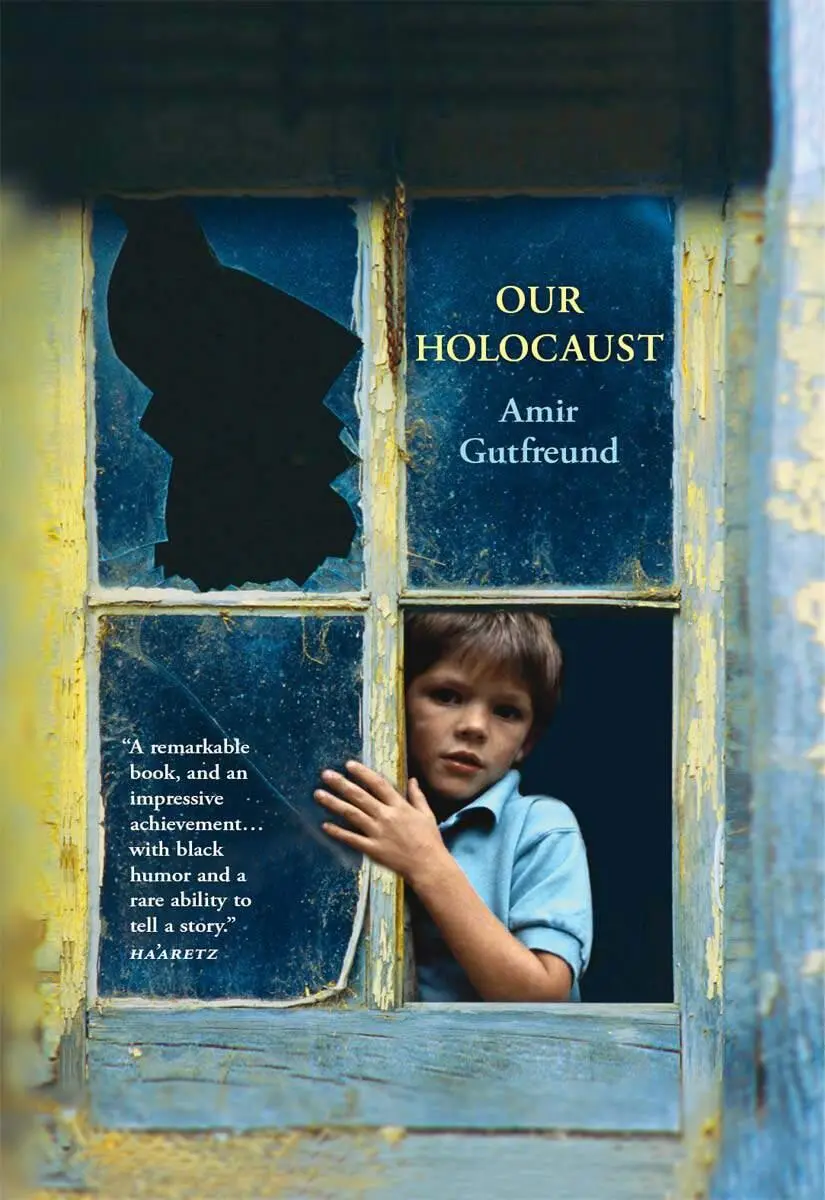
- Название:Our Holocaust
- Автор:
- Издательство:Toby Press Ltd
- Жанр:
- Год:2006
- ISBN:нет данных
- Рейтинг книги:4 / 5. Голосов: 1
-
Избранное:Добавить в избранное
- Отзывы:
-
Ваша оценка:
Our Holocaust: краткое содержание, описание и аннотация
Предлагаем к чтению аннотацию, описание, краткое содержание или предисловие (зависит от того, что написал сам автор книги «Our Holocaust»). Если вы не нашли необходимую информацию о книге — напишите в комментариях, мы постараемся отыскать её.
Our Holocaust — читать онлайн бесплатно полную книгу (весь текст) целиком
Ниже представлен текст книги, разбитый по страницам. Система сохранения места последней прочитанной страницы, позволяет с удобством читать онлайн бесплатно книгу «Our Holocaust», без необходимости каждый раз заново искать на чём Вы остановились. Поставьте закладку, и сможете в любой момент перейти на страницу, на которой закончили чтение.
Интервал:
Закладка:
Yes, it is here, but it will not come to fruition. There is too much good sun, blue skies. But what is important is that it is here, that it threatens my Yariv, that it will want to take my father away again to Plaszow camp, but I won’t let it. That I do not know how I will not let it. I pick Yariv up from kindergarten. We walk down the street and pass by the collaborators, the volunteers, the informants, the black market merchants. People with simple faces. At any moment it is possible. The wind will change, the makeup will scatter, and Yariv and I will stand facing them. It would take even less than a change in the way the wind blows. They could be exposed just like that, simply because they want to be. And my skull too will be smashed on some night-time street in some immaterialized reality in some world which I am mocked for even positing the existence of. Anat too. Why, for God’s sake, don’t they see it?
I raise my Yariv to be strong, to know how to suffer, to survive. Anat takes the seeds out of tomatoes before he eats them. I get annoyed. She does, too. “Yariv belongs to both of us. You can raise your half in Buchenwald, but I’m sending mine to Mira’s Daycare!”
Anything he has not been fully prepared for deters him, afraid, confused. I want him to peel his hard-boiled egg. He refuses. The shell is hot, it scares him. Anat takes it and peels it for him. My father was in the camps. He knows what can happen. But Yariv’s babyish fears don’t bother him. He plays with him, sees how afraid he is of the ball, how he starts crying. He runs to reassure him.
I cannot understand them. Zagazowani .
How good it was then, two little spaceships resting beside Grandpa Lolek, our voyage over, and Grandpa Lolek between us with a camera in his lap. I did not know everything I know today: that you don’t need a Holocaust to have bad Jews. That people like Grandpa Lolek, even if they do steal gold, are not the bad ones. We only knew that that was it, we could breathe easy, Grandpa Lolek was not a bad Jew. The camera on his lap started to glimmer, capturing half and more of our attention, pushing aside letters and dust and bad Jews. We started to take an interest. The price-tag was intriguing; it was a very expensive camera. We looked at Grandpa Lolek full of hope.
He who was absolved of all guilt erased his anger. “Here, Nikon make this, is very expensive, I brought for Effi as present.”
We passed the enchanted object between us, a gift for Effi, not for me. His preference for Effi was immortalized.
Grandpa Lolek hadn’t meant it. He did prefer Effi, but hadn’t intended to insult one of his “like grandchildren” on the couch in his home, after a dark moon had melted away. There was no reason for tears, even though they almost burst from my eyes. (It was at that moment that I made up my mind: I would go to the Municipality on my own and find out who Katznelson Street was named after.) In any case, the bestowal of the Nikon upon Effi was unplanned, and it was not the product of generosity. An hour earlier the camera had still sat in a display window at Carmel Center, scanning with a shuttered eye the passersby who did not buy it because it was too expensive, who only lingered briefly, eye to eye, to exercise their longing, to covet, to finally glance askance at a cheaper model displayed two shelves below. The look in their eyes changed — this was something they could afford — and they gazed at the plain model with the loathing of compromise, as if to say, “We’re doing you a favor.” Eyes yearned, calculated, went into the store to buy the simpler models. Two gentleman stood opposite the camera, ignoring the display window, busy doing business. The one wondered quietly whether the other was capable of meeting his financial obligations — he’d been warned against doing business with him. The other, dressed in finery, a hero of Monte Cassino with blue metallic eyes, sensed the man’s doubts and feared the transaction would fall through. He had to make a quick impression. His look fell on the camera in the display window. He scanned the price. Panic. Contemplation. Vacillation. Decision. The hero of Monte Cassino walked into the store and came out with the Nikon in hand, explaining to his interlocutor, “This I bought for Effi, so it will make her happy. She is like my granddaughter, Effi.” This time the like was intended to clarify that he gave his like relatives expensive gifts without a moment’s hesitation. Imagine, then, what gifts he must give his real relatives. Imagine how financially secure he must be.
“Thanks, but what am I supposed to do with a camera?” Effi asked. And a minute later, “Oh well, stand up and pose, we’ll give it a try.” And we stood up.
At first she photographed everything she came across, then landscapes on Saturday hikes, and finally family affairs. This blatant invasion of Grandpa Lolek’s domain came after he had been defeated by Brandy in the fight to reach the Moshe Pole, and after the family members had begun, one by one, to buy small, modest cars, doing away with hegemony of the Vauxhall once and for all. The battle was fought through two weddings and one briss . Finally, a moderate victory was achieved because:
Effi took nice pictures.
She didn’t ask for payment.
Grandpa Lolek was in her pictures.
The latter was an advantage praised even by the loser. In almost all of Effi’s pictures stood a tall, serious man, a hero of Monte Cassino, and his look at the lens took into account generations to come, who would ask, who is that? The masculine one, standing in his finest suit?
Effi did not like spontaneous photographs. She preferred the formal kind, arranging people like bowling pins. One click and they were dismissed. Then, “No, actually, stand that way again, it may not have come out well.” Smiles were arranged in rows, lips frozen. At weddings, parties, everywhere. Rows, lines. Little trapeze shapes with the adults in the back row, gathering with-gentle-hands-on-shoulders the children in the front row. It was the beginning of the photography era. Effi with a camera around her neck, always arranging people. As soon as people saw her, they would arrange themselves in rows. Women would reach up to their hair, men — down to their flies. They smiled when they saw her; you never knew. Always flashes, always instructions. In winter she blended with the lightening. In summer — the heat, the flies. “Stand, I’ll take a picture.” “Smile now.” They built her a fully equipped dark-room with chemicals that only two or three years earlier we would have tried to drink. Now she was careful, gave warnings, behaved responsibly, sealed the bottles, made labels with thick markers, separated containers.
Grandpa Lolek’s passing on of the photography obsession and the natural effects of age began to come between us. Effi signed up for a photography course, and I for an amateur radio course (which was a little too amateur for my taste). She graduated to a photography course for gifted children. I responded by winning an essay competition on Jerusalem. The distancing continued, became more sophisticated, swept along deposits of grudges and hostility. Substances long ago fixed into the river banks were swept along, renewing forgotten arguments. At the apex of the route — the apogee — Effi’s photographs were accepted by Maariv Lanoar magazine. My turn. I was appointed head of a ship in my seafaring course (salt water when falling overboard at the port, filthy water when falling in at the mouth of the Kishon River). That wasn’t enough. In a desperate step I defected from Tarbut encyclopedia and switched to the Hebrew Encyclopedia . I began at “ a cappella ” and started reading.
Then we started to divide our assets. Effi demanded the four-part poster of Yehoram Gaon, which we had both labored to compile. I demanded that she apologize for her comments about Mike Brandt.
Читать дальшеИнтервал:
Закладка:
Похожие книги на «Our Holocaust»
Представляем Вашему вниманию похожие книги на «Our Holocaust» списком для выбора. Мы отобрали схожую по названию и смыслу литературу в надежде предоставить читателям больше вариантов отыскать новые, интересные, ещё непрочитанные произведения.







Обсуждение, отзывы о книге «Our Holocaust» и просто собственные мнения читателей. Оставьте ваши комментарии, напишите, что Вы думаете о произведении, его смысле или главных героях. Укажите что конкретно понравилось, а что нет, и почему Вы так считаете.