J. M. Le Clézio - Terra Amata
Здесь есть возможность читать онлайн «J. M. Le Clézio - Terra Amata» весь текст электронной книги совершенно бесплатно (целиком полную версию без сокращений). В некоторых случаях можно слушать аудио, скачать через торрент в формате fb2 и присутствует краткое содержание. Год выпуска: 2008, Издательство: Penguin Books Ltd, Жанр: Современная проза, на английском языке. Описание произведения, (предисловие) а так же отзывы посетителей доступны на портале библиотеки ЛибКат.
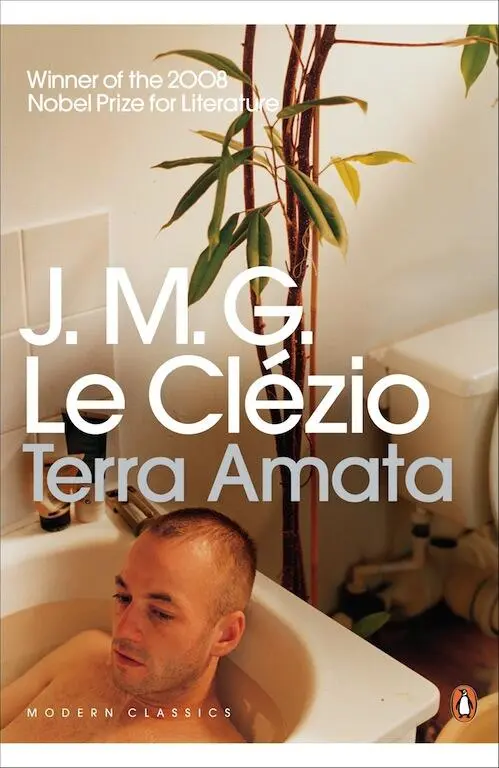
- Название:Terra Amata
- Автор:
- Издательство:Penguin Books Ltd
- Жанр:
- Год:2008
- ISBN:нет данных
- Рейтинг книги:5 / 5. Голосов: 1
-
Избранное:Добавить в избранное
- Отзывы:
-
Ваша оценка:
Terra Amata: краткое содержание, описание и аннотация
Предлагаем к чтению аннотацию, описание, краткое содержание или предисловие (зависит от того, что написал сам автор книги «Terra Amata»). Если вы не нашли необходимую информацию о книге — напишите в комментариях, мы постараемся отыскать её.
brilliantly explores humankind's place in the universe, the relationship between us and the Earth we inhabit and, ultimately, how to live.
Terra Amata — читать онлайн бесплатно полную книгу (весь текст) целиком
Ниже представлен текст книги, разбитый по страницам. Система сохранения места последней прочитанной страницы, позволяет с удобством читать онлайн бесплатно книгу «Terra Amata», без необходимости каждый раз заново искать на чём Вы остановились. Поставьте закладку, и сможете в любой момент перейти на страницу, на которой закончили чтение.
Интервал:
Закладка:
Kissing in the Korean style
‘When I got on board I met a fantastically beautiful woman nearly seven feet tall. She had long black hair and lovely blue eyes. She gave me food and tucked me up in bed, after bestowing on me a kiss in the Korean style, that’s to say she tapped me on the cheek with three fingers. Our first landing was on Mars. The landing-area was on a building made out of lunar rocks. After refreshing ourselves with food not unlike that which we eat here on earth, we set off for the Moon, and there we saw people, buildings, animals, ice and snow. The next stop was Venus. But it happened to be cloudy when we got there and we could only stay an hour and twenty minutes. Nevertheless I was still able to see a car powered by electro-magnetic energy; it was driven by a man from North Platte, Nebraska. I wasn’t able to find out his name. The next halt was on Clarion, where we only stopped for twenty minutes.
A paradise
‘On Orion, a planet with an ultra-modern society, I saw magnificent buildings and churches: the life there is so different I can’t describe it all. But I remember eating some delicious blackberries, so big that three would fill a whole jam-jar. I’d have liked to stay there, but I wasn’t allowed to. When I asked why they said it was because if I did I might disclose the most powerful works of creation. They also told me to say that nuclear explosions ought to be stopped, because they interfere with life on Orion.’
(All the details of Fiery Horse’s stay on Orion can be heard on copies of the tape-recording he brought back with him. Price 15 dollars a copy.)
Then there were all those commonplace gestures, the tics and rituals and rhythms that were repeated day after day, each time marking off the calendar with a little blue cross. There were all the cigarettes first lighted, then put out in dirty ashtrays. The morning coffee, the midday steak, the bread and honey at four o’clock, the soup at seven, the chewing-gum at ten, the toothpaste at eleven. The aspirins and the vitamin tablets. The glasses of beer, the cinema, the television, the drives in the car. Work. Fine days, cloudy days. Winter, then spring, then summer, then autumn. Everywhere were hidden the mysterious signs of true and false, and it was impossible really to tell them one from the other.
Chancelade sat motionless in a warm bath making the dirty water vibrate as if with invisible earthquake tremors. Here or elsewhere. Now or later. This or that. The ship was adrift. The circles were open, and out gushed their imperceptible substance. In the dazzling white bathroom the various threads of the world are united and destroy no longer; they present their speed too swift to measure, their plenitude more vast than the void, their presence more chill than absence. But Chancelade has lost the clue through the labyrinth. He doesn’t believe any more, he can’t believe in the precise adventure. He is already down in the centre of the earth, swallowed up in his own dream, absorbed in his own thought. He is adrift.
Sitting at his desk in the closeness of the evening, young Emmanuel is reading a book he doesn’t understand. Written on the yellow page that shines in the electric light, underneath some regular drawings in the shape of a star, are the words:
APOLLONIUS’S THEOREM
In any triangle the sum of the squares on any two sides is equal to twice the square on half the third side, together with twice the square on the median bisecting the third side.
PTOLEMY’S THEOREM
A quadrilateral is inscribable in a circle when the product of its diagonals is equal to the sum of the products of opposite sides.
But it might just as well have read:
A convex coleopter is imputrescible when the product of the bacchanalia is equal to the sum of the products of the possible pies.
The boy stared at the shining page and soon the print began to dance about before his eyes. The H’s grew huge and stretched their arms and legs all over the paper. The O’s opened and shut like fishes’ mouths. The T’s sank, the I’s toppled over. The S’s writhed like worms, the U’s went up and down, the Y’s sprouted leaves. Here and there the Z’s bestrode the page like great flashes of black lightning, then faded. The letters even came off the yellow page, lined up on the desk, and started fighting a pitched battle with loops, full-stops, apostrophes, angles and curves. The A’s and K’s and X’s and W’s and Z’s won, and walked in a long procession over the battlefield singing a squeaky song of triumph made up of their own sounds.
In another room Mina was washing her hair in a wash-basin. The warm water flowed continuously out of the metal tap, running through the hair like invisible fingers. The lather was washed away slowly, and ran down beside her face in long snowy streaks. Mina wasn’t thinking about anything. She stood with her head bent down and her eyes closed, tasting the soapy, slightly acid and bitter water that seeped in through the corners of her mouth. And the tap went on pouring into the soft hair, separating and swishing it about like great dark waves, or running them together in heavy tresses that hung down almost into the outlet of the basin.
When she’d finished washing it she lay on the bed for ages doing her hair, her right hand holding a mirror covered with finger-marks. She rolled the hair round little steel sausages which she fixed in place with pins. And her arm, bent over her wet hair, seemed fixed, frozen so to speak, immovably.
She was thinking about death, about the shopping she must do tomorrow, about the holidays, about her mother, about the spot she’d noticed on her face.
In the stifling little high-walled room, with a whitewashed ceiling and a light-bulb over the bolted door, Chancelade sat without moving. He looked at a place on the wall, a sort of scar in the paint that someone had made with their nail. Behind him the pipes gurgled and hollow thuds sounded in the walls, and mysterious creakings signifying nothing.
Here too time had come to a halt, buried in the cube of ochre paint, stifled by the thick walls, drowned in the pale light. Chancelade was in a cubicle at the ends of the earth, in the middle of Greenland or Siberia, and the ramparts were heaped up round him in order to extricate him from life. He sat there without moving, breathing in the smell of ammonia and disinfectant, listening intently to the tiny sounds, staring fixedly at the mark in the paint on the wall. The door was bolted, no one could come in. There was neither cold nor heat, only a sort of gentle unfeeling calm annihilating all desires. There wasn’t even really any light: light entered there by chance out of the bulb over the door, but it might just as well have come from somewhere else. Sounds and smells were there by chance too, and so were colours, lines, marks, corners, dust; it was a miniature grotto, a classical mausoleum of marble and stucco, an air-tight sarcophagus. Time might pass away, the years might clatter by with their noisy crowd of men and women. But here they would never enter, here they would never issue their orders and appeals. You were there, perhaps on the way to eternity, put inside a little box in unmoving space. The flies buzzed back and forth from wall to wall, continually repeating the same journey. Drops of water hissed in the cistern, and rust gradually accumulated on the old metal. What use was the sun? What use was the moon, trees, poppies? There was no longer any world, no longer any grotesque and noisy hell. There were only these walls so high and thick and covered in ochre paint, and this ceiling, this light-bulb, this red-brick floor that made your feet so cold. It was as if you had uttered a great cry inside yourself, yelled out your own name in the depths of your body, and it had suddenly been transformed into silence. Perhaps you would never speak again. You’d be silent for ever, sitting in this tiny room; you’d never make another sound to anyone.
Читать дальшеИнтервал:
Закладка:
Похожие книги на «Terra Amata»
Представляем Вашему вниманию похожие книги на «Terra Amata» списком для выбора. Мы отобрали схожую по названию и смыслу литературу в надежде предоставить читателям больше вариантов отыскать новые, интересные, ещё непрочитанные произведения.


Обсуждение, отзывы о книге «Terra Amata» и просто собственные мнения читателей. Оставьте ваши комментарии, напишите, что Вы думаете о произведении, его смысле или главных героях. Укажите что конкретно понравилось, а что нет, и почему Вы так считаете.