Li Cunxin - Mao's Last Dancer
Здесь есть возможность читать онлайн «Li Cunxin - Mao's Last Dancer» весь текст электронной книги совершенно бесплатно (целиком полную версию без сокращений). В некоторых случаях можно слушать аудио, скачать через торрент в формате fb2 и присутствует краткое содержание. Жанр: Современная проза, на английском языке. Описание произведения, (предисловие) а так же отзывы посетителей доступны на портале библиотеки ЛибКат.
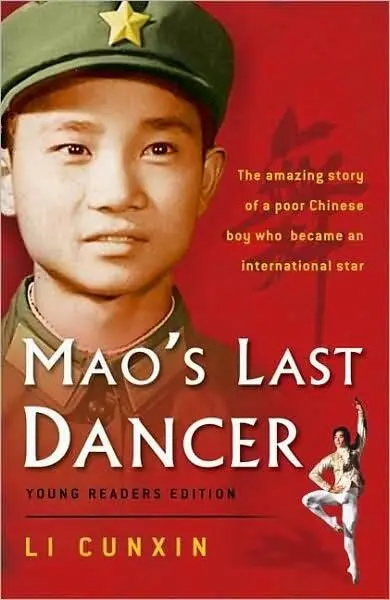
- Название:Mao's Last Dancer
- Автор:
- Жанр:
- Год:неизвестен
- ISBN:нет данных
- Рейтинг книги:3 / 5. Голосов: 1
-
Избранное:Добавить в избранное
- Отзывы:
-
Ваша оценка:
Mao's Last Dancer: краткое содержание, описание и аннотация
Предлагаем к чтению аннотацию, описание, краткое содержание или предисловие (зависит от того, что написал сам автор книги «Mao's Last Dancer»). Если вы не нашли необходимую информацию о книге — напишите в комментариях, мы постараемся отыскать её.
Mao's Last Dancer — читать онлайн бесплатно полную книгу (весь текст) целиком
Ниже представлен текст книги, разбитый по страницам. Система сохранения места последней прочитанной страницы, позволяет с удобством читать онлайн бесплатно книгу «Mao's Last Dancer», без необходимости каждый раз заново искать на чём Вы остановились. Поставьте закладку, и сможете в любой момент перейти на страницу, на которой закончили чтение.
Интервал:
Закладка:
It is Chen Lueng, the tall teacher who auditioned us, and he is with a couple more teachers from the academy who are at the station to greet us. A bus is waiting too and I am the last person to climb on. The students from Shanghai had arrived an hour before and are already impatiently waiting on the bus.
I hear one of the teachers tell the driver to close the door. I want to be helpful, so I start to pull the door closed, but the driver has pushed the control button and the door closes automatically in front of me. It takes me by total surprise. The buses at home don't have doors like this. I stumble back and fall. Everyone laughs. I have made a fool of myself within the first few minutes of being in Beijing. I feel desperately alone. At this moment I realise I have entered a completely new world.
Throughout the eleven years of my childhood in Qingdao, I'd always lived with the harsh reality of not having enough food to fill our stomachs, of seeing my parents struggle, of witnessing people dying of starvation, of constantly being trapped in that same hopeless, vicious cycle as my forefathers. I had been determined to get out of that deep, dark well. I cannot remember how many times I'd wanted to let go of my life and relieve some of my parents' financial burden. I would have sacrificed my own life to help my family, but would it have made much difference? Who did my life belong to anyway?
But somewhere deep in my heart there is a buried seed, a seed of hope. It isn't even a light. I can't see any light to guide me out of this cruel and unfair world. But that seed of hope has always existed, and it implants itself in my mind. Its power is strong. It makes me feel that one day everything will be all right. It is my escape, and my secret dream.
Beijing is my chance. I am scared to leave my parents yet I know this will be my only chance of helping them. I am afraid of what is waiting for me yet I know I have to take that first step forward. I can't let my parents down. I can't let my brothers down. I am carrying their dreams as well as my own. My niang said never look back.
I pick myself up off the floor of the bus, and walk down the aisle towards my seat.
Part Two. Beijing
8 Feather in a whirlwhind
At first, despite missing home, the thrill of being in Beijing near our great and beloved leader Chairman Mao completely overwhelmed me. Here I was, part of the Beijing Dance Academy, with Madame Mao our honorary artistic director. My family, my relatives, the people in our village and commune, even the Shandong Province officials themselves, would all have enormous expectations of me: from this moment onward, I would have an "iron rice bowl"-a good job and enough food for life.
On the way to our academy on the bus that day we detoured to Zhongnanhai, where Chairman Mao, Madame Mao and all the top government officials lived. It was a huge complex, right next to the Forbidden City, with barbed wire and high, faded red-gold walls. Security guards stood beside huge red wooden doors, their hands firmly grasping their semi-automatic guns. Guards seemed to be everywhere, spread evenly along the walls, ready to pull the trigger on anyone who might pose a threat.
I simply couldn't believe I was here! Here, where our god-like leader slept, worked and made all his important political decisions. What was it like in there? I wondered. I could see many tall trees inside, and I'd heard that there was a fishing pond there, called Daiyutai. I imagined it had lots of different fish in it, and it must surely be round, like the image of Mao, our sun.
I was stunned with the sheer scale of Beijing: enormous buildings, endless street-lighting, wide smooth streets, nothing like the muddy dirt roads we had in Laoshan County. And the men and women-their Mao-style jackets looked so smart! I could see very few patches on their clothes. And the number of cars, buses, jeeps, bicycles-it simply shocked me. How could there be so many bicycles in one city! Officers in army uniforms directed the flow of traffic, but nobody seemed to pay much attention to the traffic lights themselves. I was completely fascinated. I'd never seen traffic lights before.
As the bus pulled into Tiananmen Square, my heart leapt. I could see long rows of gigantic light-poles. I could see an ocean of people. I immediately noticed the Gate of Heavenly Peace on our left and the grand building of the People's Congress on the right. They were so familiar-I had seen them in so many pictures: even in my collection of Mao's buttons at home there was one with Chairman Mao smiling and waving at me from the top of the Gate of Heavenly Peace. It made my spine shiver. Tiananmen Square was our great symbol of communism. It was here, on the Gate of Heavenly Peace, facing millions of jubilant people, that Chairman Mao declared the birth of the People's Republic of China on October 1949. It was a date that all the children of China had etched into their minds.
For our first day in Beijing it was sunny, and the combination of body heat from the crowd, the sunshine and the smog made the Square warm. Our bus wasn't allowed to drive too close to the centre, so we got out and our political heads and teachers herded us towards the Gate of Heavenly Peace. People swarmed everywhere, many stopping to take pictures, so it took some time before we could get close. Then one of our political heads told a security guard that we were from Madame Mao's school. That mention alone was enough, and he happily let us into the security area surrounding the Gate of Heavenly Peace, so we could pose for several group photos.
It was only once I settled back onto our bus that a sense of insecurity began to overwhelm me. I sank down into my seat and looked out the window. The buildings around the Square seemed to stare at me. Why are you, peasant boy, here in this magnificent city? Throughout my childhood I had always dreamt of coming here. I had always believed I never would. Yet now I was here, among fifteen million people. I felt like a feather swept up in a whirlwind. I was only eleven years old. Nothing could have prepared me for this.
Our bus travelled through the city streets and gradually the tall buildings of Beijing were left far behind. We drove on and on, heading, we were told, towards a village called Zhuxingzhuang, about one hundred and twenty miles away. The name meant Zhu's New Village and it was to be our new home.
The wide, open fields of the countryside seemed to invigorate me. The fields here were flat compared to the layered fields surrounding my home town, but there were enough similarities in the countryside to relieve my anxiety just a little. It was a long drive, and one of the teachers suggested we sing propaganda songs as we went along and this too temporarily kept my attention.
Eventually, just as our bus turned into a drive, the political head proudly announced, "We are here! Our school is on the left."
I could see tall, bare trees on each side of a driveway (it was February and still bitterly cold) and within a couple of minutes our bus turned towards a metal-barred gate which had bright red letters over the top of it: Central 5-7 Performing and Arts University. The numbers, our political heads explained, referred to 7 May 1970, when Madame Mao delivered a famous speech to the arts and education communities, using Chairman Mao's philosophies to encourage all intellectuals to engage, both physically and mentally, with the three classes: peasants, workers and soldiers. They were golden words to the Ministry of Culture, so they proposed that Madame Mao should be the artistic director of this new university, and that it should be located in the heart of the communes, where future artists could learn and work among the peasants every day. In such an isolated site, surrounded by communes and fields, students would be protected from any negative influences from the city. Madame Mao supported this idea and the project quickly received the central government's backing.
Читать дальшеИнтервал:
Закладка:
Похожие книги на «Mao's Last Dancer»
Представляем Вашему вниманию похожие книги на «Mao's Last Dancer» списком для выбора. Мы отобрали схожую по названию и смыслу литературу в надежде предоставить читателям больше вариантов отыскать новые, интересные, ещё непрочитанные произведения.


Обсуждение, отзывы о книге «Mao's Last Dancer» и просто собственные мнения читателей. Оставьте ваши комментарии, напишите, что Вы думаете о произведении, его смысле или главных героях. Укажите что конкретно понравилось, а что нет, и почему Вы так считаете.