Arthur Hailey - Evening News
Здесь есть возможность читать онлайн «Arthur Hailey - Evening News» весь текст электронной книги совершенно бесплатно (целиком полную версию без сокращений). В некоторых случаях можно слушать аудио, скачать через торрент в формате fb2 и присутствует краткое содержание. Жанр: Современная проза, на английском языке. Описание произведения, (предисловие) а так же отзывы посетителей доступны на портале библиотеки ЛибКат.
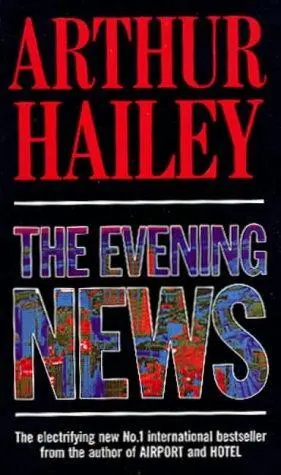
- Название:Evening News
- Автор:
- Жанр:
- Год:неизвестен
- ISBN:нет данных
- Рейтинг книги:3.5 / 5. Голосов: 2
-
Избранное:Добавить в избранное
- Отзывы:
-
Ваша оценка:
Evening News: краткое содержание, описание и аннотация
Предлагаем к чтению аннотацию, описание, краткое содержание или предисловие (зависит от того, что написал сам автор книги «Evening News»). Если вы не нашли необходимую информацию о книге — напишите в комментариях, мы постараемся отыскать её.
Evening News — читать онлайн бесплатно полную книгу (весь текст) целиком
Ниже представлен текст книги, разбитый по страницам. Система сохранения места последней прочитанной страницы, позволяет с удобством читать онлайн бесплатно книгу «Evening News», без необходимости каждый раз заново искать на чём Вы остановились. Поставьте закладку, и сможете в любой момент перейти на страницу, на которой закончили чтение.
Интервал:
Закладка:
”Sure we who seek out the news get tough at times and occasionally—I admit it—go too far. But because of what we do, a lot of crookedness and hypocrisy gets exposed, which in older days those in power got away with. So because of sharper news coverage, which TV pioneered, our society is a little better, slightly cleaner, and the principles of this country nudged nearer what they should be.
”As to presidents, Dad, if some of them look small, and most of them have, they've accomplished that themselves. Oh sure, we news guys help the process now and then, and that's because we're skeptics, sometimes cynics, and often don't believe the soothing syrup that presidents hand out. But skulduggery in high places, all high places, gives us plenty of reason to be the way we are.”
"I wish the President sort of belonged to everybody, not one party,” Nicky said. He added thoughtfully, "Wouldn't it have been better if the Founding Fathers had made Washington the king, and Franklin or Jefferson the President? Then Washington's kids and their children and grandchildren could have been kings and queens, so we'd have a head of state to feel proud of and a President to blame for things, the way the British do with their prime minister.”
"America's great loss, Nicky,” his father said, "is that you weren't at the Constitutional Convention to push that idea. Despite Washington's kids being adopted, it's more sensible than a lot else that happened then and since.”
They all laughed, then becoming serious Angus said, "The reporting in my war—that's World War II to you, Nicky—was different from what it is today. We had the feeling then that those who wrote about it, talked on the radio, were always on our side. It's not that way anymore.”
"It was a different war,” Crawford said, "and a different time. Just as there are new ways of gathering news, concepts about news change too. A lot of us don't believe anymore in 'My country right or wrong.'“
Angus complained, "I never thought I'd hear a son of mine say that.”
Sloane shrugged.”Well, you're hearing it now. Those of us who aim at truth in news want to be sure our country's right, that we're not being fed hocus-pocus by whoever is in charge. The only way you can find out about that is to ask tough, probing questions.”
"Don't you believe there were tough questions asked in my war?”
"Not tough enough,” Sloane said. He paused, wondering whether to go farther, then decided he would.”Weren't you one of those who went on the first B- 17 bombing raid to Schweinfurt?”
"Yes.” Then to Nicholas: "That was deep in Germany, Nicky. At the time, not a nice place to go.”
With a touch of ruthlessness, Crawford persisted.”You told me once that the objective at Schweinfurt was to destroy ballbearing factories, that those in charge of the bombing believed they could bring Germany's war machine to a halt because it had to have ball bearings.”
Angus nodded slowly, knowing what was coming.”That's what they told us.”
"Then you also know that after the war it was discovered that it didn't work. Despite that raid and others, which cost so many American lives, Germany never was short of ball bearings. The policy, the plans, were wrong. Well, I'm not saying that the press in those days could have stopped that awful waste. But nowadays questions would be asked—not after it was over, but while it was happening, so the questioning and public knowledge would be a restraint and probably lessen the loss of life.”
As his son spoke, the old man's face was working, creased by memory and pain. With the others' eyes upon him he seemed to diminish, to sink into himself, suddenly to become older. He said, his voice quavering, "At Schweinfurt we lost fifty B-17s. There were ten people in a crew. That's five hundred fliers lost that single day. And in that same week of October '43, we lost another eighty-eight B-17s—near enough nine hundred people.” His voice dropped to a whisper.”I was on those raids. The worst thing afterward was at night being surrounded by so many empty beds—of people who didn't come back. In the night, waking up, looking around me, I used to wonder, Why me? Why did I get back—in that week and others after—when so many didn't?”
The effect was salutary and moving, causing Sloane to wish he had not spoken, hadn't tried to score a debater's point against his father. He said, "I'm sorry, Dad. I didn't realize how much I was opening an old wound.”
As if he had not heard, his father went on, "They were good men. So many good men. So many of my friends.”
Sloane shook his head.”Let's leave it. As I said, I'm sorry.”
"Gramps,” Nicky said. He had been listening intently.”When you were in the war, doing those things, were you frightened very much?”
"Oh god, Nicky! Frightened? I was terrified. When the flak was exploding all around, throwing out razor-sharp hunks of steel that could cut you into slices . . . when the German fighters swarmed in, with guns and cannon firing and you always thought they were aiming just at you . . . when other B- 17s went down, sometimes in flames or in tight spirals so you knew the crews could never get out to use their parachutes . . . all of it at 27,000 feet, in air so cold and thin that if the fear made you sweat it froze, and even with oxygen you could hardly breathe . . . Well, my heart was in my mouth and sometimes, it seemed, my guts too.”
Angus paused. There was silence in the breakfast room; somehow this was different from his usual reminiscing. Then he went on, speaking only to Nicky who was following every word, so there seemed a communion between the two, the old man and the boy.
”I'll tell you something, Nicky, and it's something I've never told a soul before, not anybody in this world. One time I was so scared, I...” He glanced around as if appealing for understanding.”...I was so scared, I messed my pants.”
Nicky asked, "What did you do then?”
Jessica, concerned for Angus, seemed about to interrupt but Crawford gestured her to silence.
The old man's voice strengthened. Visibly, a little of his pride returned.”What could I do? I didn't like it, but I was there, so I got on with what I'd been sent for. I was the group bombardier. When the group commander—he was our pilot reached the IP and set us on our target course, he told me over the intercom, 'It's yours, Angus. Take it.' Well, I was stretched out over the Norden bombsight and I steadied myself and took my time. For those few minutes, Nicky, the bombardier flew the airplane. I got the target exactly in the cross hairs, then the bombs were away. It was the signal to the group to release theirs too.”
Angus went on, "So let me tell you, Nicky, there's nothing wrong with being scared to death. It can happen to the best. What counts is hanging on, somehow staying in control and doing what you know you should.”
"I hear you, Gramps.” Nicky's voice was matter-of-fact and Crawford wondered how much he had understood. Probably a good deal. Nicky was smart and sensitive. Crawford also wondered if he himself, in the past, had taken the trouble to understand as much as he should about his own father.
He glanced at his watch. It was time to leave. Usually he arrived at CBA News at 10:30 A.M.; today though, he would be earlier because he wanted to see the division president about firing Chuck Insen as National Evening News executive producer. The memory of last night's clash with Insen still rankled, and Sloane was as determined as ever to ensure changes in the news selection process.
He rose from the breakfast table and, excusing himself, went upstairs to finish dressing.
Selecting a tie—the same one he would wear on camera that evening—and carefully tying it in a Windsor knot, he thought about his father, envisaging the scenes the old man had described, in the air over Schweinfurt and else here. Angus, at that time, would have been in his early twenties—half Crawford's age now, just a raw kid who had hardly lived and was terrified he was about to die, most likely horribly. Certainly not even during his time as a journalist in Vietnam had Crawford endured anything comparable.
Читать дальшеИнтервал:
Закладка:
Похожие книги на «Evening News»
Представляем Вашему вниманию похожие книги на «Evening News» списком для выбора. Мы отобрали схожую по названию и смыслу литературу в надежде предоставить читателям больше вариантов отыскать новые, интересные, ещё непрочитанные произведения.




Обсуждение, отзывы о книге «Evening News» и просто собственные мнения читателей. Оставьте ваши комментарии, напишите, что Вы думаете о произведении, его смысле или главных героях. Укажите что конкретно понравилось, а что нет, и почему Вы так считаете.