Arthur Hailey - Evening News
Здесь есть возможность читать онлайн «Arthur Hailey - Evening News» весь текст электронной книги совершенно бесплатно (целиком полную версию без сокращений). В некоторых случаях можно слушать аудио, скачать через торрент в формате fb2 и присутствует краткое содержание. Жанр: Современная проза, на английском языке. Описание произведения, (предисловие) а так же отзывы посетителей доступны на портале библиотеки ЛибКат.
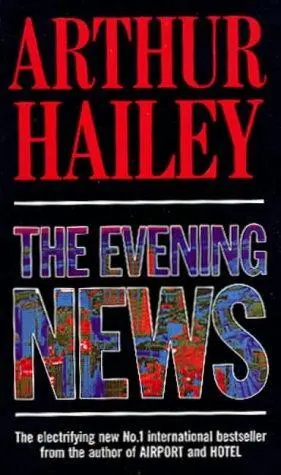
- Название:Evening News
- Автор:
- Жанр:
- Год:неизвестен
- ISBN:нет данных
- Рейтинг книги:3.5 / 5. Голосов: 2
-
Избранное:Добавить в избранное
- Отзывы:
-
Ваша оценка:
Evening News: краткое содержание, описание и аннотация
Предлагаем к чтению аннотацию, описание, краткое содержание или предисловие (зависит от того, что написал сам автор книги «Evening News»). Если вы не нашли необходимую информацию о книге — напишите в комментариях, мы постараемся отыскать её.
Evening News — читать онлайн бесплатно полную книгу (весь текст) целиком
Ниже представлен текст книги, разбитый по страницам. Система сохранения места последней прочитанной страницы, позволяет с удобством читать онлайн бесплатно книгу «Evening News», без необходимости каждый раз заново искать на чём Вы остановились. Поставьте закладку, и сможете в любой момент перейти на страницу, на которой закончили чтение.
Интервал:
Закладка:
In the past, this ordinariness had been Miguel's great good fortune, as was the fact that he did not radiate authority. His power of command remained hidden except to those on whom he exercised it, and then it was unmistakable.
An advantage to Miguel in his present enterprise was that, although Colombian, he could appear and sound American. In the late-1960s and early '70s he had attended the University of California at Berkeley as a foreign student, majoring in English and patiently learning to speak the language without an accent.
In those days he was using his real name, Ulises Rodriguez.
His well-to-do parents had provided the Berkeley education. Miguel's father, a Bogotd neurosurgeon, hoped his only son would follow him into medicine, a prospect in which Miguel had no interest, even then. Instead, as the 1970s neared, the son foresaw basic changes ahead for Colombia—conversion from a prosperous democratic country with an honest legal base to a lawless, unbelievably rich mobsters' haven ruled through dictatorship, savagery and fear. The pharaoh's gold of the new Colombia was marijuana; it would later be cocaine.
Such was Miguel's nature that the coming transition did not faze him. What he coveted was part of the action.
Meanwhile he indulged in some action of his own at Berkeley where he discovered himself to be totally devoid of conscience and able to kill other human beings, swiftly and decisively, without compunction or unpleasant aftertaste.
The first time it happened was after a sexual session with a young woman he had met earlier on a Berkeley street while both were getting off a bus. Walking from the bus stop, they got into conversation and discovered they were both freshmen. She seemed to like him and invited him to her apartment, which was at the seedy Oakland end of Telegraph Avenue. It was at a time when such encounters were normal, long before the AIDS-anxiety era.
After some energetic sex he fell asleep, then awakened to find the girl quietly looking through the contents of his wallet. In it were several identification cards in fictitious names; even then he was practicing for his international beyond-the-law future. The girl was too interested in the cards for her own good; perhaps she was some kind of informant, though he never found out.
What he did was spring from the bed, seize and strangle her. He still remembered her look of unbelief as she thrashed around, trying to release herself; then she looked up at him with desperate, silent pleading just before consciousness ebbed. He was interested, in a clinical way, to discover that killing her did not trouble him at all.
Instead, with icy calm he calculated his chances of being caught, which he assessed as nil. While on the bus the two of them had not sat together; in fact they had not known each other. It was unlikely that anyone observed them walking away from the bus stop. On entering the apartment building, and in an elevator going to the fourth floor, they encountered no one.
Taking his time, he used a cloth to wipe the few surfaces where he might have left fingerprints. Then, using a handkerchief to cover his right hand, he turned out all lights and left the apartment, allowing the door to lock behind him.
He avoided the elevator and went down by the emergency stairs, checking that the lobby was empty before passing through it to the street outside.
The next day, and for several days after, he watched local newspapers for any item about the dead girl. But it was nearly a week before her partially decomposed body was discovered, then after two or three days more, with no developments and apparently no clues, the newspapers lost interest and the story disappeared.
Whatever investigation there was had not connected him with the girl's murder.
During Miguel's remaining years at Berkeley he killed on two other occasions. Those were across the Bay in San Francisco—what he supposed could be called "thrill killings”of total strangers, though he considered both as serving a need to hone his developing mercenary skills. He must have honed them well because in neither case was he a suspect, or even questioned by police.
After Berkeley, and home in Colombia, Miguel flirted with the developing alliance of mad-dog drug lords. He had a pilot's license and made several flights conveying coca paste from Peru to Colombia for processing. Soon a developing friendship with the infamous but influential Ochoa family helped move him on to larger things. Then came M-19 with its orgy of murders and the Medellin cartel's "total war,” beginning in late 1989. Miguel participated in all the major killings, many minor ones, and had long since lost count of the corpses in his wake. Inevitably his name became known internationally, but due to his meticulous precautions there was little else on record.
Miguel's—or Ulises Rodriguez's—connections with the Medellin cartel, M-19 and, more recently, Sendero Luminoso, expanded as the years went by. Through it all, though, he maintained his independence, becoming an international outlaw, a gun-for-hire terrorist who was, because of his efficiency, constantly in demand.
Of course, politics was supposedly a part of it all. Miguel was by instinct a socialist, hated capitalism passionately and despised what he thought of as the hypocritical, decadent United States. But he was also skeptical about politics of any kind and simply enjoyed, as one might an aphrodisiac, the danger, risk and action of the life he led.
It was that kind of life which had brought him to the United States a month and a half ago, to work undercover, preparing for what would happen today, which the entire world would shortly learn of.
The route he had originally planned to the U.S. was roundabout but safe—from Bogotd, Colombia, through Rio de Janeiro to Miami. In Rio he would change passports and identities, appearing in Miami as a Brazilian publisher en route to a New York book fair. But an undercover contact in the American State Department had warned Medellin that U.S. Immigration at Miami had urgently requested all available information on Miguel, especially about identities he was known to have used in the past.
Miguel had, in fact, used the Brazilian publisher identity once before and although he believed it was still unexposed, it seemed wiser to avoid Miami altogether. Therefore, even though it meant some delay, he flew from Rio to London where he acquired an entirely new identity and a brand-new, official British passport.
The process was easy.
Ah, the innocent democracies! How stupid and naive they were! How simple it was to subvert their vaunted freedoms and open systems to advance the purposes of those who, like Miguel, believed in neither! He had been briefed, before reaching London, on how it was done.
* * *
First he went to St. Catherine's House, at the junction of Kingsway and Aldwych, where births, marriages and deaths for England and Wales are recorded There Miguel applied for three birth certificates.
Whose birth certificates? Those of anyone whose date of birth was the same as, or close to, his own.
Without speaking to anyone or being questioned, he picked up five blank birth certificate applications, then walked to where a series of large volumes were on shelves, identified under various years. Miguel—chose 1951. The volumes were divided into quarters of the year. He selected M to R, October—December.
His own birth date was November 14 that year. Leafing through pages, he came across the name "Dudley Martin”who had been born in Keighley, Yorkshire, on November 13. The name seemed suitable; it was neither too distinctive nor as obviously common as Smith. Perfecto! Miguel copied the details onto one of the red-printed application forms.
Now he needed two other names. It was his intention to apply for three passports; the second and third applications would be backups in case anything went wrong with the first. It was always possible that a current passport had already been issued to the same Dudley Martin. In that case a new one would be refused.
Читать дальшеИнтервал:
Закладка:
Похожие книги на «Evening News»
Представляем Вашему вниманию похожие книги на «Evening News» списком для выбора. Мы отобрали схожую по названию и смыслу литературу в надежде предоставить читателям больше вариантов отыскать новые, интересные, ещё непрочитанные произведения.
Обсуждение, отзывы о книге «Evening News» и просто собственные мнения читателей. Оставьте ваши комментарии, напишите, что Вы думаете о произведении, его смысле или главных героях. Укажите что конкретно понравилось, а что нет, и почему Вы так считаете.