Arthur Hailey - Evening News
Здесь есть возможность читать онлайн «Arthur Hailey - Evening News» весь текст электронной книги совершенно бесплатно (целиком полную версию без сокращений). В некоторых случаях можно слушать аудио, скачать через торрент в формате fb2 и присутствует краткое содержание. Жанр: Современная проза, на английском языке. Описание произведения, (предисловие) а так же отзывы посетителей доступны на портале библиотеки ЛибКат.
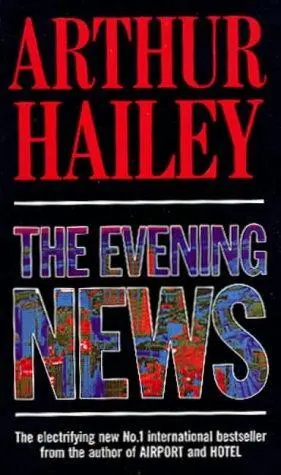
- Название:Evening News
- Автор:
- Жанр:
- Год:неизвестен
- ISBN:нет данных
- Рейтинг книги:3.5 / 5. Голосов: 2
-
Избранное:Добавить в избранное
- Отзывы:
-
Ваша оценка:
Evening News: краткое содержание, описание и аннотация
Предлагаем к чтению аннотацию, описание, краткое содержание или предисловие (зависит от того, что написал сам автор книги «Evening News»). Если вы не нашли необходимую информацию о книге — напишите в комментариях, мы постараемся отыскать её.
Evening News — читать онлайн бесплатно полную книгу (весь текст) целиком
Ниже представлен текст книги, разбитый по страницам. Система сохранения места последней прочитанной страницы, позволяет с удобством читать онлайн бесплатно книгу «Evening News», без необходимости каждый раз заново искать на чём Вы остановились. Поставьте закладку, и сможете в любой момент перейти на страницу, на которой закончили чтение.
Интервал:
Закладка:
I was seeing Nellie home.”
Sloane's forehead creased with an effort of memory.”I've heard that before. Isn't it an old song from the Civil War days?”
Nicky beamed.”Right on, Dad!”
"I think I understand,” his father said.”What you're telling me is, some of those notes are the same as in Gershwin's Prelude Two.”
Nicky shook his head.”The other way 'round—the song was first. But no one knows if Gershwin knew the song and used it, or if it was just chance.”
"And we'll never know.” Amused, and impressed with Nicky's knowledge, Sloane exclaimed, "I'll be damned!”
Neither he nor Jessica could remember exactly how old Nicky had been when he began to exhibit an interest in music, but it was in his very early years and now music was Nicky's dominant concern.
Nicky had gravitated to the piano and took lessons from a former concert pianist, an elderly Austrian living in nearby New Rochelle. A few weeks earlier, speaking with a heavy accent, the tutor had told Jessica, "Your son already has a mastery of music unusual for his age. Later he may follow one of several paths—as a performer or composer, or perhaps a scholar and savant. But more important is that for Nicholas, music speaks with the tongues of angels and of joy. It is part of his soul. It will, I predict, be the mainstream of his life.”
Jessica glanced at her watch.”Nicky, it's getting late.”
"Ah, Mom, let me stay up! Tomorrow's a school holiday.”
"And your day will be as full as any other. The answer is no."
Jessica was the family disciplinarian and, after affectionate goodnights, Nicky left. Soon after, they could hear him playing on a portable electronic keyboard in his bedroom which he used when the livingroom piano was unavailable.
In the softly lighted room, Jessica returned to the martinis she had been mixing earlier. Watching her dispense them, Sloane thought, How lucky can you get? It was a feeling he often had about Jessica and the way she looked after more than twenty years of marriage. She no longer wore her hair long and didn't bother to conceal streaks of gray. There were also lines around her eyes. But her figure was slim and shapely and her legs still brought men's eyes back for a second glance. Overall, he thought, she really hadn't changed and he still felt proud to enter a room, any room, with Jessica beside him.
As she handed him a glass she commented, "It sounded like a rough day?”
"It was pretty much that way. You watched the news?”
"Yes. Those poor passengers on that airplane! What a terrible way to die! They must have known for the longest time they didn't have a chance, then just had to sit there, waiting.”
With a pang of conscience, Sloane realized he hadn't thought about that at all. Sometimes as a professional news person you became so preoccupied with gathering the news, you forgot the human beings who made it. He wondered: Was it callousness after long exposure to the news or a necessary insulation, the kind acquired by doctors? He hoped it was the second, not the first.
”If you saw the airplane story,” he said, "you saw Harry. What did you think?”
"He was good.”
Jessica's answer seemed indifferent. Sloane watched her, waiting for more, wondering: In her mind, was the past completely dead?
"Harry was better than good. He did it like that,” Sloane said, snapping his fingers.”Without warning. With hardly any time.” He went on to describe CBA's luck in having the crew in the DFW terminal.”Harry, Rita and Minh all came through. We beat the pants off the other networks.”
"Harry and Rita seem to be working a lot together. Is something going on there?”
"No. They're simply a good working team.”
"How do you know?”
"Because Rita's having an affair with Les Chippingham. The two of them think nobody knows. Of course everybody does.”
Jessica laughed.”My god! You're an incestuous little group.”
Leslie Chippingham was the president of CBA News. It was Chippingham whom Sloane intended to see the next day about the removal of Chuck Insen as executive producer.
”Don't include me in any of that,” he told Jessica.”I'm happy with what I have at home.”
The martini had relaxed him, as it always did, though neither he nor Jessica was a heavy drinker. One martini plus a glass of wine with dinner was their limit, and during the day Sloane never drank at all.
”You're feeling good tonight,” Jessica said, "and you have another reason to.” She got up and from a small bureau across the room brought back an envelope, already opened—a normal procedure since Jessica handled most of their private business.”It's a letter from your publisher and a royalty statement.”
He took the papers out and studied them, his face lighting with a smile.
Crawford Sloane's book The Camera and the Truth had been published several months earlier. Written with a collaborator, it was his third. In terms of sales, the book got off to a slow start. The New York critics savaged it, leaping at the opportunity to humble someone of Crawford Sloane's stature. But in places like Chicago, Cleveland, San Francisco and Miami, reviewers liked the book. More important, as weeks passed, certain comments in it gained attention in general news columns—the best kind of publicity any book can have.
In a chapter about terrorism and hostages Sloane had written bluntly of "the shame most Americans felt after the 1986-87 revelations that the U.S. Government bought freedom for a handful of our hostages in the Middle East at the expense of thousands of Iraqi deaths and mutilations, not only on the Iran-Iraq battlefield but among civilians.”
The war casualties, he pointed out, resulted from weaponry supplied by the U.S. to Iran in payment for the hostages' release.”A modem dirty thirty pieces of silver”was how Sloane had described the payment, and he quoted Kipling's Danegeld :
We never pay any-one Dane-geld,
No matter how trifling the cost;
For the end of that game is oppression and shame,
And the nation that plays it is lost!
Other applauded Sloane remarks were:
—No politician anywhere has the guts to say it aloud, but hostages, including American hostages, should be regarded as expendable. Pleas from hostages families should be heard sympathetically, but should not sway government policy.
—The only way to deal with terrorists is by counterterrorism, which means whenever possible seeking out and covertly destroying them—the only language they understand It includes not striking bargains with terrorists or paying ransom, directly or indirectly, ever
—Terrorists who observe no civilized code should not expect, when caught red-handed, to shelter under laws and principles which they despise. The British, in whom respect for law is deeply ingrained, have been forced to bend that law at times in defending themselves from a depraved and ruthless IRA.
—No matter what we do, terrorism will not go away because the governments and organizations backing terrorists don't really want settlements or accommodations. They are fanatics using other fanatics and perverted religions as their weapons.
— We who live in the United States will not remain free from terrorism in our own backyard much longer. But neither mentally nor in other ways are we prepared for this pervasive, ruthless kind of warfare.
When the book came out, some of CBA's brass were nervous about the "hostages should be regarded as expendable”and "covertly destroying”statements, fearing they would create political and public resentment of the network. As it turned out, there was no reason for concern and the executives quickly joined the chorus of approval.
Читать дальшеИнтервал:
Закладка:
Похожие книги на «Evening News»
Представляем Вашему вниманию похожие книги на «Evening News» списком для выбора. Мы отобрали схожую по названию и смыслу литературу в надежде предоставить читателям больше вариантов отыскать новые, интересные, ещё непрочитанные произведения.
Обсуждение, отзывы о книге «Evening News» и просто собственные мнения читателей. Оставьте ваши комментарии, напишите, что Вы думаете о произведении, его смысле или главных героях. Укажите что конкретно понравилось, а что нет, и почему Вы так считаете.