Alberto Moravia - Two Friends
Здесь есть возможность читать онлайн «Alberto Moravia - Two Friends» весь текст электронной книги совершенно бесплатно (целиком полную версию без сокращений). В некоторых случаях можно слушать аудио, скачать через торрент в формате fb2 и присутствует краткое содержание. Год выпуска: 2011, Издательство: Other Press, Жанр: Современная проза, на английском языке. Описание произведения, (предисловие) а так же отзывы посетителей доступны на портале библиотеки ЛибКат.
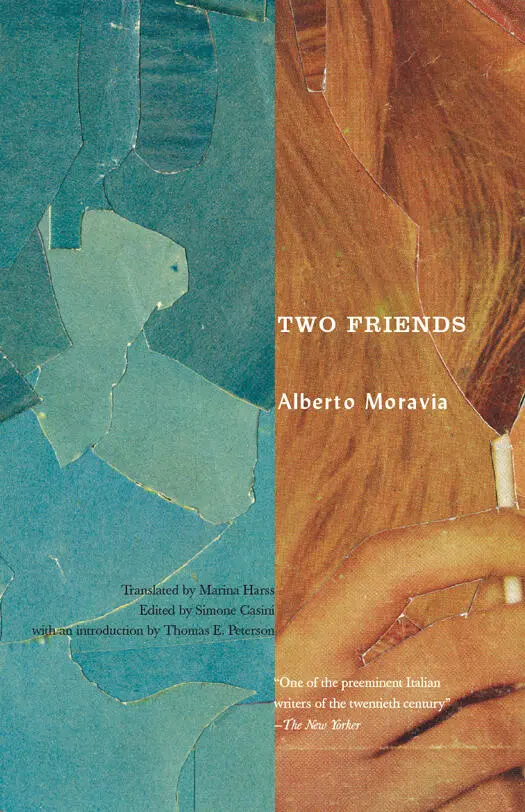
- Название:Two Friends
- Автор:
- Издательство:Other Press
- Жанр:
- Год:2011
- ISBN:нет данных
- Рейтинг книги:3 / 5. Голосов: 1
-
Избранное:Добавить в избранное
- Отзывы:
-
Ваша оценка:
Two Friends: краткое содержание, описание и аннотация
Предлагаем к чтению аннотацию, описание, краткое содержание или предисловие (зависит от того, что написал сам автор книги «Two Friends»). Если вы не нашли необходимую информацию о книге — напишите в комментариях, мы постараемся отыскать её.
Anyone interested in literature will relish the opportunity to watch Moravia at work, tinkering with his story and working at it from three unique perspectives.
Two Friends — читать онлайн бесплатно полную книгу (весь текст) целиком
Ниже представлен текст книги, разбитый по страницам. Система сохранения места последней прочитанной страницы, позволяет с удобством читать онлайн бесплатно книгу «Two Friends», без необходимости каждый раз заново искать на чём Вы остановились. Поставьте закладку, и сможете в любой момент перейти на страницу, на которой закончили чтение.
Интервал:
Закладка:
“I don’t know … I suppose so … Whatever you say,” she said, unsure of herself.
Behind the tiny bar, a chubby, indolent-looking young man was amusing himself serving drinks to his friends, imitating the gestures of a bartender. Smiling, he said, “At your service … What can I get you?
Brusquely, as if he were really a bartender, I said, “A whisky for me … Nella, what do you want?”
“I …,” she said, vaguely, “I’ll have whatever you say.”
“Whatever you say.” This was invariably her answer when I asked her “What do you want?” no matter what the subject.
I repressed my irritation at her passivity and said,
276
“Another whiskey for the signorina. ”
The young man was no longer smiling, and stared at me with a look that was both mocking and annoyed. Nevertheless, he picked up a bottle of whiskey and two glasses, poured some liquid, held out the glasses, and said: “Here are your drinks … but just to be clear … I’m not really a bartender.”
I felt myself blush and grew even more irritated. I held out my hand across the bar and said: “Please excuse me … The name is Maltese.”
He held out his hand: “Giacinti.” And then, looking at Nella, “and the signorina ?”
“Nella,” I said.
“Just Nella?”
For some reason I wanted to say, “Yes, just Nella.” But instead I muttered: “Nella Ciocchi.”
Some dance music came on the radio. Giacinti put the bottle back on the bar and turned to Nella. “Would you like to dance?”
Again I felt a surge of irritation as Nella turned to me before accepting his invitation. “Go ahead,” I said, “that’s what we’re here for.”
With the same docility as before, she reached toward the young man as he approached her. For a moment I watched them dance. The young man was stiff and upright, smartly dressed in his blue suit, like a mannequin; every so often, he moved his shoulders in a way that seemed both ridiculous and typical of a man of his particular social circle. As I watched I realized that it hurt me to see Nella, usually so awkward and unskillful, pressed up against him, her chest against his chest, her belly against his belly. It wasn’t exactly jealousy, I thought, but almost a feeling of profanation and absurdity. I gulped down my drink, still watching the two of them, then drank Nella’s as well. The dance concluded, and another began. Nella glanced over at me with an anxious expression as she accepted another dance in Giacinti’s arms. Now, feeling uncontrollably nervous but trying to simulate calm, I stepped around the bar and stood in the bartender’s spot. First, I poured myself another glass of
277
whiskey, twice as much as before. But soon a couple came up to the bar and said, as if speaking to a bartender, “Two whiskeys, please.”
They had mistaken me for a bartender. For some reason, a little devil led me to try to imitate the much more self-possessed Giacinti. I poured two glasses of whiskey, added some soda water from a siphon, and was about to offer the drinks to the two guests. The young man, who was sitting sideways at the bar and talking, said, without looking at me: “Some ice, please.”
My head was spinning. I could feel the whiskey I had drunk rising to my cheeks with an unpleasant ardor and my eyes clouding over with its fumes. I
managed to find a bucket of ice at my feet, dropped two cubes in each glass, and placed them on the bar, just as Giacinti had done: “Here are your drinks … but I just want to make something clear … I’m not the bartender.”
But here things took a confusing turn. Instead of introducing himself, the young man stared at me for a moment, surprised or perhaps simply distracted, after which he took the glasses and placed them between him and the young woman and went on talking as if nothing had happened.
I forced myself to put out my hand: “Allow me to introduce myself … Maltese.”
This time, the young man behaved with more propriety. Coldly, with a hint of annoyance, he introduced himself and his companion. I can’t remember their names, and perhaps I did not even hear them; by then I was feeling bleary, irritated, and scattered — in other words, drunk. After this quick introduction, the young man went back to his conversation. Desperately, I leaned over the bar and repeated Giacinti’s move: “Excuse me, signorina , may I have this dance?”
She was quite young, very thin and pale, wearing
278
a red velvet dress. She had a long neck, a small, bird-like head, round eyes, and a small mane of frizzy hair. She stared at me for a moment and then, without looking to her companion as Nella had, answered coldly: “Thank you, but I don’t dance.”
I felt my face burning with a sudden, absurd wave of embarrassment. I knew I had a disconcerted look on my face, and with much effort I tried to modify it with a smile that attempted to be slightly ironic and at the same time indifferent. But I realized that my efforts were unsuccessful and that I had managed only to render the stiff, embarrassing mask of bitterness and awkwardness on my face even more uncomfortable. The two went on talking, the radio went on playing dance music, and I began to look around for Nella, unsuccessfully. Was it the whiskey that clouded my eyes or my sense of embarrassment that obscured my sight and ability to reason clearly, making me feel drunk? In order to regain my dignity, I turned toward the bar and once again filled my glass — which I had already emptied four times — and then walked around the room with unsteady steps, as if looking for someone. Finally, I headed toward the French doors that led out into the garden, which were wide open.
I say “as if looking for someone,” and in fact that was precisely what I had been doing from the moment of our arrival. I was looking for Maurizio. As I walked toward the garden, I thought vaguely that I might find him outside, given that I had not seen him in the house. I now realized clearly that I was drunk, and that this drunkenness had unleashed, as the saying goes, my “true self”: the scene at the bar, my awkwardness, my sense of shame, all revealed, more powerful than ever, my old inferiority complex. For a moment, I had felt free. Yes, I thought as I walked unsteadily out of the sitting room, I was still the same person I had been ten years earlier, at least where Maurizio was concerned. The intervening years, my Party membership, my relationship with Nella, and my resolution to be strong and aggressive
279
had all come to nothing.
Stopping every so often to take a sip from my glass, I affected a blasé, worldly attitude as I stepped through the French doors onto the terrace. Outside, there was a paved courtyard surrounded by trimmed hedges with lights hidden inside, illuminating the open space. A few couples danced, others sat on benches, iron chairs, or on the low garden walls. Beyond the hedges one could make out the soaring silhouettes of tall, leafy trees, rising up toward the limpid May sky. The garden, which from the road looked like little more than a slender strip, was in fact quite large. After gazing at the couples and small groups to see if I could identify Maurizio, I began to walk down a small lateral path in the garden. My glass was almost empty, and suddenly I felt very silly walking through the garden clutching an empty glass. My drunken state, however, kept me from carrying this observation further. I continued down one path, took another, walked a good distance, and found myself standing in front of a small fountain consisting of a small basin and a mask which spat out a small dribble of water. The fountain was built into the garden wall and illuminated by the moon; the path ended there, and I was forced to turn back. I took another path. I reflected that if I met Maurizio, I would take the offensive; I would tell him exactly what I thought of him, of his house, of the people he frequented, and I would remind him once again, but this time more brutally, that he and the class he belonged to were doomed and destined to imminent destruction at the hands of the revolution. Meditating on the “writing on the wall” with which I hoped to confront Maurizio once and for all, I was filled with a violent hostility and an aggressive desire for victory. As I walked down another long, meandering path, I suddenly came to an abrupt stop. I could see Nella and Maurizio sitting on a nearby bench in a twist in the path. They were talking; Nella was closer to me, with her back turned, but I could see Maurizio’s face. Nella stood up and said, in a clear voice: “I’m going home,” and walked away. She seemed unsteady, and it occurred to me that she too was drunk. Maurizio was still sitting on the bench, smoking, staring straight ahead. As I approached him, I said, “Ah, there you are … I was looking for you.”
Читать дальшеИнтервал:
Закладка:
Похожие книги на «Two Friends»
Представляем Вашему вниманию похожие книги на «Two Friends» списком для выбора. Мы отобрали схожую по названию и смыслу литературу в надежде предоставить читателям больше вариантов отыскать новые, интересные, ещё непрочитанные произведения.




Обсуждение, отзывы о книге «Two Friends» и просто собственные мнения читателей. Оставьте ваши комментарии, напишите, что Вы думаете о произведении, его смысле или главных героях. Укажите что конкретно понравилось, а что нет, и почему Вы так считаете.