Alberto Moravia - Two Friends
Здесь есть возможность читать онлайн «Alberto Moravia - Two Friends» весь текст электронной книги совершенно бесплатно (целиком полную версию без сокращений). В некоторых случаях можно слушать аудио, скачать через торрент в формате fb2 и присутствует краткое содержание. Год выпуска: 2011, Издательство: Other Press, Жанр: Современная проза, на английском языке. Описание произведения, (предисловие) а так же отзывы посетителей доступны на портале библиотеки ЛибКат.
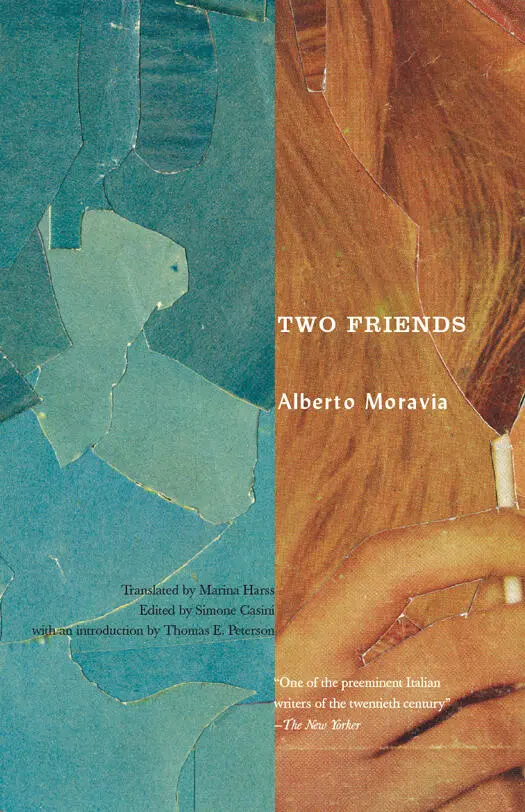
- Название:Two Friends
- Автор:
- Издательство:Other Press
- Жанр:
- Год:2011
- ISBN:нет данных
- Рейтинг книги:3 / 5. Голосов: 1
-
Избранное:Добавить в избранное
- Отзывы:
-
Ваша оценка:
Two Friends: краткое содержание, описание и аннотация
Предлагаем к чтению аннотацию, описание, краткое содержание или предисловие (зависит от того, что написал сам автор книги «Two Friends»). Если вы не нашли необходимую информацию о книге — напишите в комментариях, мы постараемся отыскать её.
Anyone interested in literature will relish the opportunity to watch Moravia at work, tinkering with his story and working at it from three unique perspectives.
Two Friends — читать онлайн бесплатно полную книгу (весь текст) целиком
Ниже представлен текст книги, разбитый по страницам. Система сохранения места последней прочитанной страницы, позволяет с удобством читать онлайн бесплатно книгу «Two Friends», без необходимости каждый раз заново искать на чём Вы остановились. Поставьте закладку, и сможете в любой момент перейти на страницу, на которой закончили чтение.
Интервал:
Закладка:
I did not have the strength to react. He walked off, leaving me standing there as he receded from view. Once he was gone, I sat down on the bench mechanically. I realized I had behaved like a fool. What had I done since arriving at that house? Not only had I let myself blurt out an absurd, ridiculous declaration — almost a declaration of love — but I had spoken of our
284
struggle and my plans to vanquish him, to achieve a final victory. Now I was ashamed, and I understood that once again I had surrendered to my drunken state and, more important, to my ever-present sense of inferiority. For a moment I felt such regret and anger that I almost gave in to the impulse to run after Maurizio, strike him, and say, “This is what you deserve … This is how I really feel about you.” But I realized that such a scene would be inopportune at the very least. Since there was no question of taking back my words and repairing the gravely compromised situation between us, I could only hope to put them in the context of a new plan of action. I felt comforted by the thought that he had admitted to feeling contempt toward the people at his party, and had almost promised to continue our conversation in the future with the words “We’ll discuss it another time.” I reassured myself with the thought that perhaps my drunken honesty had not yet ruined everything, and that I might return to battle with weapons that were not yet completely blunted.
Meanwhile, despite my thoughts of regrouping and second rounds, I was still drunk and I knew that my drunkenness would not pass anytime soon and might still lead me to say or do something regrettable. I decided it was time to leave the party which inspired such contempt in me and where I had managed to behave so contemptibly. I headed down the path toward the villa. I was very drunk and realized that I could neither walk straight nor think clearly. My drunkenness insinuated itself into my thoughts, clouding them with the very idea that I was drunk. I walked a bit farther until suddenly I found myself in front of the wall with the little fountain and the mask spitting water from its mouth, beneath the light of the moon. Instead of walking toward the house, I had gone in the opposite direction, toward the back of the garden. The mask seemed to jeer at my deflated, unhappy state and my sense of defeat after so many dreams of victory. I dunked my head in the cool water and held my breath for as long as I could. I came up to draw a breath and dunked my head again. I did this several times until I was convinced that I felt more clearheaded, and then began to walk quickly toward the villa.
This time I found my way without difficulty. The
285
first thing I saw on the terrace in front of the French doors was Nella, dancing with Maurizio. I went up to her with a decided step and took her arm abruptly. They stopped dancing and stared quizzically at me. “We have to leave,” I said, suddenly realizing that my tongue, blunted by alcohol, was moving with difficulty: “We’ve got to go now.”
“But I’m dancing,” Nella said. I looked into her face and realized that she too was drunk. Her hair was messy and her eyes more beautiful than ever, filled with the vague, drowsy, uncertain, tremulous beauty of drink. Despite her naïveté she wore a somewhat infatuated expression on her flushed face: “I’m dancing,” she repeated uncertainly, her voice plaintive as she looked toward Maurizio, pleading for his help.
Maurizio intervened: “Yes, we have to finish this dance,” he said, once again taking her in his arms. “Come on, Sergio, be nice, sit on that chair,” he said, pointing to a small wicker chair against the wall and preparing to continue dancing.
I felt a stubborn, drunken desire to have my way: “I want you to come with me now,” I said angrily to Nella.
Nella faced me: “You go … I’ll catch up with you,” she said, quite seriously, and not a little drunk.
“But you’re drunk,” I retorted angrily, trying to grab her arm.
“Oh, and you’re not?” she answered, childishly. Maurizio began to laugh. “Come on, don’t be angry, wait for me,” she continued after a brief pause, stumbling a bit over her words. “I only have, let’s see, five dances left,” she said, looking at me tenderly, “one with Maurizio, and four more.”
“And then a last dance with me,” Maurizio added, clearly amused by my disgruntled air.
“And then a last dance with him.”
“But I don’t feel like staying,” I began, “I want to go home.”
Maurizio, who seemed to be enjoying himself, suddenly called out: “Gisella …” I turned in the direction
286
of his words. In the doorway of the sitting room stood a tall, shapely, and attractive girl, with a great mane of hair that descended from her small head down to her shoulders. She was watching us uncertainly. “Gisella,” Maurizio said again, “come dance with my friend Sergio … He’s dying to dance, and I can see that you are also looking for a partner.”
A word from Maurizio was all it took. As docile as a harem girl responding to her master’s instructions, the tall, shapely Gisella approached me and, with her arms extended, said, “Here I am, shall we dance?” and I found myself pressed against the elongated body of this horse-like girl, my nose buried in her hair. Over her shoulder, I looked at Nella. She too was watching me, and as soon as she saw that our gaze had crossed, she stuck her tongue out at me mischievously, like a street urchin, as if to say: “Serves you right.” Her gesture disarmed me, because once again it revealed Nella’s deep, inalterable innocence, which was perhaps the quality that most drew me to her. The tall Gisella was speaking: “You know, I have no idea who you are.”
“A poor wretch,” I said emphatically.
She peered at me and said: “You couldn’t possibly be as wretched as I am.”
“Why is that?” I asked.
“Because I am in love with a man who does not love me,” she said, with impudent sincerity.
“Who is he?”
“That man over there,” she said, looking at Maurizio. Suddenly, I forgot my desire to leave the party; such was the power of Maurizio’s name. With feigned coarseness, I asked: “What do you see in him? I know him well …”
“Really?”
“We went to school together … So what do you see in him? He’s a hollow, selfish, arid, vain, heartless man … a useless person.”
As I said this, she observed me with her round, bird-like eyes. Suddenly she said: “Do you know why you say those things?”
“Why?”
287
“Out of envy.”
I blushed, knowing she was right. I said, violently, “And do you know why you say that?”
“Why?”
“Out of stupidity.”
She too blushed, but with anger. Pushing me away, she said: “Listen, I think we should stop dancing. I don’t feel like being insulted.” She began to walk down the path toward the little fountain. I ran after her, taking her arm: “Don’t be angry … I was just joking.”
“I don’t find that sort of thing amusing.”
“Come on … let’s dance.”
“I don’t feel like dancing anymore … It’s too hot … Let’s sit over there,” she said, no longer angry, but instead with a kind of flirtatiousness. She pointed at the bench where Maurizio and Nella had been sitting earlier.
We walked over to the bench, and the girl sat down. Fanning herself with a handkerchief, she said, “Tell me about yourself.”
For some reason, perhaps because of my drunken state, it occurred to me that she might be attracted to me and want to be alone with me. In an insinuating voice, I asked, “Why do you want to know?”
“No reason … because we’ve never been introduced.”
“It’s true … Well, my name is Sergio Maltese, and I’m a journalist and a film critic … and a Communist.”
Читать дальшеИнтервал:
Закладка:
Похожие книги на «Two Friends»
Представляем Вашему вниманию похожие книги на «Two Friends» списком для выбора. Мы отобрали схожую по названию и смыслу литературу в надежде предоставить читателям больше вариантов отыскать новые, интересные, ещё непрочитанные произведения.






Обсуждение, отзывы о книге «Two Friends» и просто собственные мнения читателей. Оставьте ваши комментарии, напишите, что Вы думаете о произведении, его смысле или главных героях. Укажите что конкретно понравилось, а что нет, и почему Вы так считаете.