Alberto Moravia - Two Friends
Здесь есть возможность читать онлайн «Alberto Moravia - Two Friends» весь текст электронной книги совершенно бесплатно (целиком полную версию без сокращений). В некоторых случаях можно слушать аудио, скачать через торрент в формате fb2 и присутствует краткое содержание. Год выпуска: 2011, Издательство: Other Press, Жанр: Современная проза, на английском языке. Описание произведения, (предисловие) а так же отзывы посетителей доступны на портале библиотеки ЛибКат.
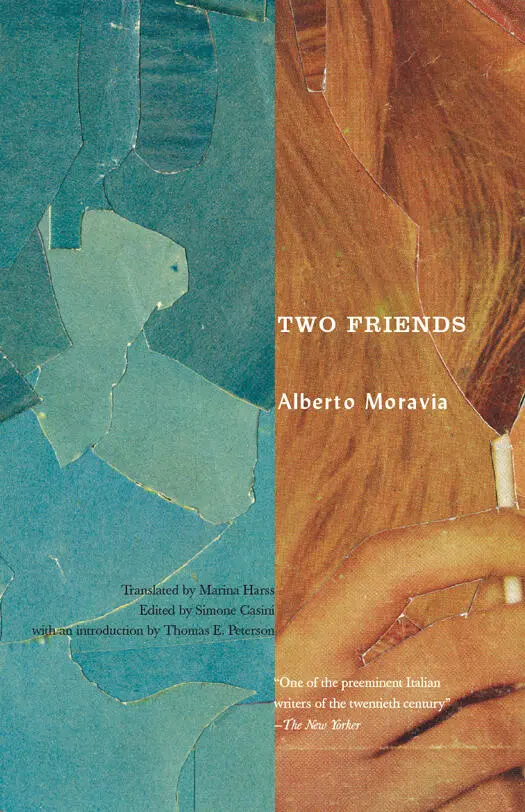
- Название:Two Friends
- Автор:
- Издательство:Other Press
- Жанр:
- Год:2011
- ISBN:нет данных
- Рейтинг книги:3 / 5. Голосов: 1
-
Избранное:Добавить в избранное
- Отзывы:
-
Ваша оценка:
Two Friends: краткое содержание, описание и аннотация
Предлагаем к чтению аннотацию, описание, краткое содержание или предисловие (зависит от того, что написал сам автор книги «Two Friends»). Если вы не нашли необходимую информацию о книге — напишите в комментариях, мы постараемся отыскать её.
Anyone interested in literature will relish the opportunity to watch Moravia at work, tinkering with his story and working at it from three unique perspectives.
Two Friends — читать онлайн бесплатно полную книгу (весь текст) целиком
Ниже представлен текст книги, разбитый по страницам. Система сохранения места последней прочитанной страницы, позволяет с удобством читать онлайн бесплатно книгу «Two Friends», без необходимости каждый раз заново искать на чём Вы остановились. Поставьте закладку, и сможете в любой момент перейти на страницу, на которой закончили чтение.
Интервал:
Закладка:
This last word surprised her: “A Communist?”
“Yes.”
“Let me warn you that I can’t stand Communists.”
“Why is that?”
“Because they want to eliminate rich people.”
288
“Are you rich?”
“No … but I like the idea that there are people out there who are.”
She said this with such an air of obtuseness and obstinate conviction that I could not help thinking, with equal conviction, “How stupid she is.” “Perhaps that is why you love Maurizio, because he’s rich,” I insinuated.
“That’s one of the reasons,” she said, with animal-like sincerity. “I don’t like poor people: they’re stingy and small-minded … You can tell Maurizio has always had money … Can’t you see how generous and gentlemanly he is?”
She was clearly a stupid woman. And yet it seemed to me that her vapid affirmations had more weight than all my well-formulated philosophical ideas about the coming revolution. With sudden aggression, I said, “People like you and Maurizio will soon be swept away … You won’t even have eyes to cry.”
She stared at me in complete bewilderment, eyes wide open. Only now did I realize that she too was quite drunk. Her round, sky-blue eyes seemed to wander and were filled with uncertainty. “What do you mean?”
“A revolution is coming,” I said, feeling twice as stupid as she, but unable to stop myself. “And all this,” I said, waving toward the house, the garden, and the young woman, “all this will be confiscated and placed at the service of the people.”
Something completely unexpected happened. The girl began to cry: “Oh no … please … please don’t hurt him,” she cried out, her head in her hands, “please don’t.”
And then, after a moment, she turned her anger toward me. “It’s all envy … People like you want a revolution because you’re envious … because you don’t have money and you prefer that nobody else have it if you can’t have it too … You’re just envious, that’s all.”
I felt defenseless, drunker than ever, and quite ridiculous. And yet I could not help defending myself: “You don’t know what you’re saying.”
“Oh yes, I do.”
289
“No, you don’t … and this time I really mean it: you are a stupid woman.”
I had stood up, and she looked me up and down. “Get out of here,” she said, angrily.
“I’m leaving,” I said, flustered; “it was you who brought me here.”
“Go away … Can’t you see I want to be alone?”
I walked away without arguing. I was angry and flustered, and even more ashamed of the way I had behaved over the course of that terrible evening. What had I been thinking, talking about Communism and revolution with that silly girl who could think only of Maurizio and her feelings of rejection? I had reduced these profound issues in my life to mere bourgeois chitchat at a bourgeois party, and for this I was terribly ashamed. I knew that all this had happened because I was drunk; but what was this drunkenness but an expression of my feelings of inferiority and weakness? I did not like to drink, nor did I enjoy being drunk; I had drunk only in order to have something to do and to overcome a moment of awkwardness and embarrassment. No matter what I did, I returned to the same point of departure: when I had planned to go to the party my intention, like a piper, had been to force Maurizio to dance to my tune, but instead it was I who had been played.
Still unsteady, and drunker than ever, I returned to the terrace. Couples were dancing on the paving stones in the light of the lamps tucked into the hedges. Nella and Maurizio were no longer there. Vaguely, I thought, “Maurizio is courting Nella … He wants to steal her away from me,” but as before, this thought did not elicit any particular reaction. Where Maurizio was concerned, I noticed, I was neither jealous nor suspicious. I went inside; here too couples were dancing, while others crowded around the bar. I saw Maurizio dancing with a slight girl with puffy hair, and felt something like disappointment, as if I had hoped rather than feared to find him courting Nella. Despite my drunkenness and confusion, I tried to decipher the reason behind this sense of disappointment as I stepped into the next room, which was almost empty. Nella was there, sitting on a couch with a man I did not know. The man, who looked to be in
290
his fifties, was large, with a wide chest, a big head of gray hair, and a striking, aristocratic face, with a pronounced nose, mouth, and chin, and sideburns down to the middle of his cheeks. When he stood up, however, he did not seem to grow any taller. In fact, he was quite short, with very short legs and tiny hands and feet. Drunkenly and without moving, Nella said: “This is Maurizio’s business partner … I’m sorry, what is your name?”
“Moroni,” he said, holding out his hand.
“He says I should be in the movies,” she said loudly; “he says I could make a lot of money … Isn’t that right, signor Moroni?”
“We would need to do a screen test,” he said, seriously, with a slight accent. “In truth, I’m not an expert, but at first blush I would say that the young lady is quite photogenic.”
“And I could make a lot of money, isn’t that right?” Nella asked loudly.
“Well of course, yes.”
“I could make lots of money and buy myself lots of clothes,” she said loudly, sounding very drunk. “Because we’re very poor, Signor Moroni … He can’t even buy me a pair of stockings … Just look at them,” she said, stretching out her leg and pulling up the hem of her dress to expose a white thigh; “look at how many times I’ve had to mend these stockings.”
Moroni, with a discretion for which I was quietly grateful, barely glanced at Nella’s shapely, tapered leg, though I could tell he would have liked to gaze at it for longer. “Yes, of course,” he said, with some embarrassment, “you could buy all the stockings you like.”
“And clothes too,” she said, loudly. “Do you know when I bought this dress? Ten years ago … Look how discolored it is under the arms … and how old-fashioned it is … I was ashamed to wear it, but then he slapped me.”
Moroni sat in embarrassed silence. Annoyed, I said: “Come on now, why should Moroni care about such things?”
She leaned toward me and took my hand: “But I love you … and I’m glad you slapped me … Bless your hand,” she said, kissing it fervently, “bless this hand, which slapped me over and over again!”
“Stop it,” I said, impatiently, trying to pull my hand
291
away.
But Nella did not mean it in this way. “You know, Mr. Moroni, I love him, and I always will, even though he treats me terribly … I would do anything for him … Don’t you believe me?”
“Oh yes,” he said, without looking at her.
“I love him … but we’re poor, and I want to make money so I can support him … He’s a Communist because we’re poor … but if we had money, he would change his mind.”
Moroni looked at me with some curiosity. Suddenly angry, I said, “You’re saying stupid things, and to make matters worse, they aren’t even true … I already told you: my political loyalties and our private life are of no interest to Mr. Moroni.”
Moroni sat down again. “Are you,” he asked, turning to Nella, in a courteous, almost shy voice, “are you a Communist as well, signorina?”
“No … I mean yes,” she said loudly, “I am everything that Sergio, my love, wants me to be … I love him, and if tomorrow he asked me to kill you because you are a capitalist, I would do it without hesitating.”
“You’re drunk,” I said, contemptuously. Then, turning to Moroni: “Don’t pay her any mind … she’s had too much to drink.”
Читать дальшеИнтервал:
Закладка:
Похожие книги на «Two Friends»
Представляем Вашему вниманию похожие книги на «Two Friends» списком для выбора. Мы отобрали схожую по названию и смыслу литературу в надежде предоставить читателям больше вариантов отыскать новые, интересные, ещё непрочитанные произведения.





Обсуждение, отзывы о книге «Two Friends» и просто собственные мнения читателей. Оставьте ваши комментарии, напишите, что Вы думаете о произведении, его смысле или главных героях. Укажите что конкретно понравилось, а что нет, и почему Вы так считаете.