Alberto Moravia - Two Friends
Здесь есть возможность читать онлайн «Alberto Moravia - Two Friends» весь текст электронной книги совершенно бесплатно (целиком полную версию без сокращений). В некоторых случаях можно слушать аудио, скачать через торрент в формате fb2 и присутствует краткое содержание. Год выпуска: 2011, Издательство: Other Press, Жанр: Современная проза, на английском языке. Описание произведения, (предисловие) а так же отзывы посетителей доступны на портале библиотеки ЛибКат.
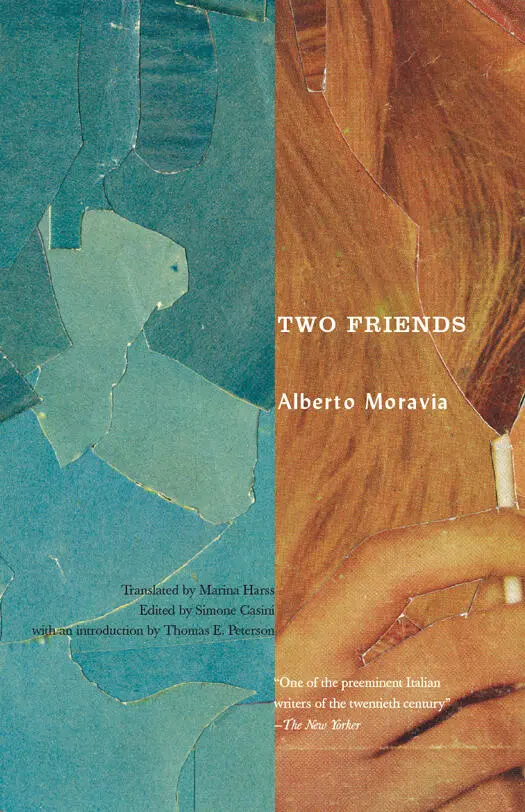
- Название:Two Friends
- Автор:
- Издательство:Other Press
- Жанр:
- Год:2011
- ISBN:нет данных
- Рейтинг книги:3 / 5. Голосов: 1
-
Избранное:Добавить в избранное
- Отзывы:
-
Ваша оценка:
Two Friends: краткое содержание, описание и аннотация
Предлагаем к чтению аннотацию, описание, краткое содержание или предисловие (зависит от того, что написал сам автор книги «Two Friends»). Если вы не нашли необходимую информацию о книге — напишите в комментариях, мы постараемся отыскать её.
Anyone interested in literature will relish the opportunity to watch Moravia at work, tinkering with his story and working at it from three unique perspectives.
Two Friends — читать онлайн бесплатно полную книгу (весь текст) целиком
Ниже представлен текст книги, разбитый по страницам. Система сохранения места последней прочитанной страницы, позволяет с удобством читать онлайн бесплатно книгу «Two Friends», без необходимости каждый раз заново искать на чём Вы остановились. Поставьте закладку, и сможете в любой момент перейти на страницу, на которой закончили чтение.
Интервал:
Закладка:
As I’ve said, this sense of irredeemable and ineffable inferiority caused me great suffering. I did not know why this ancient rivalry had now become mixed with my political aspirations, intellectual ambitions, and moral hopes, but it seemed to me, deep down, that if I could not triumph over Maurizio, then the revolution too would fail; I would continue my life as a miserable, mediocre intellectual, and all my actions would continue in the same negative, abnormal vein as they now seemed to. Maurizio was the symbol of everything I sought to defeat within and outside of myself, and our struggle was the testing ground, as they say, of my personal strength and of all the ideas and principles I embraced. I don’t know which made me more unhappy: my awareness of the fact that we were built from different metals, or the importance I attributed to my stake in this after all quite modest rivalry. I knew that I suffered as only an impotent man can suffer, like a man who leaves a woman he has intended to deflower intact on the bed, sheets crumpled in vain.
Immersed in such bitter reflections, I walked mechanically in the darkness to the end of Maurizio’s street. Mechanically — almost without realizing it — I boarded a bus, got off at my stop, walked the rest of the way, climbed the stairs, entered the boardinghouse, and shut the door. Perhaps shaken by the sight of the empty room, a silent yet eloquent witness of my defeats and torments, I felt a sudden wave of rebellion well up inside me. Yes, it was true that Maurizio was made of a harder metal than I, but it was only partly true, and only in a world where men were judged as metal bars or cogs in a machine. In the real, human world, and beyond all poetic metaphors, this question of metals meant nothing, and the truth remained that Maurizio was a man like me and like many others; in other words, his strength lay only in my weakness. It was only because I thought
265*
or felt, or in any case had convinced myself, that Maurizio was stronger, that he in fact acquired this strength. I could now see that what I had to do was convince myself of the contrary, in other words arrive at the inalterable conviction that in reality Maurizio was weak, very weak, and that I, for a host of reasons, was vastly stronger. I had already expressed this conviction in abstract form, theoretically, by objectively examining Maurizio’s situation and establishing its weakness in comparison to my own. When he and I had spoken in the garden, I had argued: “I am the new man, and you are a relic of the past.” But even as I had exclaimed these precise, true words, I had felt that Maurizio, despite belonging to the past, was still superior. Why? Now I realized that it was because I believed in this new man only with my head, but not with the deepest fibers of my being, the part of us that allows us to hold and return the gaze of a rival, that lends authority to our voice and decisiveness to our gestures, and forms the basis of the true strength of powerful men. I needed to release this conviction from the antechamber of my mind and send it to the deepest recesses of my being, into my blood, my flesh, my true matter. But I realized that by a circuitous route I had returned to the question of matter, to the evaluation of man as metal, substance, chemical makeup. In desperation, and still drunk, I turned out the light and threw myself facedown on the bed fully dressed.
I’m not sure how long I lay like this, with my mouth pressed into the pillow and my body spread across the bed. I must have slept for about an hour, a sleep without dreams, dark and deep. When I awoke, my hand went automatically to the light switch; I saw that the clock on the dresser said it was four in the morning and realized that Nella had not yet returned. It occurred to me that perhaps she was really sick, to the point that she could not leave Maurizio’s villa, but then it occurred to me that her sickened state might only have been an excuse to spend the night at the villa. I did not have any deeper thoughts on the issue; this final hypothesis did not awaken worry, jealousy, or any other particular feeling. I began to undress, pulling off my clothes and throwing them on the floor far from the bed. I climbed under the covers and once again turned out the light. I think I fell asleep almost immediately, but this time my slumber did not last long. Little more than a quarter of an hour had passed when a light came on and I caught a glimpse of Nella between half-open lids swollen with sleep as she entered the room carefully, on tiptoe, trying
266*
to avoid making noise. I closed my eyes again, feigning sleep, and watched as she went back and forth, undressing quickly, putting her clothes away in the closet — carefully, as always — and placing her slip, stockings, and shoes on a chair at the foot of the bed. When she was completely undressed, she went over to the vanity table, sat down on the narrow stool in front of the mirror, and began to comb her hair with quick, energetic strokes. From the bed I could see her torso, almost adolescent and boyish except where it widened and grew paler in the discreet but clearly feminine width of the hips. Her mane of red hair, tinged with a metallic hue in the light of the lamp, made her shoulders appear even more narrow and her arms more child-like as she brushed her hair. Every so often she turned her head slightly, energetically brushing the hair to one side, and I could see, beneath her outstretched, raised arm, the round, heavy, buttery whiteness of her breast with its pink tip. As I gazed at her, so chaste and innocent, it occurred to me that I loved her and that I was lucky to have such a lover. Then, as she got up from the stool and tiptoed over to the bed, I closed my eyes quickly. She put one knee on the bed and leaned over me, her breasts hanging over my face. I could smell her breath, innocently soaked in the ardent fragrance of alcohol. She whispered, “Are you asleep?” I pretended not to hear her, and she repeated the question one more time, in a slightly more audible voice: “Are you sleeping?” She clearly wanted to wake me, but at the same time wanted to let me sleep, a childish contradiction which suddenly made me smile. “No, I’m awake,” I said, rousing myself and putting my arms around her waist. “I thought you were sleeping,” she said, panting, pressing her cool, solid, smooth, slippery body against me. As I kissed her, I stretched out one arm to turn out the light and then embraced her more tightly, with both arms. She returned my embrace with infantile, awkward ardor, murmuring: “Do you love me? Do you love me?”
After we made love we lay side by side, my arm still around her slender waist and her hand languidly resting on my groin. For a few moments, in the dark, it seemed that we were both remembering the events of
267*
the evening. In fact, after a few minutes, Nella began to speak; her tone was that of a person who is unsure of her interlocutor’s reaction: “You remember that man, Moroni, who said he would find work for me in the movies? He was serious … He’s Maurizio’s partner … After you left, I went back downstairs and the two of them looked after me and told me that soon they will arrange a screen test for me.”
“Well, I hope it goes well for you,” I mumbled in the dark, with a touch of sarcasm.
She thought I was jealous, and immediately embraced me and planted a kiss on my cheek, saying quickly: “I’ll always love you, and only you … even if I become a movie star and make lots of money … I’ll give it all to you … You can do what you like with it. I won’t keep even a penny for myself.”
“You want me to become a kept man,” I said, with the same sarcastic tone.
“Don’t say that … I want you not to have to work for money, so you can focus on your studies … They both like you very much and, you know, Maurizio told me that deep down he more or less agrees with your political ideas.”
Читать дальшеИнтервал:
Закладка:
Похожие книги на «Two Friends»
Представляем Вашему вниманию похожие книги на «Two Friends» списком для выбора. Мы отобрали схожую по названию и смыслу литературу в надежде предоставить читателям больше вариантов отыскать новые, интересные, ещё непрочитанные произведения.




Обсуждение, отзывы о книге «Two Friends» и просто собственные мнения читателей. Оставьте ваши комментарии, напишите, что Вы думаете о произведении, его смысле или главных героях. Укажите что конкретно понравилось, а что нет, и почему Вы так считаете.