Alberto Moravia - Two Friends
Здесь есть возможность читать онлайн «Alberto Moravia - Two Friends» весь текст электронной книги совершенно бесплатно (целиком полную версию без сокращений). В некоторых случаях можно слушать аудио, скачать через торрент в формате fb2 и присутствует краткое содержание. Год выпуска: 2011, Издательство: Other Press, Жанр: Современная проза, на английском языке. Описание произведения, (предисловие) а так же отзывы посетителей доступны на портале библиотеки ЛибКат.
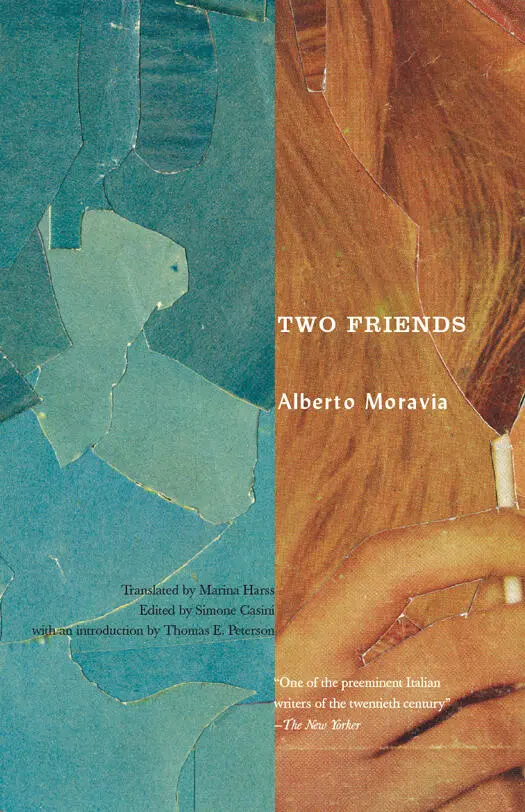
- Название:Two Friends
- Автор:
- Издательство:Other Press
- Жанр:
- Год:2011
- ISBN:нет данных
- Рейтинг книги:3 / 5. Голосов: 1
-
Избранное:Добавить в избранное
- Отзывы:
-
Ваша оценка:
Two Friends: краткое содержание, описание и аннотация
Предлагаем к чтению аннотацию, описание, краткое содержание или предисловие (зависит от того, что написал сам автор книги «Two Friends»). Если вы не нашли необходимую информацию о книге — напишите в комментариях, мы постараемся отыскать её.
Anyone interested in literature will relish the opportunity to watch Moravia at work, tinkering with his story and working at it from three unique perspectives.
Two Friends — читать онлайн бесплатно полную книгу (весь текст) целиком
Ниже представлен текст книги, разбитый по страницам. Система сохранения места последней прочитанной страницы, позволяет с удобством читать онлайн бесплатно книгу «Two Friends», без необходимости каждый раз заново искать на чём Вы остановились. Поставьте закладку, и сможете в любой момент перейти на страницу, на которой закончили чтение.
Интервал:
Закладка:
It is likely that my state of mind, which was more one of certainty than one of expectancy, rendered me particularly insensitive to the small complications of daily life. Maurizio’s invitation gave me the sense of once again entering into a dialogue with him, a healthy exchange of ideas, but it also forced me to face certain challenges that I normally tried to ignore by losing myself in dreams of total palingenesis.
The invitation was for seven-o’clock — in other words, it was a cocktail party. Nella and I spent the afternoon at home; I worked on my translation while Nella lay on the bed reading as usual. She was a bit agitated; several times she interrupted her reading to kiss me behind the ear, or to speak to me from the bed, or to complete some small task or walk around the room. I knew what was bothering her: our visit to Maurizio’s. I knew it because I also felt the same agitation, and for the same reason. Thus, after she had listlessly picked up and laid down her reading several times and I had listlessly forced myself to continue working, we finally reached the end of the afternoon. I glanced at my watch and shut the dictionary, covered the typewriter, saying, as I rose from the table: “I think it’s time to go to Maurizio’s.”
There was no answer from the bed. I turned toward Nella and saw that she was lying on her back with one arm under her head, staring up at the ceiling. She was wearing only her slip, her breasts and arms bare. I said quietly: “Come on, get dressed … it’s time to go.”
Finally, she answered me in an obstinate tone I had never heard: “You go … I’ll stay here.”
I went over to the bed, surprised, and asked: “Why don’t you want to come? He invited you as well.”
“I don’t feel like going … You go … I’ll wait here.”
Now more irritated than surprised, I asked: “What’s
263
wrong with you? Why don’t you want to come?”
“I just don’t.”
“That’s not an answer.”
“It’s the only answer I can give you.”
I sat on the bed and took her hand. “But why? Don’t you like Maurizio?”
“No, that’s not it,” she said, breaking free almost rudely. “I don’t have anything against him … I don’t mind him at all.”
“So what is it?”
“You go … I’m not coming.”
I realized that I would get nowhere with this indulgent tone, and instinctively switched to a more heavy-handed approach. I leaned over the bed where she lay with her head resting on one arm, and grabbed her by the hair, demanding, in an irritated tone: “Why are you being so stubborn?”
Now she seemed to realize that she would have to give me an explanation for this mysterious attitude. She broke free, jumped up from the bed, and walked, barefoot, to the closet containing her few clothes. She opened it and pulled out a hanger with a dress, practically throwing it in my face: “This is the only thing I have to wear to your friend Maurizio’s party … a dress from before the war … Look, the armpits are discolored by sweat … It’s been mended many times over and it’s completely out of style. I don’t want to be embarrassed in front of the women who will be at the party, dressed up in new clothes. I’d rather stay at home … that’s why I’m being so stubborn.” She said this in a tone of almost painful relief. Then she pulled up her slip and showed me her leg: “Look at these stockings … They’re full of runs … It’s the only pair I own, or rather I have another pair but they’re in even worse condition … They’ll all laugh at me … No thanks … I’d rather stay home.”
She said these words in a childishly spiteful voice which would have made me laugh if I had not already been so irritated with her. She came back and placed one knee on the bed, as if she was about to climb in. This obstinate gesture pushed me over the edge.
264
Once again I grabbed her by the hair and pulled her toward me. “You’re coming,” I said, furious.
She twisted her face, staring at me angrily, as I held her in an uncomfortable position, twisted sideways. “No, I’m not,” she said.
“Yes, you are.”
“I won’t go,” she repeated, still talking out of one side of her mouth as I pulled her uncomfortably toward me. “You want to humiliate me … That’s your aim … You want to humiliate me in front of your friend by making me look like a beggar at his party. I won’t go.”
I don’t know why, but this trumped-up accusation made me even more furious. As I reflected later on the scene, I realized that there was a grain of truth to what she said. My aim was not so much to humiliate her but rather to use our poverty — so clearly denoted by our clothes, especially hers — as a challenge and rebuke to Maurizio’s wealth. But I did not realize this fully at the time. To the contrary: I felt the accusation to be completely false. “You idiot!” I yelled, “why would I want to humiliate you? What would be the point?”
“I don’t know … but you do, you want to humiliate me and you don’t realize that it will be worse for you if I come … People will think that you don’t care about me when they see that you let me walk around dressed like this.”
“What do I care what they think? You know it isn’t true … I can’t make any more money than I do now … and that’s all there is to it.”
For some reason, I was filled with a terrible rage. Deep down I admitted to myself that, just like my inscription in the Communist Party, I saw Nella as another weapon in the arsenal I was building against Maurizio. She reinforced my position by loving me, and sustained my presence with hers. Now she was denying me this weapon. But it is possible that my rage contained a premonition of what would come later, that my consciousness was playing a kind of trick to keep me from offering Nella to Maurizio in exchange for … his defeat. But I’m getting ahead of myself. All I know is that, in the grip of rage — and at the same time ashamed of this rage — I raised my hand and struck her face, which was turned toward me as I pulled her head by the hair toward my knees. I hit her once, twice, striking the hand she had raised
265
to shield herself. I struck her again, trying unsuccessfully to reach her other cheek; then, disgusted and still furious, I wrenched her body to the ground, still holding her by the hair. She fell onto the rug at my feet, her head in her hands, moaning deeply in a tone that sounded more pleasurable than aggrieved. With renewed fervor I kicked her back and her flank, violently at first and then more weakly, already repentant, surprised at the soft, delicate pliancy of her flesh. Then I got up and began to walk almost mechanically around the room. She remained where she had fallen, curled up with her face turned toward the bed and buried in her delicate hands, as strands of her great mane of shiny red hair escaped between her fingers. I could see the light copper-colored fuzz on her neck, against the diaphanous skin, and suddenly felt a wave of tenderness. In order to avoid having to look at her, I went to sit at my table in front of the window with my back to the room.
I was disgusted with myself. I had behaved in a brutal, cruel manner and I felt ashamed. But the darker, more profound reasons for my behavior — which I did not completely comprehend, nor want to — disgusted me even more, and disconcerted me deeply. I knew that Maurizio was the real source of my anger, and that I had become angry at Nella only because the situation involved Maurizio. If she had complained about our financial situation and her lack of decent clothes in other circumstances, I would probably have been hurt and mortified, but I would
266
not have become so infuriated. I would have been able to see that after all, she wasn’t completely mistaken; women like to be well dressed, even ones who live with Communists. The reason I had struck her in this brutal, savage manner was that Maurizio was involved, and, though I could not yet make out the exact cause, I sensed that it did not put me in a good light. This brutality seemed to belie a kind of jealousy, as if I had been upset that Nella wanted to dress up for Maurizio. But at the same time I realized that beyond this jealousy lay the same feeling of social inferiority I had always suffered in Maurizio’s company. I had beaten Nella because on some level I felt that her behavior reflected my own hated weakness. But there was something more: when I had struck her and ordered her to go to Maurizio’s party even though she had no decent clothes, I had felt a kind of disgust with myself, almost as if I had wanted not merely to force Nella to take part in a banal cocktail party, but rather to gratify Maurizio in some other, deeper, more unmentionable way. Like everything else, this suspicion led back to my sense of social inferiority. I was almost like a man who feels so inferior and is so hard-pressed to make a good impression that he is willing to throw his wife in another man’s arms, just to please him. I also felt, in some vague and undeveloped way, that my relations with Nella, and the very existence of Nella — in other words the fact that I had a lover — placed me in a position of strength in relation to Maurizio and supplied me with a weapon in my struggle against him. So no matter how I looked at the situation, Maurizio was involved, and this disgusted me, humiliated me, and made me feel angry.
Читать дальшеИнтервал:
Закладка:
Похожие книги на «Two Friends»
Представляем Вашему вниманию похожие книги на «Two Friends» списком для выбора. Мы отобрали схожую по названию и смыслу литературу в надежде предоставить читателям больше вариантов отыскать новые, интересные, ещё непрочитанные произведения.









Обсуждение, отзывы о книге «Two Friends» и просто собственные мнения читателей. Оставьте ваши комментарии, напишите, что Вы думаете о произведении, его смысле или главных героях. Укажите что конкретно понравилось, а что нет, и почему Вы так считаете.