Alberto Moravia - Two Friends
Здесь есть возможность читать онлайн «Alberto Moravia - Two Friends» весь текст электронной книги совершенно бесплатно (целиком полную версию без сокращений). В некоторых случаях можно слушать аудио, скачать через торрент в формате fb2 и присутствует краткое содержание. Год выпуска: 2011, Издательство: Other Press, Жанр: Современная проза, на английском языке. Описание произведения, (предисловие) а так же отзывы посетителей доступны на портале библиотеки ЛибКат.
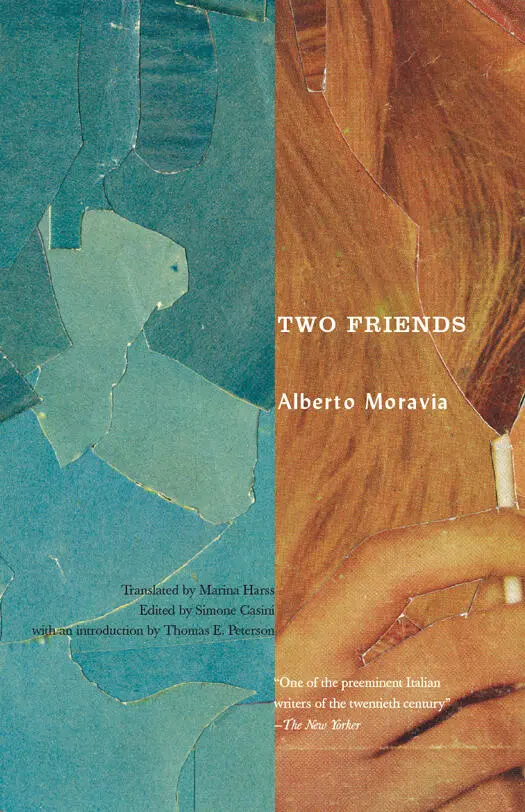
- Название:Two Friends
- Автор:
- Издательство:Other Press
- Жанр:
- Год:2011
- ISBN:нет данных
- Рейтинг книги:3 / 5. Голосов: 1
-
Избранное:Добавить в избранное
- Отзывы:
-
Ваша оценка:
Two Friends: краткое содержание, описание и аннотация
Предлагаем к чтению аннотацию, описание, краткое содержание или предисловие (зависит от того, что написал сам автор книги «Two Friends»). Если вы не нашли необходимую информацию о книге — напишите в комментариях, мы постараемся отыскать её.
Anyone interested in literature will relish the opportunity to watch Moravia at work, tinkering with his story and working at it from three unique perspectives.
Two Friends — читать онлайн бесплатно полную книгу (весь текст) целиком
Ниже представлен текст книги, разбитый по страницам. Система сохранения места последней прочитанной страницы, позволяет с удобством читать онлайн бесплатно книгу «Two Friends», без необходимости каждый раз заново искать на чём Вы остановились. Поставьте закладку, и сможете в любой момент перейти на страницу, на которой закончили чтение.
Интервал:
Закладка:
“Finally!” Maurizio said, in a tone that was already less intimate and bore a trace of irony. He opened the car door, saying, “Get in, get in … I haven’t seen you in ages! Get in, we’ll talk.”
“I’m not alone,” I said, not moving.
Maurizio answered calmly: “I can see that … Well, why don’t you both get in?”
I took a step as if to get into the car. But Maurizio’s voice, now completely sarcastic, stopped me in my tracks: “I see you haven’t changed … head still in the clouds … Why don’t you introduce us?”
I thought to myself: “Here we go, right from the start, putting me in my place and making me feel inferior. He can go to hell.” I gave Nella a little push and said: “Nella, this is Maurizio.”
“Pleased to meet you,” Maurizio said, taking Nella’s hand. Timidly, she mumbled a few words. “Here, climb in next to me,” Maurizio said, pointing to the front seat, “there’s enough space for all of us.” Without a word, Nella climbed in next to him and I followed. Maurizio shut the door and we set off.
Maurizio drove a short distance without saying a word. Nella was sitting next to him in an embarrassed, almost fearful position, pressed against my side, as if afraid that he might touch her. I had placed my arm on the headrest and could almost touch Maurizio’s neck. As we turned onto a larger, more brightly illuminated street, I glanced over at him, scanning his profile as he drove. I hadn’t seen him in four years, but at first he did not seem changed. His face was still pale and perfectly smooth beneath his dark hair, which was not exactly curly but, just as
255
I remembered, had a slight undulation and a kind of liveliness, falling in long, graceful waves at his temples and on the nape of his neck. His eyes were black, deeply set and slightly hollow, and there was a look of concentration and sharpness about him, oblique and fierce, like a predatory bird. But something had changed: his mouth, which I remembered as having a particular, almost contemptuous, even slightly cruel expression, was now partly hidden by a short mustache that almost completely covered his upper lip. There was something slightly unreal about it; in my mind I continued to see Maurizio’s mouth as I remembered it, without the mustache, and the two images did not quite coincide; instead, they seemed superimposed. It was almost as if he were wearing a mask which I could see, while still remembering his real face underneath. The dimple in his willful, shapely chin seemed to underscore his domineering, obstinate nature. As if sensing my gaze with his highly developed awareness, he was silent and still as I watched him. As soon as my curiosity was satisfied and I turned away, he began to speak. “Let’s go to the Gianicolo,” he said; “it’s a beautiful night … We can talk in peace … unless the signorina would rather go to a café …”
The car turned off of the Corso and sped down Via del Plebiscito toward Largo Argentina. It was still early and the streets were illuminated and full of cars. The car turned onto Via Merulana; we crossed the Ponte Garibaldi and took the Viale del Re. “You keep staring at me … do I look so different?” he asked.
Somewhat disconcerted, I said: “Not at all … except for the mustache.”
“Left over from the war … I had a beard when I was with the partigiani. ”
So he had been with the partigiani and he was letting me know, I thought to myself. It was almost as if he knew that I had done nothing, that during the civil war I had stayed in Rome and hadn’t even bothered to hide, since I wasn’t on any list. Once again I sensed the feeling of inferiority that had so deeply
256
marked my relationship with Maurizio. I wondered whether I should tell him that I had joined the Party, but decided to wait. He added: “I’m sure you haven’t changed … I don’t even need to look at you; I’m sure you’re still the same.”
“Well, I’ve changed too,” I couldn’t help saying, with a touch of irritation in my voice. “I haven’t grown a mustache, but I’ve changed.”
“In what way, I’d like to know? When I spotted you, I thought you looked exactly the same … still that intelligent look … always the intellectual …”
I felt a sense of profound exasperation; once again, he was accusing me of being an intellectual. “I see your opinion hasn’t changed.”
“What do you mean?”
“You still think that intellectuals are good for nothing.”
“Why do you say that?” He feigned surprise. “I only said that you looked like an intellectual, not that you looked like a good-for-nothing.”
Once again he was right, and once again I had revealed my own weakness. I bit my tongue out of exasperation and said, “I know that’s what you believe.”
“No, actually, that’s not at all what I believe,” he said, quite seriously.
Meanwhile, we had turned onto Via Dandolo and were speeding up the spiraling road, swerving around each turn in the shade of the tall trees. I felt Nella’s hand reach for mine, and once again, I became irritated with her. It seemed to me that she had noticed Maurizio’s effect on me and wanted to console me with her gesture, and assure me of her solidarity and affection. Almost violently, I pulled my hand away and said with ill-concealed bitterness: “So neither of us has changed … that’s the truth of the matter.”
After a long series of uphill turns, we finally arrived at the square in front of the Fontana dell’Acqua Paola. Maurizio drove up to the stone parapet and turned off the motor. For a moment we sat in silence. Then Maurizio said, “Let’s stretch our legs,” opening the car door. We climbed out and went over to the stone wall, gazing down at the sparkling lights of the darkened city. I was eager to reveal that I had joined the Party; it was the most important news in
257
my life, and also the newest weapon in my struggle with Maurizio. But I wanted to approach the subject gradually: “So,” I asked in the dark, “do you still live in your old villa on Via Bertoloni?”
“Yes,” he answered, distractedly.
“With your parents?”
“My father is dead. I live with my mother.”
“And your sister?”
“My sister?”
“Is she married?”
“No.”
“Do you still give parties with music and dancing?”
“Sometimes.”
“And cocktail parties?”
“Yes.” He was silent for a moment. “We had a party just the other day in honor of my Allied friends … If we’d crossed paths earlier, I would have invited you.”
“Do you still have a butler and staff?”
My tone had become clearly sarcastic. Still he answered with the same calm confidence. “Yes, that’s right.”
“Do you still live off of your annuity?”
“More or less. But I also work.”
“What do you do?”
“I work in the movies.”
“In what way?”
“Oh, it’s not much … I’m in business with a small producer.”
Cautiously, I asked: “So you were with the partigiani ?”
“Yes, in the North, in the Veneto.”
“What party were you affiliated with?”
I was so used to having him slip through my fingers
258
that for a moment I was afraid he would say that he had been with the Communists and that my secret weapon would be obliterated before I had even had the chance to use it. But he said, with the same calm air: “Oh, no party in particular … I’m more or less a liberal, if you must know my political allegiance.”
I hoped he would ask me about myself, but he didn’t. Instead, he said, “Let’s talk about other things … It’s such a beautiful night, and this is such a beautiful view.” I detected a decidedly ironic note in his voice. In fact, after a moment, he added: “You’re just being your usual intellectual self … you can’t relax even for a moment.”
Читать дальшеИнтервал:
Закладка:
Похожие книги на «Two Friends»
Представляем Вашему вниманию похожие книги на «Two Friends» списком для выбора. Мы отобрали схожую по названию и смыслу литературу в надежде предоставить читателям больше вариантов отыскать новые, интересные, ещё непрочитанные произведения.



Обсуждение, отзывы о книге «Two Friends» и просто собственные мнения читателей. Оставьте ваши комментарии, напишите, что Вы думаете о произведении, его смысле или главных героях. Укажите что конкретно понравилось, а что нет, и почему Вы так считаете.