Leopoldo Marechal - Adam Buenosayres
Здесь есть возможность читать онлайн «Leopoldo Marechal - Adam Buenosayres» весь текст электронной книги совершенно бесплатно (целиком полную версию без сокращений). В некоторых случаях можно слушать аудио, скачать через торрент в формате fb2 и присутствует краткое содержание. Год выпуска: 2015, Издательство: McGill-Queen's University Press, Жанр: Классическая проза, на английском языке. Описание произведения, (предисловие) а так же отзывы посетителей доступны на портале библиотеки ЛибКат.
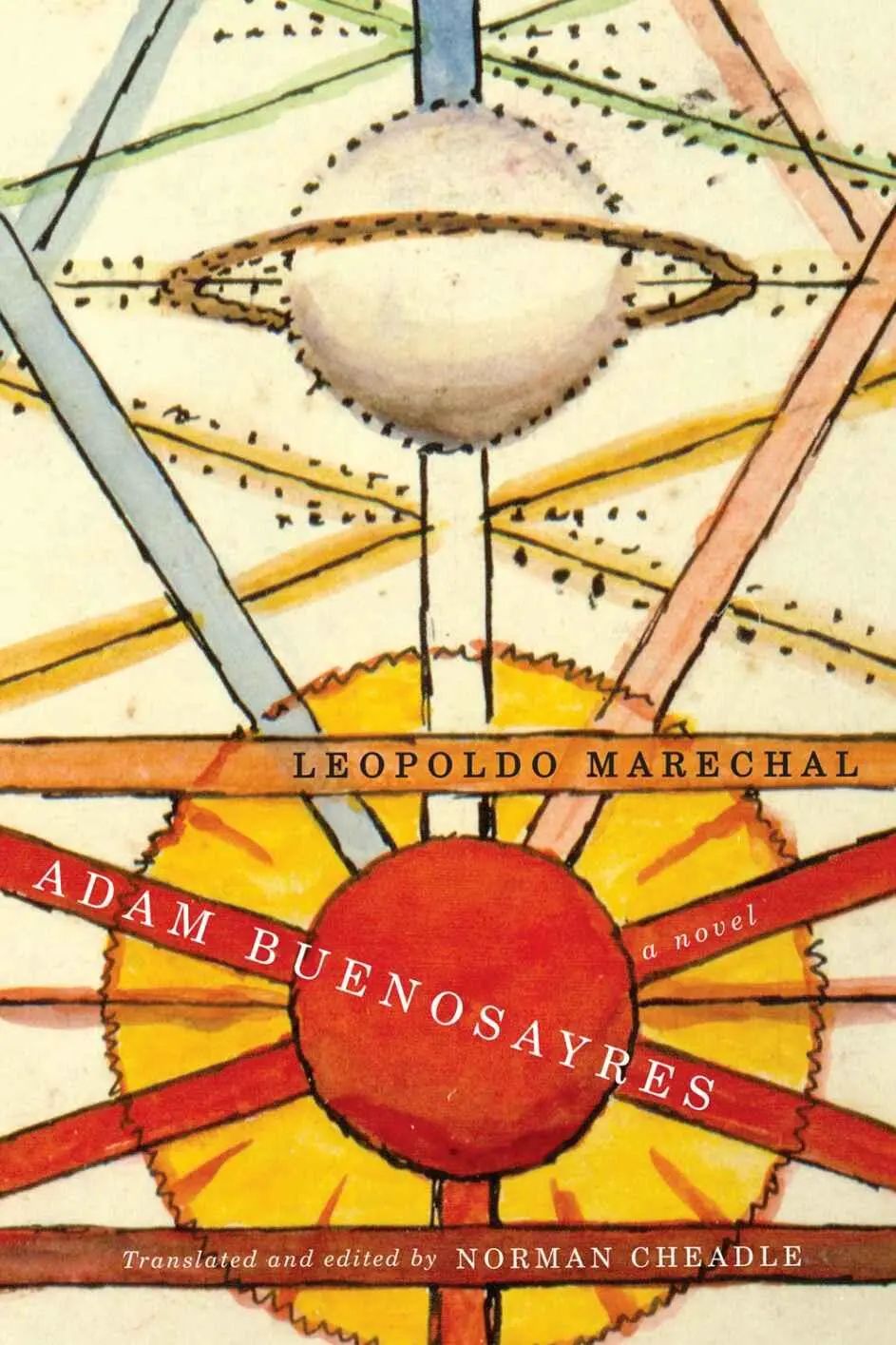
- Название:Adam Buenosayres
- Автор:
- Издательство:McGill-Queen's University Press
- Жанр:
- Год:2015
- ISBN:нет данных
- Рейтинг книги:5 / 5. Голосов: 1
-
Избранное:Добавить в избранное
- Отзывы:
-
Ваша оценка:
Adam Buenosayres: краткое содержание, описание и аннотация
Предлагаем к чтению аннотацию, описание, краткое содержание или предисловие (зависит от того, что написал сам автор книги «Adam Buenosayres»). Если вы не нашли необходимую информацию о книге — напишите в комментариях, мы постараемся отыскать её.
Adam Buenosayres — читать онлайн бесплатно полную книгу (весь текст) целиком
Ниже представлен текст книги, разбитый по страницам. Система сохранения места последней прочитанной страницы, позволяет с удобством читать онлайн бесплатно книгу «Adam Buenosayres», без необходимости каждый раз заново искать на чём Вы остановились. Поставьте закладку, и сможете в любой момент перейти на страницу, на которой закончили чтение.
Интервал:
Закладка:
Let’s examine the first phase: poetic inspiration. (Great expectancy.) At a given moment, either because he receives a puff of divine breath or because, faced with created beauty, he feels stirring within himself a fond reminiscence of infinite beauty, the poet finds himself inundated by a musical wave, totally, to the point of plenitude, similar to the way air fills the lungs in the movement of breathing.
SCHULTZ
Is it really a musical wave?
ADAM
I say “musical” by analogy. It is a harmonious plenitude, truly ineffable, superior to all music.
PEREDA
(Victim of confused Genevan memories.)
I seem to remember that Schiller — was it Schiller? — defined the poetic state as something like “a vaguely musical disposition.”
ADAM
(Infinitely modest.)
Schiller was not a metaphysician. I go further than Schiller. I would say that all possible forms of music resonate in the harmonious plenitude acquired by the poet during his inspiration. They all resonate, though no particular one of them yet, in a kind of strange unity that makes all possible songs one and makes each song into all possible music. They are all there in a certain musical “present” of music in which one song does not exclude the other in the dimension of time, because all of them make a single ineffable song…
PEREDA
(Complaining.)
That’s chaos!
ADAM
(Looks at him in surprise and distrust.)
Who told you? Yes, that just what it is: chaos. Just as in primordial Chaos, before creation, all things were present, without differentiation or strife, so are all songs together in the musical chaos of poetic inspiration.
PEREDA
(Visibly confused.)
Now it turns out that I’m a metaphysician by fluke!
SCHULTZ
(Mysterious.)
Bet you don’t know the etymological meaning of the word “Chaos.”
ADAM
What does it mean?
SCHULTZ
The void of the yawn .
ADAM
What’s that to me?
SCHULTZ
(Authoritarian.)
Come now, yawn, all of you!
(Adam, Pereda, and Ciro, intimidated, try out an imitation yawn.)
ADAM
(Happily astonished.)
Remarkable! The yawn is a profound inspiration!
SCHULTZ
(Triumphant, but not triumphalist.)
That’s what I wanted to demonstrate.
ADAM
Amazing, Schultz! And now I remember that when poetic inspiration comes to me, a very deep physical inspiration comes with it.
SCHULTZ
And what else?
ADAM
Let’s see. (Imitates another yawn.) The eyelids close partially, as when one is falling asleep.
SCHULTZ
Just so. Chaos is the concentration and the sleep of all things that do not yet want to become manifest. And after that?
ADAM
(Somber.)
Next comes the second phase, the poetic exhalation — the great fall!
PEREDA
Why a fall?
CIRO
(Polemical.)
Diavolo , yes! How come?
ADAM
Listen. The poet, as I’ve said, is enjoying an inspiration in which he savours all the plenitude of music. Suddenly, an intimate movement — necessity or duty — induces him irresistibly to manifest or express that ineffable musical chaos in a particular way. And then, among the infinite possibilities inherent in that chaos, he chooses one and gives it form, thereby excluding the other possibilities and descending from inspiration to creation, from the infinite to the finite, from immobility to happening. Thus will be born a poem, then another one, twenty, a hundred. And thus the poet’s fall into multiplicity: through his multiple songs, he will strive in vain to manifest that musical unity; and through finite means, the infinite — that infinity he carries within during inspiration. This is the first fall!
PEREDA
What? Are there more?
ADAM
There are two falls. The poet, as you’ve seen, falls first of all when he chooses for his song one among the infinity of possible forms. But this is still a creation ad intra , an internal creation, endowed with all the amplitude of the spiritual and immaterial. Then comes the creation ad extra , and the form chosen by the artist in the intimacy of his soul exteriorizes to become incarnate in a material, in language, which in turn imposes new limits. This other moment of poetic creation I call the “second fall.”
PEREDA
(Grumbling.)
Yes, the last bit is clear.
CIRO
(Who still hasn’t got it.)
Clear as acqua !
SCHULTZ
(Cunning.)
Hmm! Are you talking about a fall in the sense of “sin”?
ADAM
No. I mean a descent imposed on the artist by creative necessity. A descent without which he would not exactly be a creator, but rather a contemplative.
SCHULTZ
(Going for broke.)
But you just spoke of a kind of correspondence between the creation of an artificer and divine creation. Watch out! Must one then suppose that in God there is a similar necessity and a similar descent?
ADAM
(Suddenly confused and hesitant.)
God… is the motionless beginning, the principle of immobility. He neither descends nor ascends. He is the Omniperfect, free of necessity. (Anxious, he goes back to fidgeting with the branch.)
SCHULTZ
And so?
PEREDA
(Imperious.)
Exactly! And so?
CIRO
(Exalted.)
Cristo! That’s what I say!
ADAM
He is an infinite, eternal, and simple perfection. He knows himself for all eternity and manifests himself in his inner Word, which, as an intimate expression of divinity, participates in the divine essence and is one with God. This being so, what possible need could he have to manifest himself later through exterior creatures?
SCHULTZ
Nevertheless, he has manifested himself.
ADAM
There’s nothing for it but to admit a free act of his will. He created because he wanted to, when and how he chose. An act of love, the theologians call it.
SCHULTZ
The poet, on the other hand, creates out of necessity. Isn’t that it?
ADAM
His, too, is an act of love, but not free.
SCHULTZ
A forced act of love?
PEREDA
Bah!
CIRO
Diavolo!
ADAM
Here’s how I see it. Every creature has received some perfection and must communicate it in some way to lesser creatures. It’s the economic law of charity. If I were to explain the mechanism of the angel…
PEREDA
(Scandalized.)
Hey! Only Schultz can talk about angels.
CIRO
Angels. Cripes!
SCHULTZ
(Severe.)
This is no joking matter!
ADAM
… you would see in the angel two distinct movements. One is circular; the angel revolves around the eternal light to become fully illuminated. The other movement is downward; the angel communicates a part of that light to the next angel below in the hierarchy. Since there are three hierarchies of angels, the first and highest communicates to the second, the second to the third, and the third to humankind. And since there are hierarchies among humans, each receives and gives (or ought to give) in proportion to what is received. Now, the poet receives something at the moment of inspiration and must communicate this to those who have received nothing. His is a loving act. But, as in the case of the rest of the creatures who offer something, the poet is only an instrument of the First Love.
PEREDA
(Skeptical.)
Hmm! And if the poet were to work only out of ambition?
ADAM
Ambition for what? Generally he reaps more thorns than flowers in this world!
Читать дальшеИнтервал:
Закладка:
Похожие книги на «Adam Buenosayres»
Представляем Вашему вниманию похожие книги на «Adam Buenosayres» списком для выбора. Мы отобрали схожую по названию и смыслу литературу в надежде предоставить читателям больше вариантов отыскать новые, интересные, ещё непрочитанные произведения.




Обсуждение, отзывы о книге «Adam Buenosayres» и просто собственные мнения читателей. Оставьте ваши комментарии, напишите, что Вы думаете о произведении, его смысле или главных героях. Укажите что конкретно понравилось, а что нет, и почему Вы так считаете.