Leopoldo Marechal - Adam Buenosayres
Здесь есть возможность читать онлайн «Leopoldo Marechal - Adam Buenosayres» весь текст электронной книги совершенно бесплатно (целиком полную версию без сокращений). В некоторых случаях можно слушать аудио, скачать через торрент в формате fb2 и присутствует краткое содержание. Год выпуска: 2015, Издательство: McGill-Queen's University Press, Жанр: Классическая проза, на английском языке. Описание произведения, (предисловие) а так же отзывы посетителей доступны на портале библиотеки ЛибКат.
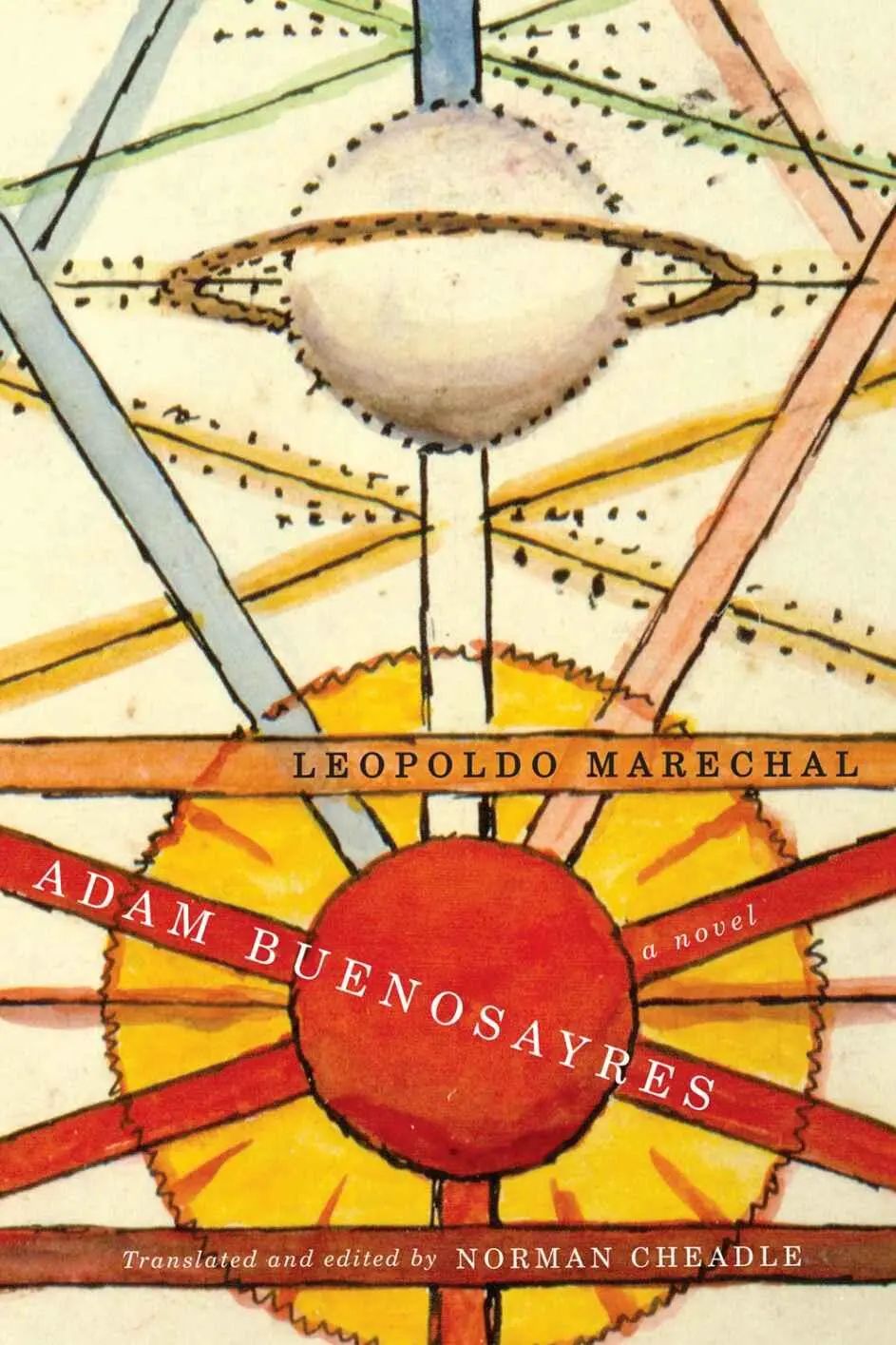
- Название:Adam Buenosayres
- Автор:
- Издательство:McGill-Queen's University Press
- Жанр:
- Год:2015
- ISBN:нет данных
- Рейтинг книги:5 / 5. Голосов: 1
-
Избранное:Добавить в избранное
- Отзывы:
-
Ваша оценка:
Adam Buenosayres: краткое содержание, описание и аннотация
Предлагаем к чтению аннотацию, описание, краткое содержание или предисловие (зависит от того, что написал сам автор книги «Adam Buenosayres»). Если вы не нашли необходимую информацию о книге — напишите в комментариях, мы постараемся отыскать её.
Adam Buenosayres — читать онлайн бесплатно полную книгу (весь текст) целиком
Ниже представлен текст книги, разбитый по страницам. Система сохранения места последней прочитанной страницы, позволяет с удобством читать онлайн бесплатно книгу «Adam Buenosayres», без необходимости каждый раз заново искать на чём Вы остановились. Поставьте закладку, и сможете в любой момент перейти на страницу, на которой закончили чтение.
Интервал:
Закладка:
But the payador Tissone quickly shook off his paralysis, settled the guitar on his thigh, and with lithe fingers played a long warm-up. Finally, he opened his mouth; everyone held their breath in suspense. Alas! Not a peep issued from his lips! The listeners exchanged looks. His forehead shiny with sweat, Tissone played his lead-in again, got to where the song starts, and opened his mouth. And again, silence. A dull murmur stirred among the contest’s witnesses. They were about to count him out. Franky was smiling, already certain of his victory. Samuel hung his head as though insufferably humiliated. But wait! Once more, the payador Tissone has thrashed out his introductory riffs; in desperation he looks straight at Franky Amundsen and sings his answer:
White shits the seagull-seagull,
like the payador said so true
because, sure ’nuff, it don’t know
how to shit in no other hue. 15
The ghost errant of Santos Vega! Musical shade of the gaucho Martín Fierro! Southern troubadours, glorious souls of yesteryear, whose bones today lie beneath the pampa, mother of guitar-toting centaurs! I have seen you come down to succour the payador Tissone and crown him with victory; and I have seen how the payador’s brow lowered beneath the weight of so many laurel leaves. The listeners went wild in adulation. Franky Amundsen ardently embraced Tissone, crying out the enormity of his defeat. As the others took turns hugging the winner, Samuel Tesler publicly forswore the erudite science he’d professed heretofore and announced that henceforth he would heed only the voices of the gnomic wisdom infused in humble folk by decree of the lofty and very occult Tetragrammaton.
That moment marked the apogee of the banquet and signalled the beginning of the end. The great Ciro understood this, first when he noticed the commensals lapsing into silent lassitude, and again as he watched the funereal waiter take away the leftovers from the feast (greasy plates, gaunt bottles, glasses grimy with fingerprints), and yet again when the musicians packed up their instruments. At last, everyone stood up. Goodbye was now in the air, and Ciro Rossini grew gloomy once more.
— Diavolo!
They took their leave at the big front door of the gazebo, the blustery wind whipping the trees out in the street. The first to go, heading westward, was Prince Charming, cold and cranky, perhaps ruminating a long diatribe against magnates. The three Bohemians said their goodbyes as they took off running to catch a Lacroze streetcar tottering in the direction of La Chacarita. Lastly, the payador Tissone weighed anchor; many fond eyes followed him as the night swallowed him up, guitar and all.
— Poor guys! commented Ciro. The gazebo’s over for them.
But the great Ciro’s melancholy reached its extreme when he felt Adam Buenosayres’s hands take his own. Moved to the depths of his being, he embraced the poet of Villa Crespo, then the rest of his party, clinging to each man like a shipwrecked sailor to a plank.
— Giovinezza! he wept. Addio, addio!
The group finally tore itself away from the emotional goodbye scene and set off staggering down the street. At the corner of Triunvirato and Gurruchaga, they stopped, not knowing where to go next. The autumn night offered herself naked and full of dark possibilities; the mad wind seemed to bid them join a witches’ sabbath; everything was inciting them to furtive, guilty acts. As his companions were deliberating, Adam heard the bells of San Bernardo ring two-thirty in the morning; up on the bell tower, the yellow clock looked like a dead man’s face. Time to go home? Then Samuel Tesler, his steps unsteady since leaving the gazebo, whispered a few secretive words into Franky Amundsen’s ear.
— Libidinous Israelite! exclaimed Franky, covering his ears as though scandalized.
— It’s the Terrestrial Venus! Samuel insinuated in a persuasive tone. The demonic or popular Venus!
— What are you guys getting up to over there? asked Luis Pereda.
Franky pointed an accusing finger at Tesler.
— It’s the philosopher, he said. He wants to throw all decency overboard.
Nevertheless, he publicly revealed Samuel’s designs, and since no one found them outrageous, the pipsqueak Bernini gave the marching order.
— To Canning Street! he ordered mysteriously.
Still hesitant, Adam Buenosayres looked again at the phantasmagorical clock of San Bernardo. Then he looked down Gurruchaga, the empty street that led homeward. He thought of the work waiting for him in his torture chamber, under the cursèd lamp and the stupidly familiar objects. A shiver of terror sent him back to the drunken party, the ship of fools on which he’d come sailing:
— Absurd night! he cried yet again in his soul. Night of mine!
He set off with the rest of them, as though in flight from himself.
Chapter 2
Step right up, gentlemen! Come and see the ancient monster, the beast of a thousand shapes and none, whose poverty is equalled by her sumptuousness, dressed in all the world’s finery, the most bedizened among the naked, the most naked of the bedizened, nothingness tricked out as Iris, the shadow of a mystery! Before your dazzled eyes She may appear as something firm and strong: fortress or barbican, bastion or battlement, rock or metal. But look out! Nothing is as frail as She, nothing crumbles as easily as her gaudy edifice of spume. Or perhaps you believe that She is fragile, and her very fragility invites you to make lyrical comparisons. But watch out! For you will find nothing so resistant to violence and punishment, nothing so strong as She when it comes to the rigour of battle. To be sure, you will see her surround herself in mystery, disguise herself as an enigma, and wrap herself entirely in tulle, wishing to be impenetrable to your gaze. But wise up! In her very eagerness to appear mysterious, it’s easy to see that no creature is more devoid of mystery. And now, gentlemen, come see the ancient deity, the one of a thousand barbarous names, the never-profaned goddess! Come right in, gentlemen! Shhh!
Someone on the other side had just turned the door handle. The eleven characters in the vestibule suddenly stopped talking and fixed their eyes on the closed door. Doña Venus herself, snoozing atop her stool, opened her right eye to take a look:
— See what a girl is Jova! she whined without enthusiasm. Look what a girl!
The door, however, did not open. The men in the vestibule relaxed their vigilance. But first they heard tinkling laughter in the room behind the door, a warm trill as old as the world.
— Will that woman never come out? protested the philosopher Tesler, grimacing like an obscene gargoyle.
Franky gave him a friendly pat on the shoulder.
— Calm down, beast! he said. You’ll get your ration of meat.
The vestibule was narrow; the eleven characters (as well as Doña Venus and her lapdog Lulu, curled up beside her) filled it completely. They sat in the following order. On the left, against the blood-coloured wall, several contradictory figures sat on a bench directly facing the anteroom whose door handle had just turned: the Syrian Merchant, the Galician Conductor, the Italian Gasfitter, and the Mature Gentleman. At the back, against a wrought-iron-and-glass partition separating the vestibule from the patio, were seated Luis Pereda, the pipsqueak Bernini, Franky Amundsen, and the philosopher Tesler, all of whom were able to keep an eye on two doors. One of these led to the room adjoining the anteroom; to one side of this door sat Doña Venus, sleeping with one eye ajar. The other was the frosted-glass inner door that allowed ingress from the street, once its security chain had been stealthily slid open. Between the glass partition and the bloody wall, a nook opened out; that was where Adam Buenosayres, the astrologer Schultz, and the Taciturn Young Man were sitting in Vienna chairs. Light from an electric bulb smeared the walls, glared off the window panes in the partition, and cruelly illuminated those twelve human faces, revealing them with the brutality of a mug shot. Aside from the expectancy prevailing in the vestibule and the mysteries apparently being celebrated in the hermetic room and anteroom, there were no other signs of life in the rambling old house, as though silence and night were its only tenants.
Читать дальшеИнтервал:
Закладка:
Похожие книги на «Adam Buenosayres»
Представляем Вашему вниманию похожие книги на «Adam Buenosayres» списком для выбора. Мы отобрали схожую по названию и смыслу литературу в надежде предоставить читателям больше вариантов отыскать новые, интересные, ещё непрочитанные произведения.










Обсуждение, отзывы о книге «Adam Buenosayres» и просто собственные мнения читателей. Оставьте ваши комментарии, напишите, что Вы думаете о произведении, его смысле или главных героях. Укажите что конкретно понравилось, а что нет, и почему Вы так считаете.