Leopoldo Marechal - Adam Buenosayres
Здесь есть возможность читать онлайн «Leopoldo Marechal - Adam Buenosayres» весь текст электронной книги совершенно бесплатно (целиком полную версию без сокращений). В некоторых случаях можно слушать аудио, скачать через торрент в формате fb2 и присутствует краткое содержание. Год выпуска: 2015, Издательство: McGill-Queen's University Press, Жанр: Классическая проза, на английском языке. Описание произведения, (предисловие) а так же отзывы посетителей доступны на портале библиотеки ЛибКат.
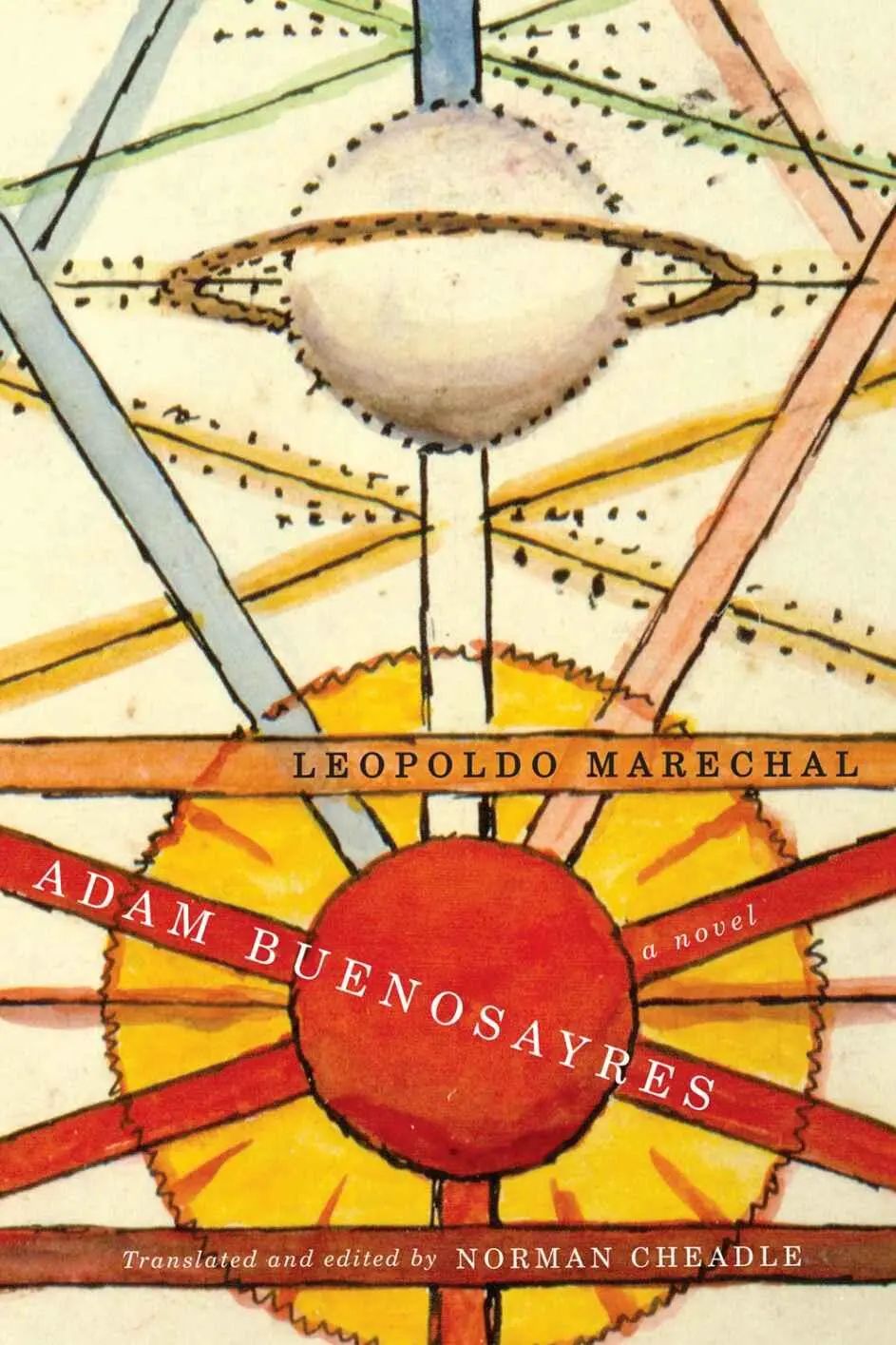
- Название:Adam Buenosayres
- Автор:
- Издательство:McGill-Queen's University Press
- Жанр:
- Год:2015
- ISBN:нет данных
- Рейтинг книги:5 / 5. Голосов: 1
-
Избранное:Добавить в избранное
- Отзывы:
-
Ваша оценка:
Adam Buenosayres: краткое содержание, описание и аннотация
Предлагаем к чтению аннотацию, описание, краткое содержание или предисловие (зависит от того, что написал сам автор книги «Adam Buenosayres»). Если вы не нашли необходимую информацию о книге — напишите в комментариях, мы постараемся отыскать её.
Adam Buenosayres — читать онлайн бесплатно полную книгу (весь текст) целиком
Ниже представлен текст книги, разбитый по страницам. Система сохранения места последней прочитанной страницы, позволяет с удобством читать онлайн бесплатно книгу «Adam Buenosayres», без необходимости каждый раз заново искать на чём Вы остановились. Поставьте закладку, и сможете в любой момент перейти на страницу, на которой закончили чтение.
Интервал:
Закладка:
— No thanks, Adam excused himself modestly. For now, that’s not really my thing.
— Come on! What would it cost you?
— It’s just that I don’t like ombú trees. They say their shade is unwholesome.
— Slander! I’ve slept many a time in the shade of an ombú.
— Okay, an ombú then, Adam conceded. But when you get right down to it, your infatuation with Haydée Amundsen makes you just as good a candidate for the scaffold and the epistle.
— But I don’t know how to rhyme, alleged the philosopher, visibly saddened.
From this point forth, the Visited and the Visitor, having laid their arms aside, knew the taste of peace, the ease of a language without sharp edges, and the nobility of hands reaching out to one another. The dialogue deepened as Visited and Visitor penetrated further into the domain of good sense. Gently obliged to make a confession, the Visitor exposed the scant reality of his love. With a passing reference to a mysterious Blue-Bound Notebook, he confessed that his love had only the fragile essence of an ideal construct, although this was based on a flesh-and-blood woman. Upon hearing this, and after exacting from him certain bits of information with the utmost tact, the Visited asked the Visitor if he wasn’t making incursions into the realm of Celestial Aphrodite. And since the Visitor wasn’t sure about that, the Visited proceeded to convince him of his happy hypothesis by means of an eloquent display of examples he claimed to have drawn from ancient literatures, both Oriental and Occidental, wherein discourse on divine love was so frequently couched in the language of human love that it bordered on gibberish. Convinced by such solid documentation, the Visitor admitted he was fashioning a heavenly woman on the basis of an earthly woman. The Visited, attentive to the metaphysical work of the Visitor, asked if the terrestrial woman was still indispensable to his labours of sublimation. And since the Visitor answered yes, the Visited opened wide the floodgates of his discretion to announce that he bore a message from a beauty whom the angels of paradise called Solveig Amundsen, and that this same belle dame had displayed a truly otherworldly benevolence by bidding him communicate to the Visitor that his presence was greatly missed in the gardens of Saavedra. To convey the pleasure that inundated the Visitor upon hearing this gratifying news is a task beyond the style of mortal man. In spite of the caution induced by his immeasurable hopelessness, the Visitor asked the Visited if the message from the lady fair was an expression of her immense courtesy or perhaps of a deeper feeling that the Visited might have noticed. When the Visited answered that in his opinion the second hypothesis was more plausible, the Visitor felt he was blessed among the Blessed. Whereupon Visited and Visitor agreed to meet in Saavedra that very afternoon.
Samuel Tesler, philosopher, did not die of indigestion caused by smoked herring; this calumnious rumour was circulated throughout Villa Crespo by a rival sect. Equally apocryphal is the legend that has him die, like Pythagoras, in a bean field. This story was invented by Samuel’s heterodox disciple Kerbikian, an Armenian dishwasher at the Café Izmir on Gurruchaga Street, of whom it is said that, being gifted with a singularly obtuse intelligence, he never understood the first thing about the philosopher’s teaching. What really happened — and it might even be true — is that Samuel Tesler, ripe now for grand revelations thanks to his judicious practice of the heroic virtues, simply climbed down from this world as one gets off a Lacroze streetcar. 29Surrounded on his deathbed by the innermost circle of his disciples, he implored them not to weep for him, nor to cover their brows with ashes, nor, in their anguish, to rend their clothes (being mindful of the exorbitant price of English woollens 30); he exhorted them rather to forget the ephemeral gifts of natura naturata and to seek instead the invisible, yet intelligible, traces of natura naturans . 31Already in his death throes, Samuel Tesler first gave vent to a burst of laughter, then to a fit of sobbing. When asked about the reason for his hilarity, he replied that before him he beheld the true image of Death in a surpassingly beautiful virgin who was calling him now to a sleep induced by the opium poppies wreathing his brow; so it made him laugh, he said, to recall the skeleton armed with scythe and other lugubrious props attributed to Death by the brooding imagination of versifiers. As for his weeping, it was provoked by the sad thought that centuries would pass before Buenos Aires might be blessed again with a thinker of his calibre. At the moment his soul flew free, they say, a strong odour of benzoin, myrrh, and cinnamon wafted from his body and spread throughout the entire neighbourhood. So strong it was, that the good people of Villa Crespo wondered if Abdullah the Turk’s perfume shop wasn’t getting looted over on Warnes Street.
Historico-critical attempts to pigeonhole Samuel Tesler as a Cynic, an Epicurean, or a Stoic philosopher have been laughable, for the metaphysician of Villa Crespo was an Eclectic of the finest kind, and those who cannot understand this will wrack their brains until Judgment Day. Samuel Tesler had two reasons for detesting Diogenes, the one in the barrel. First, he claimed, Diogenes was the paradigm of vanity; he had only to step before a mirror to find “the man” he so eagerly sought. Secondly, Samuel found the business of the barrel grossly absurd, for he maintained that a philosopher could neither be the content of a barrel nor a barrel the vessel of a philosopher, since both philosopher and barrel were the natural vessels of the sacred liquor that Noah invented after the Flood, no doubt to recover from so great an excess of water. Samuel Tesler was no less judicious about the weeping Heraclitus and the laughing Democritus. In his view, Heraclitus was a sentimental calf and Democritus a gleeful magpie. The two of them were equally dehumanized, since neither had discovered that the true law of the human condition is the useful and prudent alternation of laughter and weeping. To laugh dramatically at one’s fellows and weep for them comically, these are two equal aspects of compassion . This aphorism was taught by Samuel Tesler, philosopher. Similar sentences testify to his eclecticism in diverse matters. They used to ask him about the surest method for achieving sofrosyne ; 32cognizant of the duality of human nature, he replied: Go number two in body and in soul every day . Once he chanced to be among a circle of rubberneckers watching a Calabrian fruit-seller methodically thrashing his concubine, and the philosopher inquired into whether it was meet to punish a woman. His conclusion: In general, no; in particular, yes . To those too fond of frolicking with Venus, he said: Thou shalt sleep with women, but dream of goddesses . His optimism about the human species is manifest in a maxim worthy of Terence: I love children because they are not yet men, and the elderly because they no longer are so . Unfortunately, save for a few fragments collected by Asinus Paleologos 33in his Latin edition, nothing remains of his treatises. Rumour has it that his landlady (a certain Doña Francisca, a hairy-chested woman sometimes compared to Socrates’s wife, Xanthippe) sold off his books to collect a paltry debt and even hawked his manuscripts as used paper at three cents a kilo — a literary catastrophe, according to some admirers, equalled only by the tragic fire that destroyed the library of Alexandria.
BOOK TWO
Chapter 1
Her broomstick tapping rhythmically, Old Lady Chacharola made her way down Hidalgo Street toward Monte Egmont, slowly, all right, but erect and straight as a spindle. Her mouth cruelly clenched, eyes stony, brow stormy, the whole of her exuded bile and vinegar as she shuffled along the sunlit sidewalk in her faded, floppy shoes. In her Sicilian heart, as in a chemist’s retort, hatred simmered on the slow fire of memory, the memory of a daughter whose name she never uttered if not to curse it countless times — as countless as the drops of milk she’d fed her, she thought, then struck her wizened breasts, self-castigation for the sin of suckling a serpent. It wasn’t so much her daughter’s life in the milongas , her insults and wickedness and gossiping. No, what she could never forgive — here she kissed her thumb-crossed-over-index-finger, shrivelled crucifix — was that she’d run off with that young punk of a bandoneón player. On top of it all, they’d made off with four linen sheets she’d brought over from Italy, her chunky wedding ring, plus the fifteen pesos she’d kept in a wool stocking in the trunk. At the memory of the sheets, Old Lady Chacharola stopped and ground her teeth, a sour belch rising to her mouth. Then she moved on, a walking vessel of rage, acrimony mounted on two aimless legs.
Читать дальшеИнтервал:
Закладка:
Похожие книги на «Adam Buenosayres»
Представляем Вашему вниманию похожие книги на «Adam Buenosayres» списком для выбора. Мы отобрали схожую по названию и смыслу литературу в надежде предоставить читателям больше вариантов отыскать новые, интересные, ещё непрочитанные произведения.










Обсуждение, отзывы о книге «Adam Buenosayres» и просто собственные мнения читателей. Оставьте ваши комментарии, напишите, что Вы думаете о произведении, его смысле или главных героях. Укажите что конкретно понравилось, а что нет, и почему Вы так считаете.