Leopoldo Marechal - Adam Buenosayres
Здесь есть возможность читать онлайн «Leopoldo Marechal - Adam Buenosayres» весь текст электронной книги совершенно бесплатно (целиком полную версию без сокращений). В некоторых случаях можно слушать аудио, скачать через торрент в формате fb2 и присутствует краткое содержание. Год выпуска: 2015, Издательство: McGill-Queen's University Press, Жанр: Классическая проза, на английском языке. Описание произведения, (предисловие) а так же отзывы посетителей доступны на портале библиотеки ЛибКат.
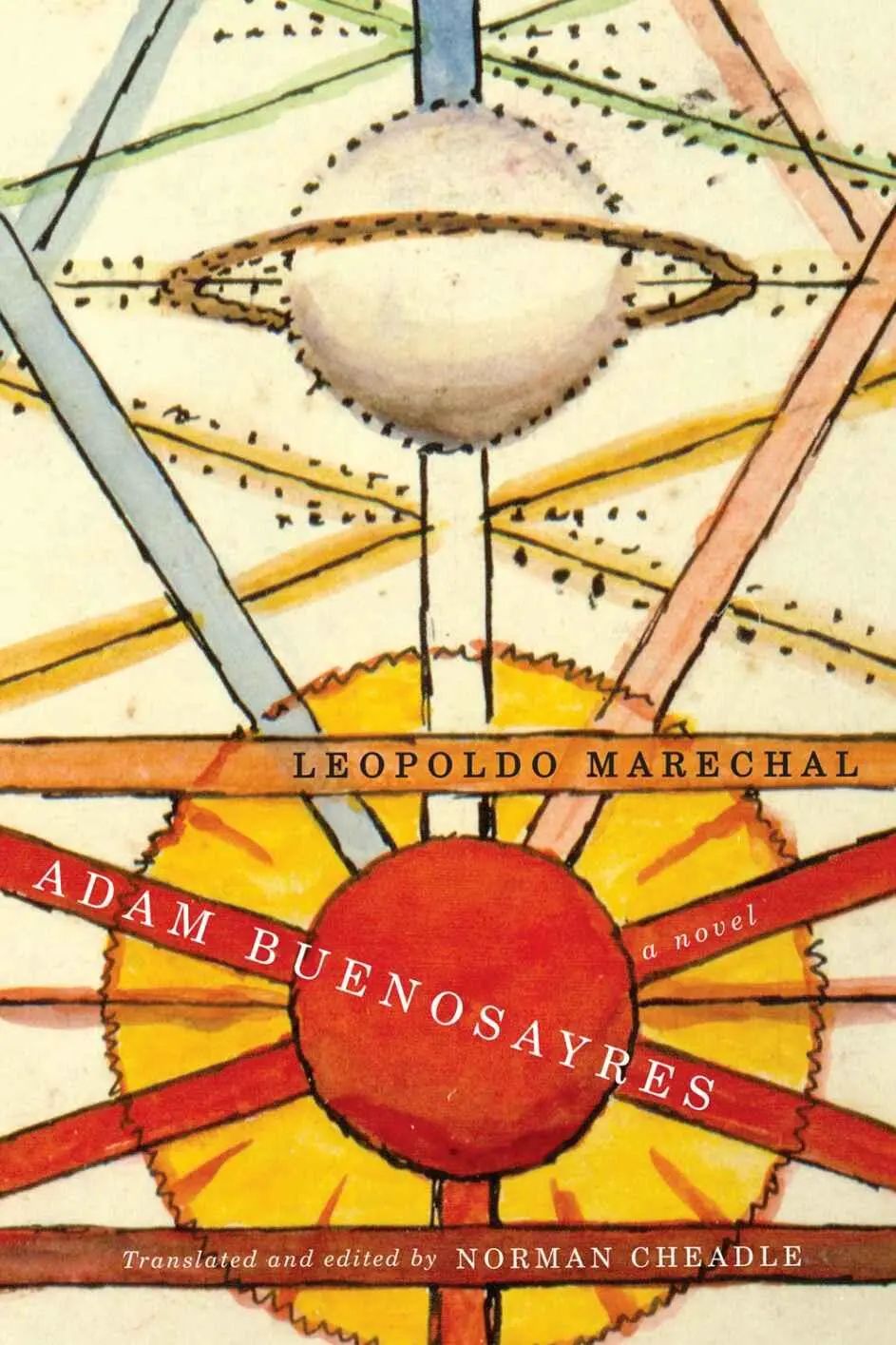
- Название:Adam Buenosayres
- Автор:
- Издательство:McGill-Queen's University Press
- Жанр:
- Год:2015
- ISBN:нет данных
- Рейтинг книги:5 / 5. Голосов: 1
-
Избранное:Добавить в избранное
- Отзывы:
-
Ваша оценка:
Adam Buenosayres: краткое содержание, описание и аннотация
Предлагаем к чтению аннотацию, описание, краткое содержание или предисловие (зависит от того, что написал сам автор книги «Adam Buenosayres»). Если вы не нашли необходимую информацию о книге — напишите в комментариях, мы постараемся отыскать её.
Adam Buenosayres — читать онлайн бесплатно полную книгу (весь текст) целиком
Ниже представлен текст книги, разбитый по страницам. Система сохранения места последней прочитанной страницы, позволяет с удобством читать онлайн бесплатно книгу «Adam Buenosayres», без необходимости каждый раз заново искать на чём Вы остановились. Поставьте закладку, и сможете в любой момент перейти на страницу, на которой закончили чтение.
Интервал:
Закладка:
— Sometimes, declared Samuel, I’m sorely tempted to give up on the bleary-eyed donkey of philosophy and boot its ass over to Pipo the Wop’s corral.
— No!
Samuel Tesler adopted an air of mysterious reserve.
— For some time now I’ve been visited by an angel of reinforced concrete. 21
— Really?
The philosopher planted himself in front of his visitor. He balanced himself on one leg while raising the other behind him, piously joined his hands, and constructed a mechanical smile, his eyes mimicking ecstasy. Having struck the posture of the angel, he spoke thus:
THE CEMENT ANGEL: (Voice at once silly and unctuous.) Samuel, worthy man! You are the last scion of a once pastoral race that sang the rosy-cheeked Eclogue. Why do you insist on living in the sinful city? (Admonitory.) Do you not fear the scourges of tuberculosis and offensive newspapers? (Didactic.) Remember that Argentina has some three million square kilometres, ready to receive the seed of bread and the sweat of human labour. (Imperious.) Get thee to the prairie, O illustrious little loafer! Make the plough march before thee; let the oxen of aromatic manure march before the plough; let the earth, before the oxen, open her fertile vagina! (Between suggestive and chaste.) Let there be a woman by your side, let her conceive fourteen look-alike children who will gulp down bitter mate and intone the National Anthem without mispronouncing a single word. (Lyrical.) Out there on the pampa of sturdy loins and beneath a sun not yet grown old and grey, the smell of your feet will be your song! (Dubious.) But even if you hold to atavistic propensities and disdain Ceres in favour of money-spinning Mercury, run to the plain anyway! Has it not been compared to a billiard table? Well then, on it thou shalt lay down the three balls. 22
Breaking the angel pose, Samuel let out a single guffaw so irresistible that his visitor gave in to the temptation to join him in exercising that privilege of human dignity.
— Not a word of lie! insisted Samuel Tesler. The angel and I punch each other out every night.
— Looks to me like your angel is a demon with a dangerously matrimonial bent, observed Adam Buenosayres, still laughing. Now I understand your little excursions to Saavedra! Which one of the girls is the angel’s candidate? (“Watch out!”)
— Don’t worry, it isn’t Solveig Amundsen! replied the suddenly melancholy philosopher.
He fell into an ecstatic silence, as though the cool shade of a woman had abruptly fallen over his kimono’d figure.
(Samuel Tesler, philosopher, lectured his disciples in the Agora many times on the inanity of woman, who, being a mere fragment of the Adamic rib cage, could barely hide her naked metaphysical lack. Precisely this destitute nudity — he affirmed with abundant quotations both modern and classical — explained why women were eternally obsessed with getting dressed up at any cost and did not hesitate to strip carnivorous animals of their sleek furs, birds of their sublime plumage, reptiles of their scales, trees of their fibres and bark, worms of their glistening spit, and the earth of its precious metals and gems. Samuel Tesler, philosopher, did not censure this exploitation of the three kingdoms, meant to repair an absolutely irreparable nakedness, even though a certain cosmic pity, which never brought a tear to his eye, occasionally moved him to lament the sad lot of the lowlier creatures. He would point out in passing that Jehovah had tried in vain to cover a nudity which, though decked out with the entire visible Creation, remained for all that even more naked than before. But what the philosopher would not allow — and on this point he was intransigent to the point of anger — was that woman, after adorning herself with all the graces of the natural world, should do the same with the graces of the intellect, thanks to the despicable servility of poets in love or poetic lovers, whose truly laughable erotic fantasy was capable of embellishing their false idols with the attributes of goddesses, naiads, sylphs, and nereids. To combat this temptation to subordinate the subtle order to the gross order of existence, he taught his disciples an infallible trick he’d resorted to himself, consisting in the reverse operation. For example, imagining the divine Cleopatra picking her nose and making little snotballs, or Helen of Troy sitting on the john. Such prudence won for Samuel Tesler the recognition of his contemporaries, who had the following epitaph engraved on his tomb: “Traveller who goeth to Cytherea: here lies a man who never confused the Terrestrial Venus with the Celestial Venus.”)
A prickly silence lay between the two interlocutors. Adam said nothing, but was thinking that Samuel was about to confide in him and that his confidence would oblige Adam to respond in kind, an eventuality Adam was trying to forestall for the sake of the “name under reserve” and the secret contained in the Blue-Bound Notebook. Samuel’s muteness was slightly alarming: true, the muscles of his face had relaxed, as though fatigued from maintaining the actor’s mask, but now they were rearranging themselves to suggest yet another expression, this one grave and morose.
— Don’t worry, it isn’t Solveig Amundsen! he repeated at last. I’m going to tell all; I want to give you a lesson in frankness.
— Me? asked Adam apprehensively.
— Yes, you! said Samuel with energy. Do you think nobody notices you posing like Hamlet with a head cold every time the brat looks at you? Haven’t I seen you break out in an Othellian sweat whenever anyone mentions the brat’s name?
— You’re crazy! Adam Buenosayres managed a laugh. (“Look out, look out!”)
— And today, Thursday, why have you ruined a philosopher’s sleep? added Samuel. To fish for information about Saavedra and find out what I’ve seen or heard in that grotto of delights!
Sharp as awls were the eyes that impaled the visitor, and Adam’s eyes wobbled under the weight of so much truth. The philosopher, sensitive to the other’s embarrassment, desisted from severity and switched to mercy:
— No, brother! It’s time porteños overcame their stupid reserve. The thirty-two foreign philosophers who dishonoured us with their visits, who took Buenos Aires’s pulse and inserted a thermometer into her anal orifice, finally came up with the diagnosis that our city is sad. 23Reasons? They didn’t give any. They were too busy stuffing themselves with our famous chilled beef . The gringos didn’t realize that Buenos Aires is an archipelago of men, all islands unto themselves.
Samuel laughed malevolently:
— What I can’t understand is how our great Macedonio, living in Buenos Aires, could come to this astounding metaphysical conclusion: “The world is an I-less soul-idarity.” 24God forgive him his neologisms. Under the same circumstances, I draw a very different conclusion.
— What conclusion? the visitor wanted to know.
— This one — round, musical, and meaningful: “The world’s a fartful I-ness.”
He stopped a moment, apparently to meditate on the profundity of his maxim, then scrutinized his visitor as if to gauge how amazed he was by so much brilliance. And Adam Buenosayres’s wonderment must not have been scant, for Samuel Tesler returned to his theme:
— Now then, he announced, between generous and bitter. I, a European, am going to take the initiative. I’ll speak to you with brutal frankness. 25
— It must be a hair-raising story, Adam laughed. How did your romance start?
— Ah! growled Samuel. That’s what I ask myself, metaphysical animal that I am.
He fell into a studied silence, behind which could be discerned a feverish preparation for his next histrionic move. Then, leaving the window, he picked up the chamber pot from his bedside table and stood there urinating into it, with a dignity Diogenes Laërtius would have attributed to his namesake, the one in the barrel. A harmonious lament issued from the urinal: a deep crescendo was followed by a sharp decrescendo, petering out in the final musical drops. The philosopher put the recipient back in its place, sat down on the unmade bed, and asked his visitor point-blank:
Читать дальшеИнтервал:
Закладка:
Похожие книги на «Adam Buenosayres»
Представляем Вашему вниманию похожие книги на «Adam Buenosayres» списком для выбора. Мы отобрали схожую по названию и смыслу литературу в надежде предоставить читателям больше вариантов отыскать новые, интересные, ещё непрочитанные произведения.










Обсуждение, отзывы о книге «Adam Buenosayres» и просто собственные мнения читателей. Оставьте ваши комментарии, напишите, что Вы думаете о произведении, его смысле или главных героях. Укажите что конкретно понравилось, а что нет, и почему Вы так считаете.