Leopoldo Marechal - Adam Buenosayres
Здесь есть возможность читать онлайн «Leopoldo Marechal - Adam Buenosayres» весь текст электронной книги совершенно бесплатно (целиком полную версию без сокращений). В некоторых случаях можно слушать аудио, скачать через торрент в формате fb2 и присутствует краткое содержание. Год выпуска: 2015, Издательство: McGill-Queen's University Press, Жанр: Классическая проза, на английском языке. Описание произведения, (предисловие) а так же отзывы посетителей доступны на портале библиотеки ЛибКат.
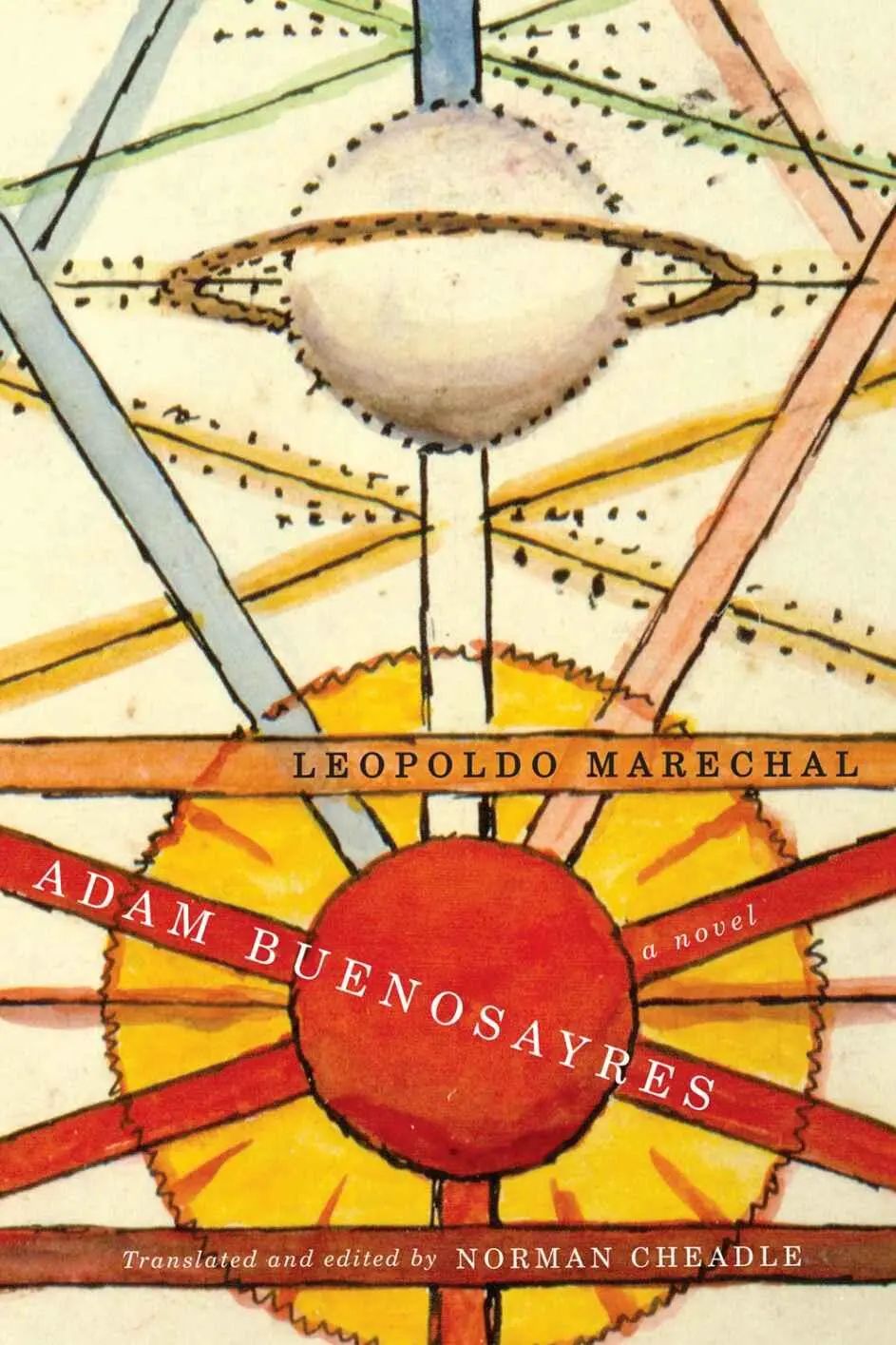
- Название:Adam Buenosayres
- Автор:
- Издательство:McGill-Queen's University Press
- Жанр:
- Год:2015
- ISBN:нет данных
- Рейтинг книги:5 / 5. Голосов: 1
-
Избранное:Добавить в избранное
- Отзывы:
-
Ваша оценка:
Adam Buenosayres: краткое содержание, описание и аннотация
Предлагаем к чтению аннотацию, описание, краткое содержание или предисловие (зависит от того, что написал сам автор книги «Adam Buenosayres»). Если вы не нашли необходимую информацию о книге — напишите в комментариях, мы постараемся отыскать её.
Adam Buenosayres — читать онлайн бесплатно полную книгу (весь текст) целиком
Ниже представлен текст книги, разбитый по страницам. Система сохранения места последней прочитанной страницы, позволяет с удобством читать онлайн бесплатно книгу «Adam Buenosayres», без необходимости каждый раз заново искать на чём Вы остановились. Поставьте закладку, и сможете в любой момент перейти на страницу, на которой закончили чтение.
Интервал:
Закладка:
— What are we supposed to do with this creature?
— If you’d paid more attention to your classics, he answered, you’d know that in cases like this, facing a dragon, you’ve got to make it fall fast asleep.
He looked around, suddenly anxious:
— Son of a bitch! he groaned. Where did I put my arsenal of hypnotics?
He dashed off toward a corner of the vestibule. Before long, he was back with an armful of fat books, pamphlets, and newspapers, which he dumped on the ground. From the pile he picked out the material he thought most apt, then squared off in front of the dragon and started to read aloud excerpts from what I recognized straightaway as Argentine literature. But the beast (it must be said in fairness) showed every sign of taking the punishment very well and didn’t so much as bat an eye. Observing which, the astrologer told me:
— This is one heck of a tough customer. Your turn. Recite some of your poetry for him.
Doing as I was told, I showered the dragon with a terrific flood of metaphors, and was lucky enough to see the monster’s eyelids droop for a moment, as if an irresistible torpor had overcome it. Unfortunately, the beast didn’t take long to recover; it smiled at me with the utmost tenderness and wagged its tail in a show of delight. Then Schultz, getting impatient now, decided to resort to extreme measures. Facing off against the smiling dragon, he read out the ninety pages of the Code of Mining Regulations, every last Fernández listed in the Telephone Directory, the recorded Minutes of the parliamentary Chamber of Deputies, three editorials from La Prensa , 73the Digest of Public Instruction, a Dissertation by the Council of History and Numismatics, and the Balance Sheet of the State Railways. By God, those readings soon took visible effect! Down at the mouth, yawning cavernously, eyes drooping and muscles going slack, the dragon stopped smiling and fell into a deep lethargy. Schultz prodded him with his foot a few times. Seeing the dragon remain absolutely still, he shouted with unnecessary urgency:
— Head for the door! Through the door!
I hopped over the sleeping animal and charged the revolving door, setting it into a quick spin that sucked me through until I was thrown inside the new segment of spiral. I had yet to find my footing in the new place, when a brutal gust of wind struck me full in the face and knocked me against the wall. My broad-brimmed hat flew off (alas, forever!), and my hair was blown into my eyes. Blinded, staggering, I nevertheless heard Schultz’s voice calling to me:
— Grab hold of the rope!
I groped around for it, but wouldn’t have found it without the astrologer’s help. Following close behind me, he hadn’t forsaken for a single moment his duties as presenter and guide. Only then, clinging to the rope and buffeted incessantly by the wind, was I able to make out the general contours of the fifth circle of hell. It was an arid plain extending apparently to the horizon. In the air or atmosphere or sky above it, there were human beings in the form of balloons, feathers, kites, and other such flying objects. They were all gliding above the plain, rising or falling, driven hither and thither in continuous agitation, on the wings of conflicting cross-winds.
— Not a bad set-up for Sloth! the astrologer told me. The wind blows day and night over the plain from the four cardinal directions. Each of the four winds must blow to its right, sweeping across a ninety-degree arc, so the lazy slobs in this place never get a single moment’s repose.
He abruptly stopped talking and seemed to listen for something in the distance. Then he shoved me back against the wall, and he too stuck to it like a barnacle.
— Watch out! he shouted. Here comes the South Wind, hell-bent for leather!
The astrologer’s cry of alarm wasn’t even out of his mouth, when I saw the Pampero running full speed toward us. His bronze body was naked, his virile organs hanging loose and jouncing, thorax palpitating, beard tangled, and hair blooming in a riot of blue thistles and pink flamingo feathers that waved in the breeze. When the giant blew, his cheeks puffed out and his eyes bulged. So beautiful did I find the image of our country’s national wind, that I was on the point of crying out, like the poet:
Audacious son of the plain
and guardian of our native soil! 74
He rushed past us, making the earth tremble beneath his heels. As soon as he’d gone by, Schultz had me cross the Wind’s narrow racecourse. Not letting go of the good old rope (which no doubt circumscribed the entire infernal space and ramified into an interior network for the use of travellers), we entered what the astrologer, with utter sang-froid, declared to be the Zone of the Homokites . In that segment of atmosphere, tethered to the ground by lengths of strong twine, innumerable human sketches assumed diverse forms of the children’s kite and were pitching in the choppy breeze, now rising toward the zenith, now precipitously plummeting, their multicoloured streamers snapping festively and their rag-tails gaily wagging. As I watched their capricious evolutions, two of those human kites, whose lines seemed to have crossed and become entangled, described a vertiginous descending curve until they smashed into the ground at our feet. They got up right away, laughing uproariously, hugging one another, with their streamers intertwined. They were two types of kite: one was a very skinny papagayo or “parrot,” the other a fresh-faced octagonal bomba or “bubble.” 75The papagayo laughed in a deep trombone tone; the bomba laughed in the high-pitched timbre of a clarinet. Once their hilarity had calmed down, both papagayo and bomba took a look around them. When they saw us, they erupted in fresh gales of laughter.
— Well, if it isn’t himself! said the one with the clarinet-laugh, in a clarinettish squeak.
— The sorcerer of Saavedra! exclaimed the one with the trombonelaugh, in a trombonish profundo.
I had no doubt the homokites were referring to the astrologer.
— Who are those two happy cartoon characters? I asked.
— The duo Barroso and Calandria, answered Schultz. Two budgetivores from Public Works. A hundred and ninety pesos a month, which…
— Hey, sorcercer! interrupted Barroso the papagayo, still laughing. Gimme a tip on next Sunday’s horse races!
The astrologer, dolefully severe, looked from one to the other:
— That’s you all over! he said to them. Race-track rats and dance-hall bums! And owing money to everybody and his uncle!
— C’mon buddy, whined Calandria. Life’s short, ya gotta enjoy it while it lasts.
— Without darkening the door of the office! Schultz kept on scolding. Hanging out day and night at the Café Ramírez in Saavedra, giving the tailor the slip, and putting enough grease in your hair to leave an oilslick behind you. Getting into slugfests at soccer games. Sneaking into dances without paying at the Unione e Benevolenza . 76
— Sometimes we forked out! protested Calandria.
— Sure, conceded Schultz. But first you spent an hour loitering in the dance-hall vestibule, taking a good look at the feminine contingent going in, so as to decide whether it was worth the price of admission.
Barroso the papagayo grimaced with his green and pointed face:
— Buddy, he said to Schultz, his sad eyes pleading for understanding. What would you do with a hundred and ninety a month?
— Our country, envy of the world, answered Schultz, is awaiting the new energy, the manly spirits, the vigorous muscles of her young people, ready to yield the mineral gold of her mountains, the vegetal gold of her wheat-fields, the animal gold of her flocks, the gold…
— Layin’ it on kinda thick, aren’t ya, buddy? warned Calandria.
Читать дальшеИнтервал:
Закладка:
Похожие книги на «Adam Buenosayres»
Представляем Вашему вниманию похожие книги на «Adam Buenosayres» списком для выбора. Мы отобрали схожую по названию и смыслу литературу в надежде предоставить читателям больше вариантов отыскать новые, интересные, ещё непрочитанные произведения.











Обсуждение, отзывы о книге «Adam Buenosayres» и просто собственные мнения читателей. Оставьте ваши комментарии, напишите, что Вы думаете о произведении, его смысле или главных героях. Укажите что конкретно понравилось, а что нет, и почему Вы так считаете.