Leopoldo Marechal - Adam Buenosayres
Здесь есть возможность читать онлайн «Leopoldo Marechal - Adam Buenosayres» весь текст электронной книги совершенно бесплатно (целиком полную версию без сокращений). В некоторых случаях можно слушать аудио, скачать через торрент в формате fb2 и присутствует краткое содержание. Год выпуска: 2015, Издательство: McGill-Queen's University Press, Жанр: Классическая проза, на английском языке. Описание произведения, (предисловие) а так же отзывы посетителей доступны на портале библиотеки ЛибКат.
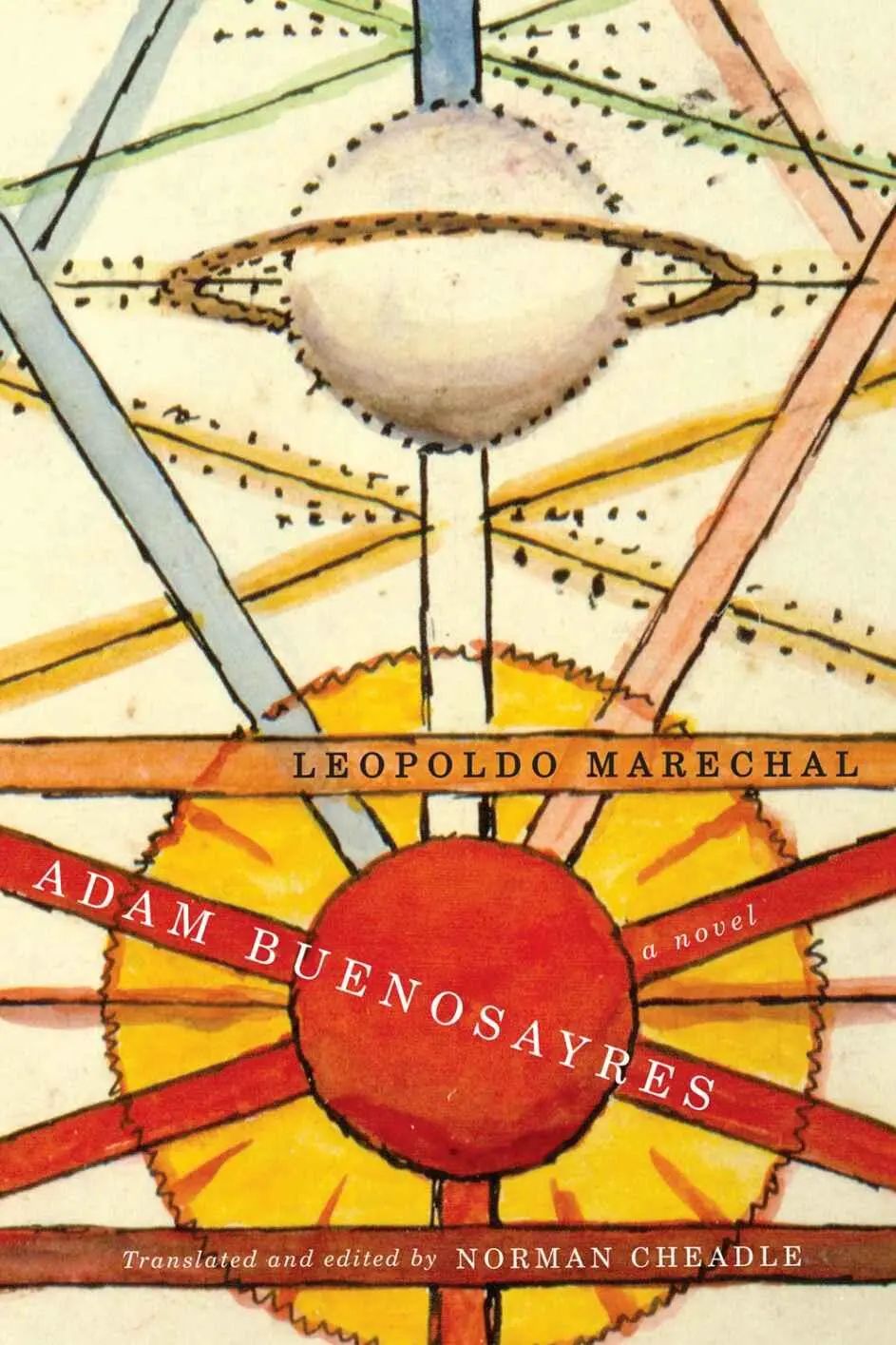
- Название:Adam Buenosayres
- Автор:
- Издательство:McGill-Queen's University Press
- Жанр:
- Год:2015
- ISBN:нет данных
- Рейтинг книги:5 / 5. Голосов: 1
-
Избранное:Добавить в избранное
- Отзывы:
-
Ваша оценка:
Adam Buenosayres: краткое содержание, описание и аннотация
Предлагаем к чтению аннотацию, описание, краткое содержание или предисловие (зависит от того, что написал сам автор книги «Adam Buenosayres»). Если вы не нашли необходимую информацию о книге — напишите в комментариях, мы постараемся отыскать её.
Adam Buenosayres — читать онлайн бесплатно полную книгу (весь текст) целиком
Ниже представлен текст книги, разбитый по страницам. Система сохранения места последней прочитанной страницы, позволяет с удобством читать онлайн бесплатно книгу «Adam Buenosayres», без необходимости каждый раз заново искать на чём Вы остановились. Поставьте закладку, и сможете в любой момент перейти на страницу, на которой закончили чтение.
Интервал:
Закладка:
The Personage gave us a sad smile, which then twisted into a sort of prideful arc:
— I come from an illustrious family, he told us. My great-grandfather, Colonel X, was among the 120 lads who rode with General San Martín on his famous cavalry charge at San Lorenzo. Pushing the “Goths” 80back at sabre-point, he had his horse rear up at the very edge of the ravine; and in that instant of precarious balance, his exalted gaze took in, all at once, the waters of the Paraná River, the Spaniards’ ships opening fire, the fields damp with dew, the dust of the combat, the spires of San Lorenzo, 81and the immense blue expanse tinged by the dawn light. Later, he crossed the Andes with the Great Captain, made landfall in Peru with Arenales, 82returned a hero from Ayacucho, 83and died on the battlefield during the civil war. 84Like many of his comrades in glory, his life was like an archer’s bow tensed to the breaking point: for them, the Patria was not a mother or even a bride; she was their newborn daughter, whose childhood would continue beyond their deaths.
”With the same sense of urgency characteristic of the epoch, my grandfather followed in his father’s footsteps and pursued the soldier’s vocation. However, his martial temperament was joined to a saturnine nature which instilled in him a deep attachment to the land, a love of solitude, and a cult of silence. He must have been strangely fascinated by the pampa of the native Ranquel people, for, without allegiance to any political stripe (a rare thing at that time), my grandfather participated only as an expeditionary in the Desert Campaigns. 85Not that he recoiled from the brutal clashes with hostile Indian raiders, but he nonetheless preferred military exploration, looking not with the eyes of a conquistador but those of a lover at the terra incognita as she was unveiled before him; he preferred the encounter with the wilderness, whether it smiled upon him benevolently or gesticulated in anger. In that immensity of clover, grass, reeds, and marshes, my grandfather settled at last and called his ranch La Rosada, “The Rosy One,” a smiling name at odds with the military stiffness of its building and the army-like discipline imposed on his ranch hands, all of whom were gauchos, ex-bandits, or former soldiers being won over by the nascent idyll of Peace.
”When my grandfather died, his nine sons divided up La Rosada. There was certainly enough for everyone in that spread, whose original measure was “the distance a man on horseback can gallop from dawn till dusk”! My father, being the firstborn, kept the farmhouse and out-buildings for himself. He was one of those exceptional men who felt as at home in the wild, bringing down ostriches with boleadoras , as they did attending the Paris Opera. Under his management, La Rosada knew its best days. The Scottish bulls, the Arabian horses, the Spanish grapevines, and the trees he’d brought back from his scientific travels in the north, did not take long to enrich and humanize the land that until then had conserved its formidable telluric savageness. In his creative fervour, my father dreamed of establishing a “patrician order” that might endow the wilderness with human forms and laws, and populate it with fervent multitudes who, by settling in our land, would add a new note to the universal chord. Unfortunately, that happy enterprise was soon aborted. With infinite bitterness my father suddenly saw how the patricians of the incipient order abandoned their family lands and gave themselves over to such dubious interests and pernicious ambitions as seethed in the abstract heart of the City. At the same time, he saw new faces arriving from another world. They turned up on the prairie searching for a way of life to replace the one they’d left behind, far away beyond the sea — a way of life not on offer in the prairie, in its state of abandon and formlessness. All my father’s disappointments finally found expression in a single sentence, one we heard him repeat — ironically, bitterly — many times at the old dinner table at La Rosada: “The era of the patricians is over; now comes the time of the lawyers.” As things turned out, that sentence was to be prophetic for our lives. One unforgettable day, our father rounded up his three adolescent sons in the front room where the old arms of the wars of independence were still hanging. There, he announced that we were going away to school in Buenos Aires. The three of us were dumbstruck, first by surprise, then by panic. Never had it crossed our minds that we might leave our world so full of strength and colour, within whose bounds we were happy. Strapping young lads whose greatest ambition was to raise fine bulls and purebred horses, we felt, moreover, that our teachers at La Rosada had already taught us everything useful we needed know. Recovering from my stupor, and being the eldest son, I ventured a few timid protests, which my father silenced, good and stubborn man that he was. So off we went to Buenos Aires, not without shedding tears over that first rupture: the time of the lawyers was beginning, and that’s what my two brothers became, God only knows how! As for me…
The Personage became silent and withdrawn for a moment, as though fondly remembering his youth.
— I wasn’t a good student, he continued. My baccalaureat and the few subjects in Law I managed to pass (by who knows what miracle) didn’t inspire much hope in the old patrician of La Rosada. On the other hand, the bustle of the city stimulated in me certain literary inclinations, whose first inklings I’d noticed out on the prairie and which now began to take form. I read anything and everything, frequented intellectual circles, expounded upon ideas, and made arguments that attracted attention. But later I noticed that, when it came to putting pen to paper, all the talent I displayed so ardently at tertulias would peter out and vanish, like a ghost refusing incarnation. In irritable discontent, I told myself, as so many others have done, that my sterility might be due to the lack of a “propitious environment.” Determined to find such a milieu in Europe, I wrote to my father asking for his opinion and his consent. That magnanimous man, generous and open to any eventuality, responded laconically with a word or two of encouragement, a bill of exchange, and a fare-thee-well. So it was that a fortnight later I left the harbour of Buenos Aires with the emotion of a second and final rupture: little did I know that twenty-five years would pass before I was to return, having nothing to show for my absence, only to be subjected to a process of abominable alchemy! But I mustn’t get ahead of my story. You gentlemen may have heard stories about early-twentieth-century Paris. It was a marvellous decade for its colour, the free play of its vital energies, its madcap dreams, a sort of chaotic beauty that people thought was the dawn of something but in fact was a nightfall. Thrown into such a world, submerged body and soul in its drunkenness, I soon forgot about everything and gave myself entirely over to that great human comedy, believing I was an actor when I was really only a stunned onlooker. The creative atmosphere one breathed in that unique city, the presence of the period’s great talents, spurred on my artistic bent, which again failed in a hundred sorry skirmishes. But then life was a mighty river sweeping me along, and it consoled me for my failures by insinuating, deceitfully, not the ars longa, vita brevis of the ancients, but the notion of vita longa versus art’s brevity. In my befuddled state, all thought of my country and family faded further and further away. One day a telegram informed me of my father’s death, and I belatedly wept in remembrance. Another telegram detailed the dispositions of his will; I was to inherit the farmhouse and outbuildings of La Rosada, with its half-league of land, as well as the thousand hectares out back. Without budging from Paris, I dealt with an administrator in Buenos Aires; in his cold letters I learned that faceless tenants were working the land of my grandparents.
Читать дальшеИнтервал:
Закладка:
Похожие книги на «Adam Buenosayres»
Представляем Вашему вниманию похожие книги на «Adam Buenosayres» списком для выбора. Мы отобрали схожую по названию и смыслу литературу в надежде предоставить читателям больше вариантов отыскать новые, интересные, ещё непрочитанные произведения.




Обсуждение, отзывы о книге «Adam Buenosayres» и просто собственные мнения читателей. Оставьте ваши комментарии, напишите, что Вы думаете о произведении, его смысле или главных героях. Укажите что конкретно понравилось, а что нет, и почему Вы так считаете.