Leopoldo Marechal - Adam Buenosayres
Здесь есть возможность читать онлайн «Leopoldo Marechal - Adam Buenosayres» весь текст электронной книги совершенно бесплатно (целиком полную версию без сокращений). В некоторых случаях можно слушать аудио, скачать через торрент в формате fb2 и присутствует краткое содержание. Год выпуска: 2015, Издательство: McGill-Queen's University Press, Жанр: Классическая проза, на английском языке. Описание произведения, (предисловие) а так же отзывы посетителей доступны на портале библиотеки ЛибКат.
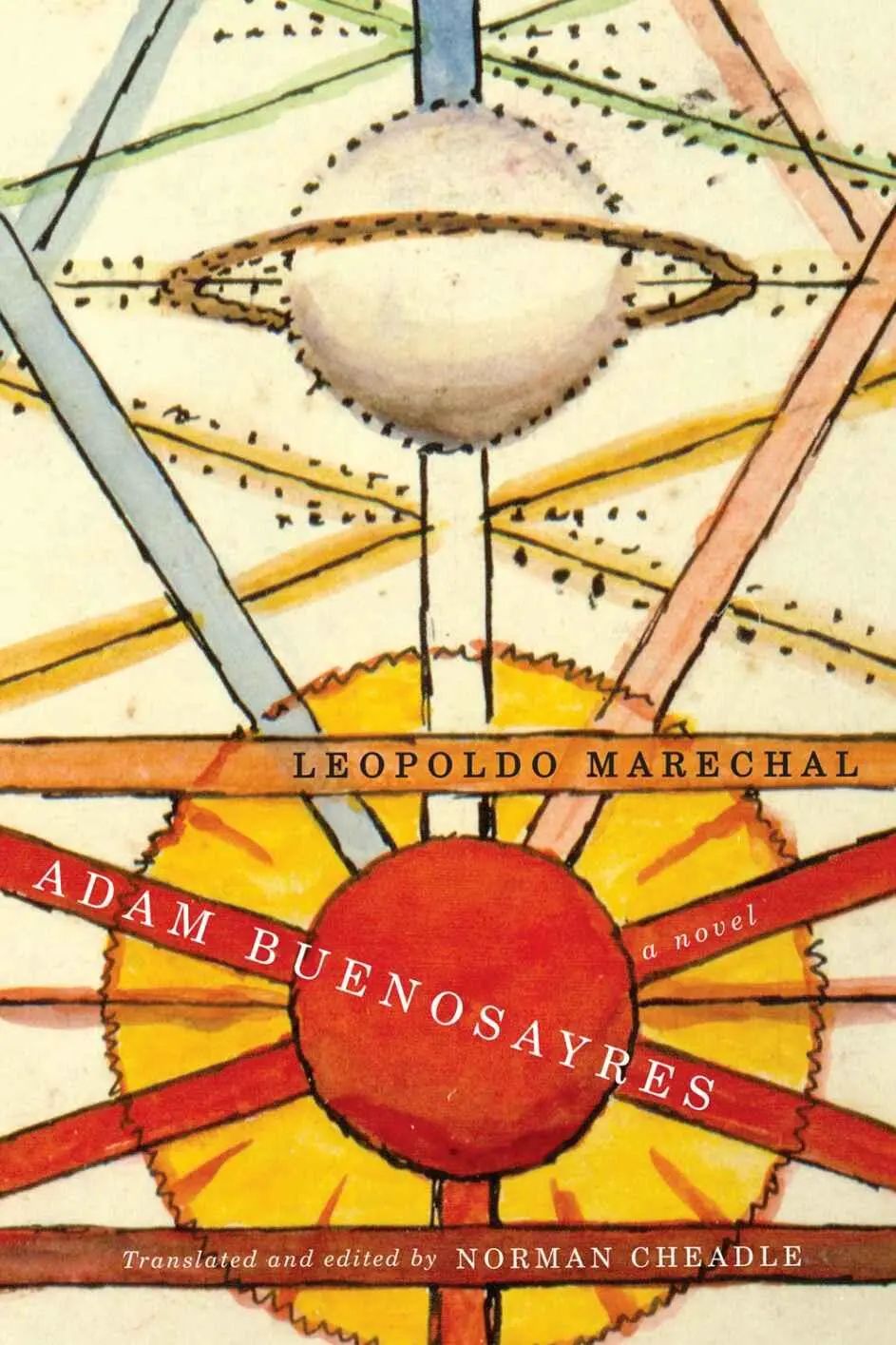
- Название:Adam Buenosayres
- Автор:
- Издательство:McGill-Queen's University Press
- Жанр:
- Год:2015
- ISBN:нет данных
- Рейтинг книги:5 / 5. Голосов: 1
-
Избранное:Добавить в избранное
- Отзывы:
-
Ваша оценка:
Adam Buenosayres: краткое содержание, описание и аннотация
Предлагаем к чтению аннотацию, описание, краткое содержание или предисловие (зависит от того, что написал сам автор книги «Adam Buenosayres»). Если вы не нашли необходимую информацию о книге — напишите в комментариях, мы постараемся отыскать её.
Adam Buenosayres — читать онлайн бесплатно полную книгу (весь текст) целиком
Ниже представлен текст книги, разбитый по страницам. Система сохранения места последней прочитанной страницы, позволяет с удобством читать онлайн бесплатно книгу «Adam Buenosayres», без необходимости каждый раз заново искать на чём Вы остановились. Поставьте закладку, и сможете в любой момент перейти на страницу, на которой закончили чтение.
Интервал:
Закладка:
— Balderdash! Mr Midas said at this point. Take a look at the present city, and tell me the bourgeoisie is in third place!
— What? Schultz asked. Do you find it placed in another position?
— Right up there in first place.
— That’s what I was driving at! the astrologer then exclaimed. If the third estate is now the first, it means that, in the course of History, a double usurpation has been committed.
Schultz recounted to me later that only at this point did the man with the crown look at him with some respect.
— Fine, Mr Midas said. Tell me with grace, concision, and brevity the story of both usurpations.
— It is known, expounded the astrologer, that Brahma (be he a thousand times praised!) arranged humanity in four classes, estates, or hierarchies. The first is that of Brahmin the metaphysician, who, because he knows the eternal truths, exercises the very subtle function of leading all men in the ways of earth and heaven. The second is the estate of Kshatriya the warrior, whose vocation is for worldly government and military defence. The third is that of adipose Vaishya, the bourgeois, who has the function of creating and distributing material wealth. And fourth in the hierarchy is the estate of sweaty Shudra, who was born at the feet of Brahma (be he a thousand times praised!). When all four classes remain faithful to their vocation and stay in their place in the hierarchy, human order rules, and justice assumes the form of a bull firmly planted upon his four pins.
— Whoa there, mister! said Midas. Spare me the metaphorical ballistics!
— But alas! continued Schultz. Errare humanum est. Et nunc, reges, intelligite: erudimini qui judicatis terram . 69
— Sir, I beg you! Midas reprimanded him again. State your case in straightforward language. Have you forgotten you are addressing the general public?
— I was saying, said Schultz sententiously, that all good things come to an end. Just when the going looks good, somebody’s gotta upset the applecart, because there’s always one bad egg, and that’s just the way the cookie crumbles… Anyway, let’s imagine the four classes in their proper hierarchy and in peace — O fruitful Harmony! O even-keeled Jubilation! But, then what happens all of a sudden? The battle-hardened Kshatriya throws the stone of scandal.
— What? How do you mean?
— Kshatriya’s essential virtue, answered the astrologer, is that of worldly governance and defence of the state. His corresponding vice is the sensuality of power, the pride of arms, the thirst for conquest. That’s why he is subordinate to Brahmin the metaphysician, who gives him prudent advice: “Don’t be getting out of line now,” and “You went a little overboard there,” and “Don’t forget you’re going to have to answer to the good Lord up above for the shenanigans you get up to here below.” But the time comes when Kshatriya just can’t help himself any longer. Fed up with the old man’s scolding, he decides to bushwhack him. So he goes ahead and rebels against Brahmin, robbing him of the top spot. And to pull it off, he’s had the help of Vaishya the bourgeois, who also had it in for Brahmin, because the old codger had become a real pain in the neck with his boring sermons about greed and so on.
— Accurate in substance, approved Mr Midas, though vulgar in form.
— Don’t forget I’m addressing the general public, Schultz reminded him venomously.
— So be it. We now have Kshatriya in the first position. What happens next?
— Alas! replied Schultz. With nothing holding him back now, and in thrall to his evil inclinations, Kshatriya soon shows his dark side. He started out as a hero of noble and amorous chivalry, and he ends up as an unjust conqueror; from an equitable king, he goes to being a despot; his former austerity gives way to overweaning pride; and his heroic nudity is at last clothed in the rich and heavy overcoat of worldly vainglory. Of course, all that luxury costs a mint! And where does Kshatriya turn for money, if not to the affluent Vaishya? But Vaishya the bourgeois professes a tender love for his doubloons; teary-eyed, he watches the increasing haemmorrhage from his pockets. And he weepily says to himself: “That’s what I get for helping out that tinpot general!” Time goes by, and Vaishya stops crying and thinks to himself: “If Kshatriya, with my help, could pull a fast one on Brahmin, couldn’t I do the same to him, if Shudra helped me out a bit?” It’s a tempting idea, and the more he turns it over in his mind, the more Vaishya gets to like it. Finally he enters into talks with sweaty Shudra, promising him all the tea in China; and when he sees he’s convinced, he waits for the right occasion. Meanwhile, pardner, you oughta see what a sorry pass Kshatriya has come to! Sick and tired of battles and honours, he lives now in his palace. He’s turned into a night owl, a party animal, a pretty-boy. What with champagne and women all the time, he’s completely lost it. Instead of a military helmet, he’s got a curly wig on his head. Wars don’t mean a thing to him any more; instead, he’s crazy about dances and carnivals. In short, my friend, a pathetic shell of a man! And Vaishya never takes his eye off him; as soon as he sees him weak and effeminate, he starts by needling him, then gets him riled up, and ends up cutting his throat just like that. Since then, Vaishya has been master of the situation and grows fat in the first rank of the hierarchy, quod erat demonstrandum .
— Not bad, said Mr Midas at this point.
Then he added venomously:
— Though your account seems influenced by recent readings of a certain Gallic metaphysician… 70
At those words, the astrologer turned visibly red, not with embarrassment, as he told me later, but out of righteous indignation.
— Look here, sir, he stammered. If I used someone else’s schema, and nothing more than a schema, I have on the other hand fleshed it out in quite an original fashion. Moreover, my own contribution is coming up.
— Hmm! said the crowned man. There’s more to come?
— I have yet to get to the heart of the matter, replied Schultz. Do you really think I would have taken on Vaishya if that slob of a bourgeois had limited himself to hogging the community’s nickels and dimes?
— What other offense do you hold against him?
— That he has universally imposed his gross mystic cult.
— Explain youself, sir, explain yourself, grunted the man with the crown.
— Old Brahmin alone, Schultz explained, possesses the true mysticism, the one all men should follow, each according to his limitations. But Kshatriya, Vaishya, and Shudra all have there own mystic cult as well, a private cult that each derives from his own inner inclinations. Thus, for example, Kshatriya worships the heroic as figured in its two values: honour and valour. The mysticism of Vaishya is an acute pragmatism that tends to glorify matter and the material in its single cypher — gold. Shudra, for his part, worships the manual work of trades and their techniques. When the four classes are in their proper order and act in fairness, the three particular mystic cults, responding symbolically to the universal mysticism, are three different human attitudes or forms of prayer addressed to the same Absolute. It is then that Brahma, in satisfaction, smiles a ninety-degree smile.
— Amazing! Mr Midas practically yawned.
— But, concluded Schultz, as soon as an inferior class usurps the first place in the hierarchy, it imposes its particular mystic cult on the world, universalizing that cult and thereby traducing all values accordingly.
— For example?
— During the reign of Brahmin, emphasis is placed on the religious aspect of life, and the scale of human values is constructed on a spiritual basis. When Kshatriya rules, emphasis shifts to the political, and man is measured by his nobility, honour, and valour. Now that Vaishya has taken over, the economic aspect is all-important, and man is measured by his cheque book. Brahmin used to say: “In the beginning is Being.” Then Kshatriya said: “In the beginning is Action.” Now Vaishya says: “In the beginning is Matter.” Brahmin waged wars that were religious crusades, and Kshatriya waged imperial wars. Now Vaishya makes war for economic reasons. As for the domain of art…
Читать дальшеИнтервал:
Закладка:
Похожие книги на «Adam Buenosayres»
Представляем Вашему вниманию похожие книги на «Adam Buenosayres» списком для выбора. Мы отобрали схожую по названию и смыслу литературу в надежде предоставить читателям больше вариантов отыскать новые, интересные, ещё непрочитанные произведения.










Обсуждение, отзывы о книге «Adam Buenosayres» и просто собственные мнения читателей. Оставьте ваши комментарии, напишите, что Вы думаете о произведении, его смысле или главных героях. Укажите что конкретно понравилось, а что нет, и почему Вы так считаете.