Leopoldo Marechal - Adam Buenosayres
Здесь есть возможность читать онлайн «Leopoldo Marechal - Adam Buenosayres» весь текст электронной книги совершенно бесплатно (целиком полную версию без сокращений). В некоторых случаях можно слушать аудио, скачать через торрент в формате fb2 и присутствует краткое содержание. Год выпуска: 2015, Издательство: McGill-Queen's University Press, Жанр: Классическая проза, на английском языке. Описание произведения, (предисловие) а так же отзывы посетителей доступны на портале библиотеки ЛибКат.
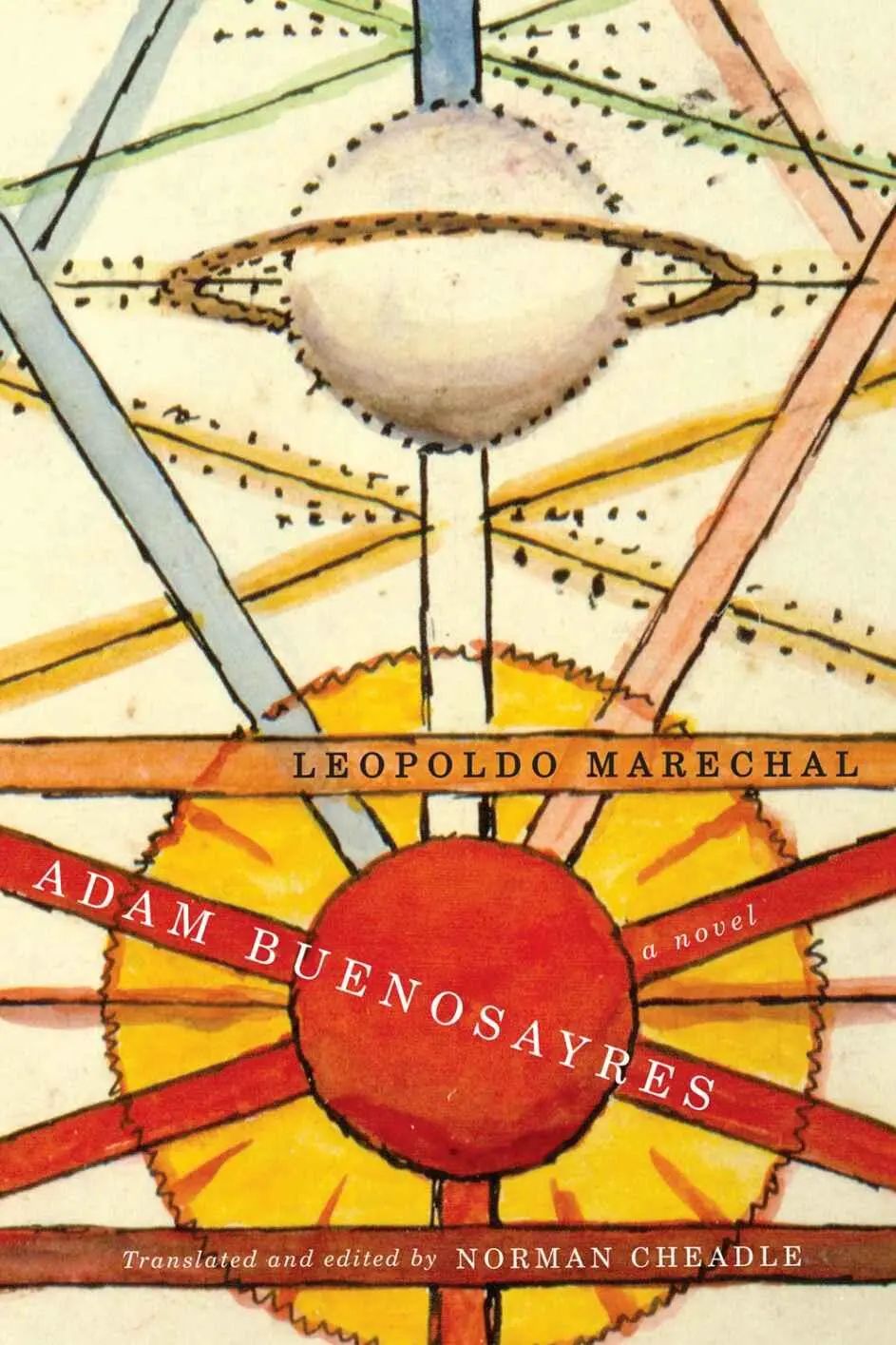
- Название:Adam Buenosayres
- Автор:
- Издательство:McGill-Queen's University Press
- Жанр:
- Год:2015
- ISBN:нет данных
- Рейтинг книги:5 / 5. Голосов: 1
-
Избранное:Добавить в избранное
- Отзывы:
-
Ваша оценка:
Adam Buenosayres: краткое содержание, описание и аннотация
Предлагаем к чтению аннотацию, описание, краткое содержание или предисловие (зависит от того, что написал сам автор книги «Adam Buenosayres»). Если вы не нашли необходимую информацию о книге — напишите в комментариях, мы постараемся отыскать её.
Adam Buenosayres — читать онлайн бесплатно полную книгу (весь текст) целиком
Ниже представлен текст книги, разбитый по страницам. Система сохранения места последней прочитанной страницы, позволяет с удобством читать онлайн бесплатно книгу «Adam Buenosayres», без необходимости каждый раз заново искать на чём Вы остановились. Поставьте закладку, и сможете в любой момент перейти на страницу, на которой закончили чтение.
Интервал:
Закладка:
A new round of cold applause was heard as the curtain descended. The dancers moved to the sempiternal music, which was now assuming the form of a tango. And again the announcer stopped them with his liturgical drone:
— Gentlemen, he said, the curtain has just risen to reveal a third scene to your astonished gaze. You see the interior of a temple. Look at the twelve sons of Don Moses Rosenbaum, all standing by the baptismal font in the presence of grave witnesses who apparently have their foreskins intact, and receiving the redemptive water the way a person might take a dubious cheque! One thing’s for sure: the twelve lads wear their morning coats quite stylishly (take away a couple of the rings burdening their fingers, and they would be perfect). Now turn your eyes to Don Moses Rosenbaum and see how he sneaks a sidelong glance at the Crucified One. Did you catch it? Well then, that glance has got some pedigree: it’s two thousand years old. And you will ask me now, what angel or demon is at work on this tribe? My response: hmm, this business is making me very uneasy.
The man with the megaphone stopped talking, and the dancers repeated their routine, breaking off when the fourth scene was unveiled:
— Ah, gentlemen! recited the announcer. If you now see me waving, practically in your faces, the ever-sweet torch of Hymenaeus, 65do not think my heart exults with pleasure. Voilà the fourth scene! It’s the altar of a basilica: the twelve scions of Don Moses Rosenbaum are contracting marriage with as many young ladies from our high society. Aristocrats come down in the world, ruined families, illustrious lineages gone bankrupt, none have hesitated to sacrifice their finest buds for the sake of Mammon, if we may so rename Don Moses Rosenbaum, who stands by the altar sweating anguish (just look at him!), eyes popping out of his head, ears peeled, nostrils flared in order to ensure that the candles are burning properly, that the incense is the one agreed upon in the contract, that the organist isn’t skimping on the semi-quavers. But hell’s bells! Have you not just noticed the light has grown dimmer? It was Don Moses Rosenbaum who, on the sly, has just blown out the flames in the candelabrum. The wretch just can’t help himself! Ah, gentlemen, do not think my heart overflows with pleasure just because you see me lighting, almost under your noses, the not-always-so-sweet torch of Hymenaeus!
The announcer headed for the fifth stage, as dancers and musicians resumed their roles. Then he brought the megaphone to his mouth, the curtain rose, and silence fell:
— Well, gentlemen, said the annoucer. Here we are before a scene evoking, with no stretch of the imagination, the scandalous times of Babylon. See the banquet hall, soon to be stained before your very eyes by the violent hues of saturnalia! Who are those hosts, in their magnificence seeming to revive the bygone days of Asia? They are the twelve sons and the one hundred and forty-four grandsons of Don Moses Rosenbaum, now celebrating the splendour of their house! Splendour, did I say? Just look at those women! Are they not as beautiful as pagan goddesses? And in their refinement, is there not that painful je-ne-sais-quoi we sense in a flower at the moment preceding its demise? And look at those men! Are they not modelled on Ganymede? And does one not divine in their Byzantine elegance something ineluctably final? Gentlemen, heed my words: I have no wish to pass for a prophet, but I sense an invisible autumn descending upon this house. What does it matter! The wine flows in abundance, though without joy; the bacchanal now begins, and they are going through the motions without enthusiasm, as in a cold ceremony. But pay attention now! Do you not see that old man, wild-eyed, scruffy-bearded, unsteady on his feet, the one making his agitated way among the guests, the one nobody notices? Why, it’s Don Moses Rosenbaum! He has exhumed his ancient lustring frock coat and his astrakhan hat. See how his crazed gaze wanders over the banquet table! And observe how, in the face of such devastation, he tears tufts from his beard, weeps without a sound, raises his arms toward the ceiling, as though trying to prop it up? Great God, what’s he doing now? In his madness, the poor wretch has started gathering crumbs from the tablecoth, righting toppled glasses, and salvaging the spilled wine. But no one sees or hears him, and around him the debauchery intensifies. Look out, now! Ah, just as I feared! Don Moses Rosenbaum is standing still at last: he has torn a lapel from his frock coat, a savage shout bursts from his lips, and he flees… Heavens! But where? Up and over the footlights!
Here the announcer hesitated in momentary confusion, as if something unexpected had happened. Then he began to vociferate, sans megaphone now:
— Hey, Don Moses, the exit is backstage! Come back here to the stage, Don Moses! What the heck, this isn’t some avant-garde theatre!
But his clamorous entreaties were in vain. The curtain had just come down on the bacchanal, and the musicians were trying to cover up the glitch by playing con brio the same old tune, tricked out now as a River Plate folk dance, while the dancers, lashed into a sudden frenzy, went round and round, stamping their feet like madmen, laughing and shouting, waving white-and-blue kerchiefs. 66Meanwhile, Don Moses Rosenbaum was crossing the room in the direction of the announcer:
— Wastefulness! he cried, pointing at the orchestra. There’s two harps and three bagpipes too many!
Barging through the circle of dancers, he ran toward the back of the room. But before exiting, he flipped a switch and turned out half the lights.
— Let’s follow him, Schultz hastily told me.
We reached the back door and entered what seemed to be a backstage area, with its gridiron, props, and drop cloths; we looked around among them for the fugitive, but in vain. We were eventually drawn by some light leaking underneath a door. Approaching, we pushed it open and saw what looked like a sixth stage, at the centre of which stood Don Moses Rosenbaum, as still as a plaster statue: a glaring spotlight illuminated his bust, highlighting his arid eyes, his rampant nose, and the hard lines of his mouth, which opened to hum the same lugubrious air the orchestra had been playing, but now restored to its true tonality of malediction or elegy.
Leaving him to his terrible solitude, we left the mansion by way of the Egyptian facade. Up until then I had seen or heard so many images, persons, scenes, musics, and voices, all jouncing in such a crazy tangle, that they began to swamp my memory and overwhelm my imagination. On top of it all, there was the travel fatigue, for my bones could not fail to know that, if Schultz’s Helicoid was generous in fantasy, it was hardly so when it came to convenience of passage. No wonder, then, I showed faint interest when the astrologer, still fresh as a rose, drew my attention to some geometrical constructions lined up along what looked like the last stretch of the spiral. These were great cylinders, cones, spheres, ellipses, and cubes, all painted red, yellow, and black (the devil’s liturgical colours); the vividness of the colours might have retained my attention, had it not been on the wane.
— In this place, Schultz told me, there suffers a notoriously nauseating subspecies of humanity. It includes all those intermediaries, hoarders, and other such pests, who wedge themselves between the producer and the consumer, plundering both parties by means of a subtle chain of speculations, traps, ruses, and sleight of hand. You’ll see them in that red cylinder, up to their crotches in slime and covered with leeches.
— Very equitable, I yawned.
But I refused to enter the red cylinder, and started walking toward the exit.
— This yellow cone, Schultz insisted as he drew even with me, is inhabited by those who react with alarm to a bumper crop and, being anxious to keep prices usuriously high, have burned silos brimming over with wheat, thrown tons of fruit into the Paraná River, and dumped wine into the sewers of Mendoza one year when every burro in the province got drunk contra natura .
Читать дальшеИнтервал:
Закладка:
Похожие книги на «Adam Buenosayres»
Представляем Вашему вниманию похожие книги на «Adam Buenosayres» списком для выбора. Мы отобрали схожую по названию и смыслу литературу в надежде предоставить читателям больше вариантов отыскать новые, интересные, ещё непрочитанные произведения.









Обсуждение, отзывы о книге «Adam Buenosayres» и просто собственные мнения читателей. Оставьте ваши комментарии, напишите, что Вы думаете о произведении, его смысле или главных героях. Укажите что конкретно понравилось, а что нет, и почему Вы так считаете.