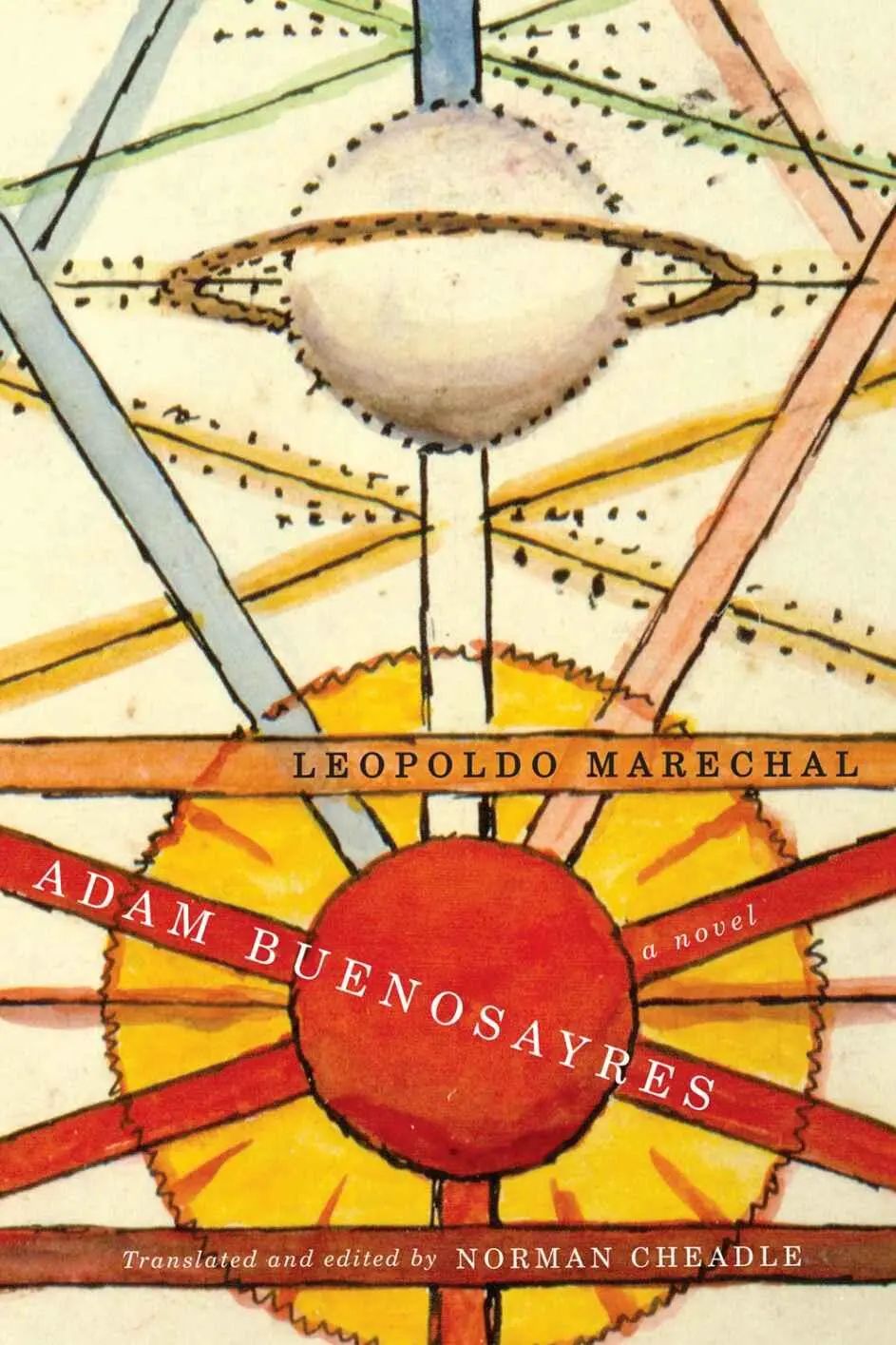
Leopoldo Marechal - Adam Buenosayres
Здесь есть возможность читать онлайн «Leopoldo Marechal - Adam Buenosayres» весь текст электронной книги совершенно бесплатно (целиком полную версию без сокращений). В некоторых случаях можно слушать аудио, скачать через торрент в формате fb2 и присутствует краткое содержание. Год выпуска: 2015, Издательство: McGill-Queen's University Press, Жанр: Классическая проза, на английском языке. Описание произведения, (предисловие) а так же отзывы посетителей доступны на портале библиотеки ЛибКат.
- Название:Adam Buenosayres
- Автор:
- Издательство:McGill-Queen's University Press
- Жанр:
- Год:2015
- ISBN:нет данных
- Рейтинг книги:5 / 5. Голосов: 1
-
Избранное:Добавить в избранное
- Отзывы:
-
Ваша оценка:
Adam Buenosayres: краткое содержание, описание и аннотация
Предлагаем к чтению аннотацию, описание, краткое содержание или предисловие (зависит от того, что написал сам автор книги «Adam Buenosayres»). Если вы не нашли необходимую информацию о книге — напишите в комментариях, мы постараемся отыскать её.
Adam Buenosayres — читать онлайн бесплатно полную книгу (весь текст) целиком
Ниже представлен текст книги, разбитый по страницам. Система сохранения места последней прочитанной страницы, позволяет с удобством читать онлайн бесплатно книгу «Adam Buenosayres», без необходимости каждый раз заново искать на чём Вы остановились. Поставьте закладку, и сможете в любой момент перейти на страницу, на которой закончили чтение.
Интервал:
Закладка:
— Cute little orchestra! Isn’t that you all over! I cried to Schultz, expressing my displeasure.
— A mere detail, he clarified. Let’s go over to the table and see what’s really important in this part of hell.
I followed the astrologer over to the banquet table, where I could observe at my pleasure the double line of commensals seated there. They were skeletal, scrawny-necked men and women, with green faces, deep bags under their eyes, and bilious hands. The men were stuffed into rumpled rental tuxedos; the women were shrouded in decadent evening gowns. The extraordinary thing was that all of them, despite their sickly appearance, were furiously chewing and swallowing the myriad varieties of food being produced in the infernal kitchen and served up by the white-gloved Cyclopes. But their voracity was mechanical: they ate with no pleasure or distaste whatsoever. It wasn’t long before I became aware of the close relationship between the music and the rhythm of the banquet, for as the orchestra’s crescendos mounted, the waiters became more frantic and the commensals swallowed faster and faster. And when music and banquet had reached a nightmarish tempo, Ciro Rossini, exultant in his livery, reappeared carrying a skeleton with articulated joints, which he then dangled over the banqueters, making it dance in the air over their heads.
— Gobble till you burst! Ciro shouted at them in a fanatical tone. How many lives do we have? Just this one! What are we, after all? This!
He shook the skeleton vehemently, then hurried off at the same trot as when he had come. 49But it was clear the diners were at the end of their rope. Some began to nod off, others fell face-down on their plates. And then the Cyclopes revealed just how nasty they really were: they shook the sleepers, pinched their noses closed, and forced them to keep on swallowing. When the sufferers at last fell under the table, another squad of Cyclopes picked them up like limp rags and carried them off to the back, while a new team of commensals, arranged in two lines, silently occupied the empty seats.
— Let’s go over there, Schultz said, pointing toward the Cyclopes who were making off with their human cargo.
But instead of following them, the astrologer got down on all fours and crawled under the table. Once again I imitated him — Lord knows how grudgingly! Once we got to the other side, we headed toward an area of gloom opening onto a new sector of this hellish place. We hadn’t gone far, when countless lightbulbs switched on above, piercing the darkness and projecting cones of light onto an endless number of operating tables. Alongside these, cyclopean surgeons attired in white aprons, masks, and rubber gloves were sorting and preparing their alarming instruments. Presently, the Cyclopes arrived bearing the surfeited banqueters, flopped them down on the operating tables, and roughly stripped them. Then, with diabolical zeal, the giants in surgical masks set upon those inert anatomies, subjecting them to implacable emetics, enemas, catheters, and needle-jabs. The horror of those bodies thus stripped naked, the fury of the operators, the violent reaction of the patients, along with the stench of viscera clogging the air: all combined to make me double over in an immense nausea.
— I’m not going one step further in this inferno! I shouted at Schultz.
Turning on my heels, I took off running toward the lighted area where the banquet was in progress, accompanied by Schultz, who fled no less urgently than I. But at the strip of semi-darkness, I stopped short. In front of me were one, two, three bizarre characters seated upon as many toilets and no doubt waiting to go back to the table. The personage in the middle was a middle-aged homunculus, scrawny, yellowish, and bald, swaying like a pendulum as he dozed atop his john, and gargling a sort of puerile snore. On his left, with a pensive air, sat a priestly figure who, in the land of the living, must have been very fat; now, however, his black soutane was gathered up around two skinny thighs. The third character, to the right of the homunculus, was neither asleep nor pensive; a dapper old fop, full of himself, he was looking this way and that with an air of offended dignity.
The gravity of those men contrasted so greatly with their indecorous posture that I turned to Schultz, bursting to unleash a choice remark. And I would have let him have it, too, had he not cut me short: the astrologer was quite upset about the toilet-bowl heroes.
— Shhh! he whispered. An unlucky encounter!
With one finger to his lips and the very image of stealth, Schultz was trying to tiptoe away. But he hadn’t taken three steps when the homunculus abruptly stopped snoring:
— Good afternoon, Schultz, young man! he purred, half-raising his right eyelid.
The astrologer stood stock still as if turned to stone.
— Don Celso, sir, he stammered. If at this grave hour it were possible for me…
— Hah! the homunculus barked mirthlessly. The past comes back to haunt you, as they say in novels. It’s a small world, young man! I can still see in my mind’s eye those three orchids on the buffet.
— What about her ? asked a stunned Schultz.
— Three nuptial orchids! purred the homunculus. And the sweet little gold ring you put on her dainty finger. “I love you, yes, I love you!” Coo, coo! “Oh, forever and ever!” Of course. Little rich boys who sneak into honourable homes to trouble the sleep of virgins.
— Dearly beloved brethren! the priestly figure exclaimed in a supplicating tone.
— My apologies! stuttered Schultz. I was so young!
But the homunculus was swaying and snoring again. Seeing this, the astrologer turned to me beseechingly:
— What the ogre just said is a bare-faced lie! he revealed. Because I honestly did love her, I swear it.
— Who was she? I asked.
— The daughter of the ogre you see in front of you, who as usual has just nodded off again. Her name was Nora. Imagine braided hair of bronze, willow-green eyes, the bust of Minerva, the thighs of Atalanta…
— My brethren! the priestly figure interrupted again, unable to bring himself to cover his scandalized ears.
— … and a sensibility, concluded Schultz, that is unique to the girls of the Flores barrio. Because, as you are surely aware, girls from Flores are made from the wood of Stradivarius violins…
Quite alarmed by his madrigalesque exaltation, I gave him a few pats on the shoulder:
— Easy does it! I said. And for Pete’s sake, talk normal.
But the astrologer ignored me and pointed his index finger at the sleeping Don Celso.
— There you have the scourge of my first dreams, he growled. Ah, monster! I can still see him at the festive board on that unforgettable noonday.
Once again the homunculus opened his small sleep-filled eyes:
— Good afternoon, Schultz, young man! he gurgled. Where were we? Ah, yes! We were talking about three nuptial orchids and a poor, inconsolable bride. Don’t imagine, however, that you were the only good-for-nothing. And believe me, if they hadn’t dragged me away from the famous dining room in the nick of time, all my girls would have ended up as old maids. Do you remember the details?
— It was a glorious noontide, said Schultz in an evocative tone. We had just sat down to table, and everyone’s face was beaming with joy, for I had slipped a little gold ring on her dainty ivory finger. “I love you, yes, I love you!”
— Coo, coo! rejoined Don Celso in a sing-song voice. “Oh, forever and ever!” And three orchids on the buffet. Coo, coo!
— On my right, continued the astrologer, Nora was silent and smiling, smiling and silent. Oh, springtime! O youth! Farewell, farewell! On my left, her three sisters burned and sizzled and consumed themselves like three wedding torches. In front of me, their sweet mother (ancient jewellery, antique lace) looked me over with darkened brow, like someone wondering what the future might hold: her mother dear, burdened with years, jewellery, lace, and smugness (begging Don Celso’s pardon, he being here among us). And at her side, Don Celso himself, here among us, with his napkin tied round his neck and playing the gruffly good-natured father-in-law (ah, the monster!). And the gay sounds in the house, the festive smells wafting from the kitchen. Who was that couple walking in the garden? Tristan and Isolde, Romeo and Juliet, Abelard and Heloise! Romance has died. A tombstone! Place a tombstone on the grave of romance! With the epitaph: “Wayfarer, here lies a love affair.”
Читать дальшеИнтервал:
Закладка:
Похожие книги на «Adam Buenosayres»
Представляем Вашему вниманию похожие книги на «Adam Buenosayres» списком для выбора. Мы отобрали схожую по названию и смыслу литературу в надежде предоставить читателям больше вариантов отыскать новые, интересные, ещё непрочитанные произведения.











Обсуждение, отзывы о книге «Adam Buenosayres» и просто собственные мнения читателей. Оставьте ваши комментарии, напишите, что Вы думаете о произведении, его смысле или главных героях. Укажите что конкретно понравилось, а что нет, и почему Вы так считаете.